
An MA in higher education is a graduate degree that prepares you to lead, administer and shape colleges and universities, with coursework in student affairs, academic administration, policy, finance and research. Most programs take one to two years, and they lead to roles such as admissions director, registrar, student affairs officer, institutional researcher or policy analyst. This article explains how the degree is structured, how formats differ, what careers follow, and how working professionals in Ghana can approach the decision.
What an MA in Higher Education Covers
A master's in higher education teaches the operations, governance and student experience of postsecondary institutions. The curriculum is built for people who want to work inside universities or in the agencies and organizations that regulate and support them.
Most programs share a common set of core subjects:
- Foundations of higher education: the history, purpose and structure of universities and how they differ from one country to another.
- Student development theory: how undergraduate and postgraduate students learn, adjust and succeed.
- Governance and leadership: how decisions are made across boards, senates, deans and administrative offices.
- Finance and resource management: budgeting, fee structures, grants and institutional sustainability.
- Law and policy: accreditation, regulatory compliance and national education policy.
- Research methods: the skills to evaluate programs and use data in decisions.
Many programs add a practicum or internship, which places you inside a university office for a set period. That applied component often matters as much as the coursework, because hiring managers in higher education value demonstrated experience alongside a credential.
Common Degree Titles
The label on the diploma varies. You will see Master of Arts, Master of Education (M.Ed.) and Master of Science options, sometimes with a specialization in administration, student affairs or policy. The title matters less than the curriculum, the accreditation and the relevance of the program to the role you want. For a closer look at how institutions structure these offerings, the University of Gold Coast has published an overview of higher education programs.
Program Formats: Full-Time, Part-Time and Online
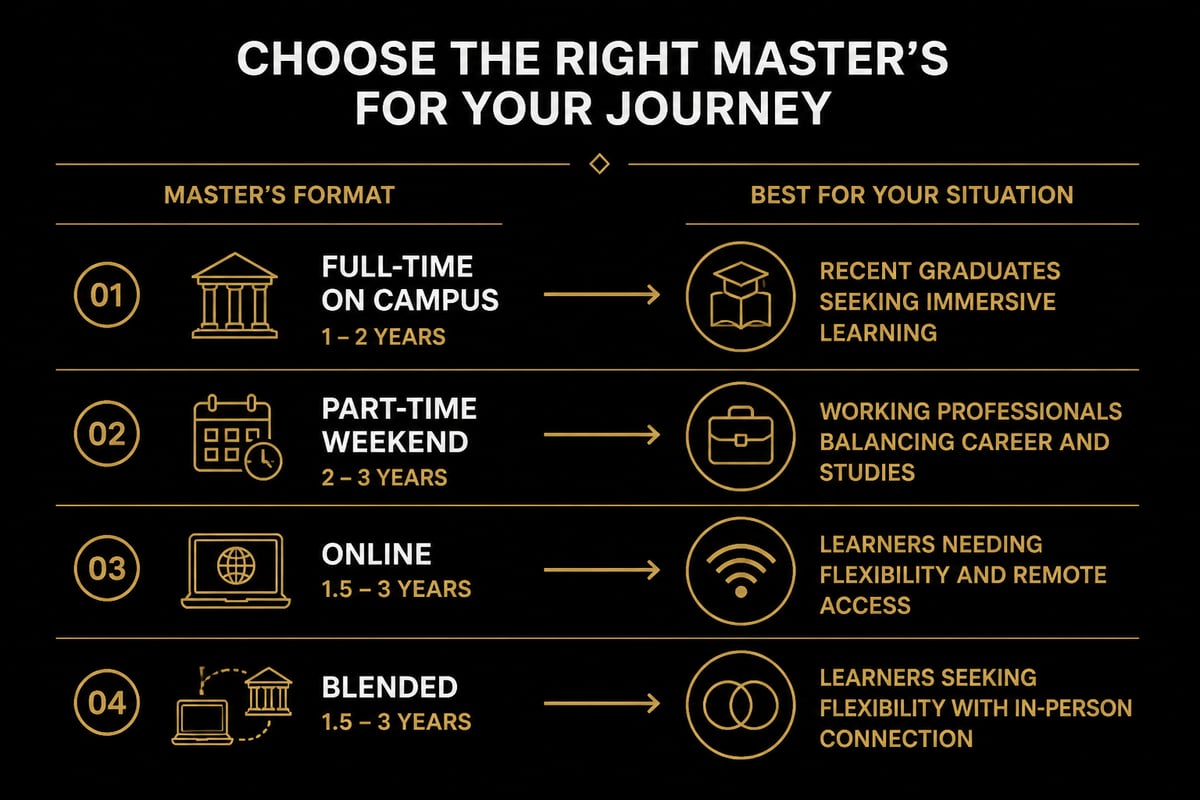
The right format depends on whether you can pause your career, and for most working professionals the answer is no. Programs generally fall into three formats, and each one distributes the same coursework differently across time.
| Format | Typical Duration | Best Fit |
|---|---|---|
| Full-time, on campus | 1 to 2 years | Career changers who can leave employment |
| Part-time, evening or weekend | 2 to 3 years | Employed professionals who prefer in-person study |
| Online or blended | 1.5 to 3 years | Learners who need location flexibility |
Full-time study concentrates the workload into a shorter window, which suits someone moving into the sector who also wants time for a practicum or graduate assistantship inside a university office. Part-time and weekend structures have become the practical choice for managers who hold senior responsibilities. They carry a lighter course load per term, so a registrar, HR manager or training lead can apply a governance framework or a retention model at work the following Monday. That immediate application strengthens both your studies and your performance. Online and blended formats trade fixed class times for self-paced modules, which helps if you travel often or live far from a campus, though they ask for steady self-discipline. If distance learning appeals to you, the University of Gold Coast explains what to expect from higher education online study, and a separate page covers master’s in higher ed online options in more detail.
Admission Requirements You Should Expect
Admission to an MA in higher education usually requires a recognized bachelor's degree, academic transcripts and evidence of motivation or professional experience. Requirements differ by institution, so always confirm them on the program page or with the admissions office. The bachelor's degree is typically accepted in any discipline, so graduates in business, social sciences, education or the humanities all apply on equal footing.
A typical application includes:
- A completed bachelor's degree from an accredited institution.
- Official transcripts showing your academic record.
- A personal statement explaining why you want to work in higher education.
- A current CV or resume that highlights relevant experience.
- Two professional or academic references.
- Proof of English proficiency where the language of study is not your first language.
The personal statement carries real weight, because it is where you connect your background to the field. A strong one names a specific interest, such as student retention, quality assurance or admissions policy, and explains how your current work led you there. Choose referees who can speak to your analytical ability or leadership, such as a line manager, a senior colleague or a former lecturer.
Work experience is rarely mandatory, but it strengthens an application. Experience in teaching, training, human resources, student support, administration or project management all transfers well. If you are unsure whether your background qualifies, a conversation with an admissions advisor is a faster route than guessing.
Career Paths After a Master's in Higher Education
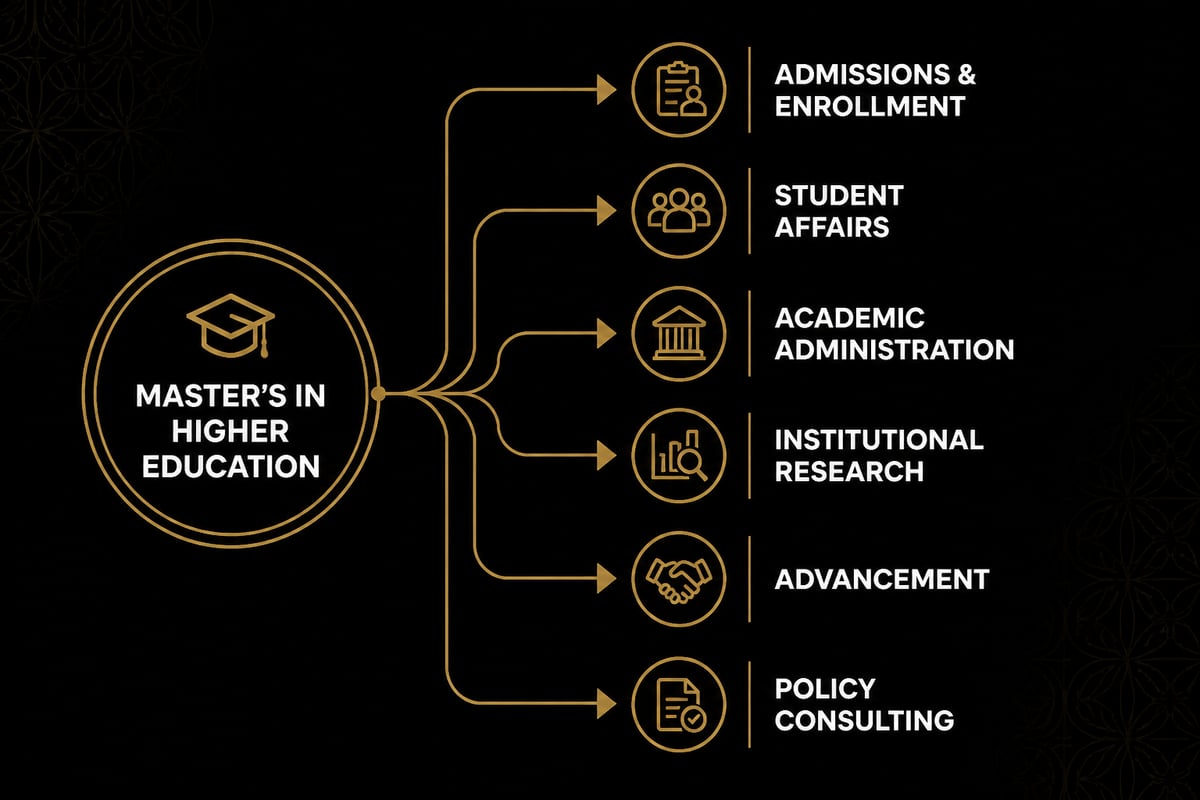
Graduates move into administration, student services, policy and consulting roles across universities, colleges, ministries and nonprofit organizations. The degree does not lead to one job title. It opens a family of careers that share a common knowledge base.
Typical Roles
- Admissions and enrollment management: recruiting, selecting and onboarding students.
- Student affairs: housing, counseling coordination, orientation, student conduct and campus life.
- Academic administration: department management, scheduling, program coordination and registrar services.
- Institutional research and quality assurance: collecting and analyzing data for accreditation and planning.
- Advancement and fundraising: alumni relations, donor engagement and grant development. The CASE career center lists education advancement positions and connects job seekers with employers.
- Policy and consulting: working with education ministries, regulators and development agencies.
Salary and demand data come mostly from the United States, but they show the general direction of the field. The U.S. Bureau of Labor Statistics reports that postsecondary education administrators typically need a master’s degree, and that a bachelor's degree may suffice at some small colleges and universities. The same source projects employment growth of 2% from 2025 to 2035, with about 14,500 openings annually on average. Growth is modest, which means competition for senior roles rewards candidates with a graduate credential and practical experience.
Ghanaian salary scales and hiring patterns differ, so treat these figures as a reference point for the credential's value rather than a local forecast.
Why Working Professionals in Ghana Consider This Degree
For managers and professionals in Accra, a higher education qualification can serve two purposes: moving into the education sector, or strengthening leadership skills in an organization that trains, certifies or develops people. Many corporate roles now include responsibility for learning and development, accreditation or institutional partnerships, and the coursework applies directly.
Ghana's tertiary sector has expanded steadily, and private universities, professional institutes and training bodies all need administrators who understand quality assurance and regulatory compliance. A graduate who understands accreditation standards, student retention and governance is useful well beyond a university campus.
Related development in youth skills also shapes the field. Platforms such as Life Hub, which builds money skills, career readiness and digital literacy in young learners through paid micro-learning tasks, show how education providers are widening what readiness for university and work means. Administrators who track these shifts can design better transition and support programs.
How to Choose a Program
The strongest programs combine recognized accreditation, relevant coursework, applied learning and a schedule you can sustain. Use the following criteria to compare options.
Accreditation and Recognition
Confirm that the institution and the program are accredited by the relevant national authority. In Ghana, that authority is the Ghana Tertiary Education Commission (GTEC). Accreditation affects whether employers, other universities and professional bodies recognize your degree.
Curriculum Fit
Review the course list rather than relying on the title. Check whether the program emphasizes administration, student affairs, policy or research, and match that emphasis to your intended role. A program with a strong policy focus suits a future ministry or regulatory career, while a student affairs track suits campus-based roles.
Faculty Experience
Instructors who have worked as deans, registrars, quality assurance officers or policy advisers bring examples that textbooks cannot. Look for faculty biographies that show real institutional experience.
Schedule and Cost Structure
Check the class schedule against your work calendar, and ask how payment is organized. Financing deserves attention: borrowing to fund graduate education is common, and the cost can be substantial. Those patterns are American, but they illustrate why a payment structure that fits your income matters before you enroll.

Studying at the University of Gold Coast
The University of Gold Coast offers graduate study that can be arranged around the schedules of employed professionals. Classes are scheduled to suit employed professionals, so students can keep their jobs while completing a postgraduate qualification. Flexible payment options are available to help spread the cost.
The university holds the Presidential Charter granted by the Government of Ghana, and its academic programmes are accredited by GTEC. Degrees are awarded by the University of Gold Coast. The learning environment is Christ-centred, combining academic excellence with ethical leadership.
Prospective students interested in the education field can review the M.Ed. in higher education administration page, the advanced programme in higher education and the broader higher education degree overview. For current course details, schedules and fees, consult the program pages directly or contact the admissions team.
Making the Most of the Degree
A master's in higher education pays off most when you treat the program as professional development rather than a credential alone. Several habits improve outcomes.
- Choose a work-relevant research topic. A dissertation or capstone on retention, quality assurance or fee policy at your own organization produces findings you can present to leaders.
- Build a network deliberately. Classmates and faculty become colleagues, referees and collaborators. In a field where many roles are filled through reputation, these relationships carry weight.
- Seek a practicum even if it is optional. Direct experience in an admissions office, registry or quality assurance unit makes your CV more concrete.
- Track the sector. Follow regulatory announcements, accreditation changes and enrollment trends so your studies stay current with practice.
Graduate-level study also builds transferable skills in analysis, writing and evidence-based decision-making. These matter in any leadership role, which is why the degree attracts professionals who plan to remain in business, law or government as well as those moving into education.
Common Questions About the Degree
How long does an MA in higher education take?
Full-time study usually takes one to two years. Part-time and weekend formats take longer, often two to three years, because students carry a lighter course load alongside work.
Do I need teaching experience?
Teaching experience is rarely required. Backgrounds in administration, human resources, training, student services and management all provide a sound foundation. A clear statement of purpose in your application matters more than a specific job history.
Can I study while working full time?
Yes, if you choose a part-time, weekend or online format. Compare each program's schedule against your work calendar before applying, and ask about assessment deadlines so you can plan around busy periods at work.
Is the degree useful outside universities?
Yes. Training bodies, professional associations, regulators, development agencies and corporate learning teams all employ people with higher education expertise. Skills in policy analysis, program evaluation and leadership transfer across these settings.
Start by listing the two or three roles you want in five years, then check which postgraduate curriculum builds the skills those roles require. When you are ready to move from research to action, you can apply now to begin your postgraduate study at the University of Gold Coast. You can also browse the postgraduate classes page to see how the schedule might fit your work calendar.