
Post graduate classes are the taught modules you complete after a bachelor's degree to earn a master's degree, postgraduate diploma or postgraduate certificate. At University of Gold Coast, these classes are structured to allow managers and professionals in Accra and across Ghana to study while keeping their jobs.
This guide explains what the classes involve, which programmes the university lists, how the structure works, what to expect on cost and entry requirements, and how to decide whether the format suits your career.
What Are Graduate School Courses?
Graduate school courses are advanced, specialized modules taken after an undergraduate degree, and they combine taught content with applied projects, a capstone or a dissertation. Unlike undergraduate study, which builds broad foundations, these courses expect you to analyze, apply and critique ideas drawing on your own workplace experience.
For a working manager, the practical difference is significant. Modules are built around decision-making, strategy and leadership rather than introductory theory. You will typically work through case studies, group assignments and individual research that can be tied directly to problems in your organization. If you want a clearer view of how the two levels differ, University of Gold Coast explains the difference between graduate and undergraduate study in more detail.
Programmes Available in Post Graduate Classes at University of Gold Coast
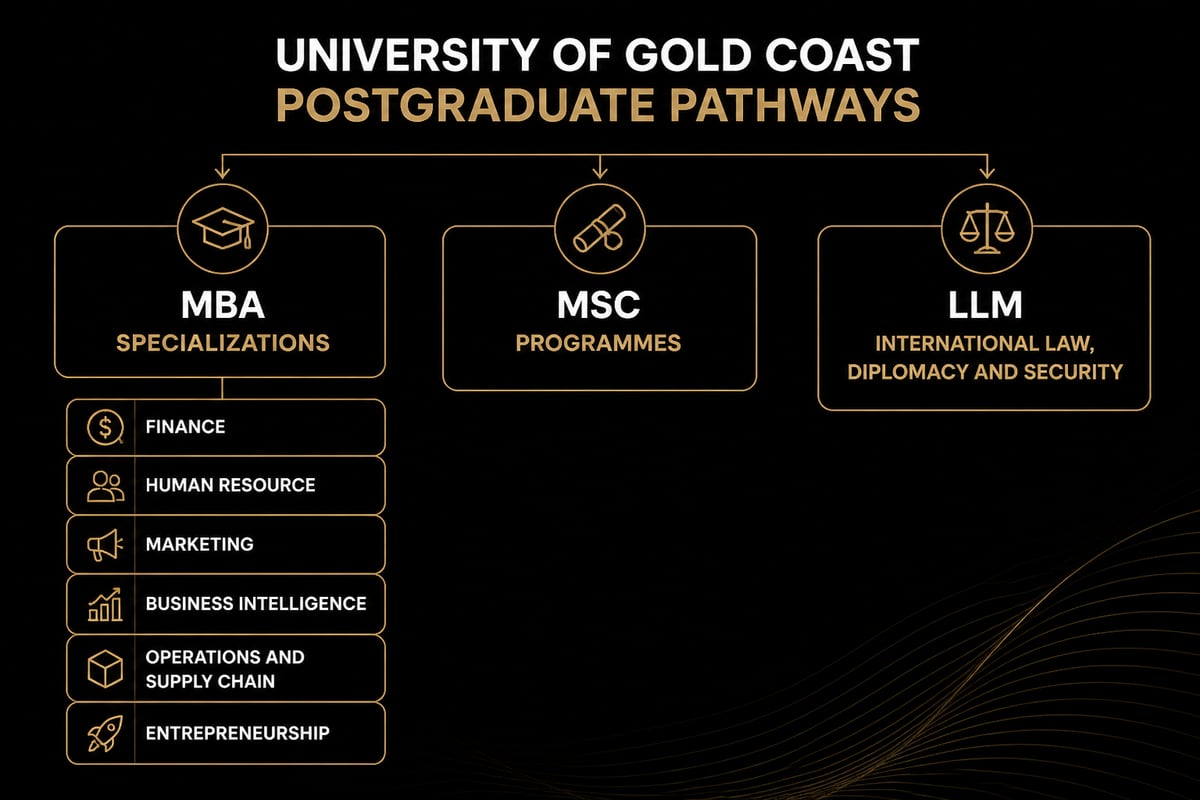
The university offers MBA, MSc and LLM pathways, and its programme listing shows several MBA specializations:
- Finance
- Human Resource Management
- Marketing and Communications
- Business Intelligence and Analytics
- Operations and Supply Chain Management
- Entrepreneurship and Innovation
The same listing includes MSc programmes in Public Affairs, International Relations, Accounting and Finance, Human Resource Management, Marketing and Communications, and International Law, Diplomacy and Security. Professionals whose work touches governance, policy or compliance will find the MSc and LLM routes relevant alongside the business degrees.
The postgraduate programme brochure lists a 12-month generic MBA, a 12-month Wrexham MBA and a 12-month LLM in International Law, Diplomacy and Security. The programme application page also lists 12-month options for the MSc in Accounting and Finance, MSc in Communication and International Marketing, MSc in Human Resource Management and MSc in International Relations.
How the Weekend Class Format Works
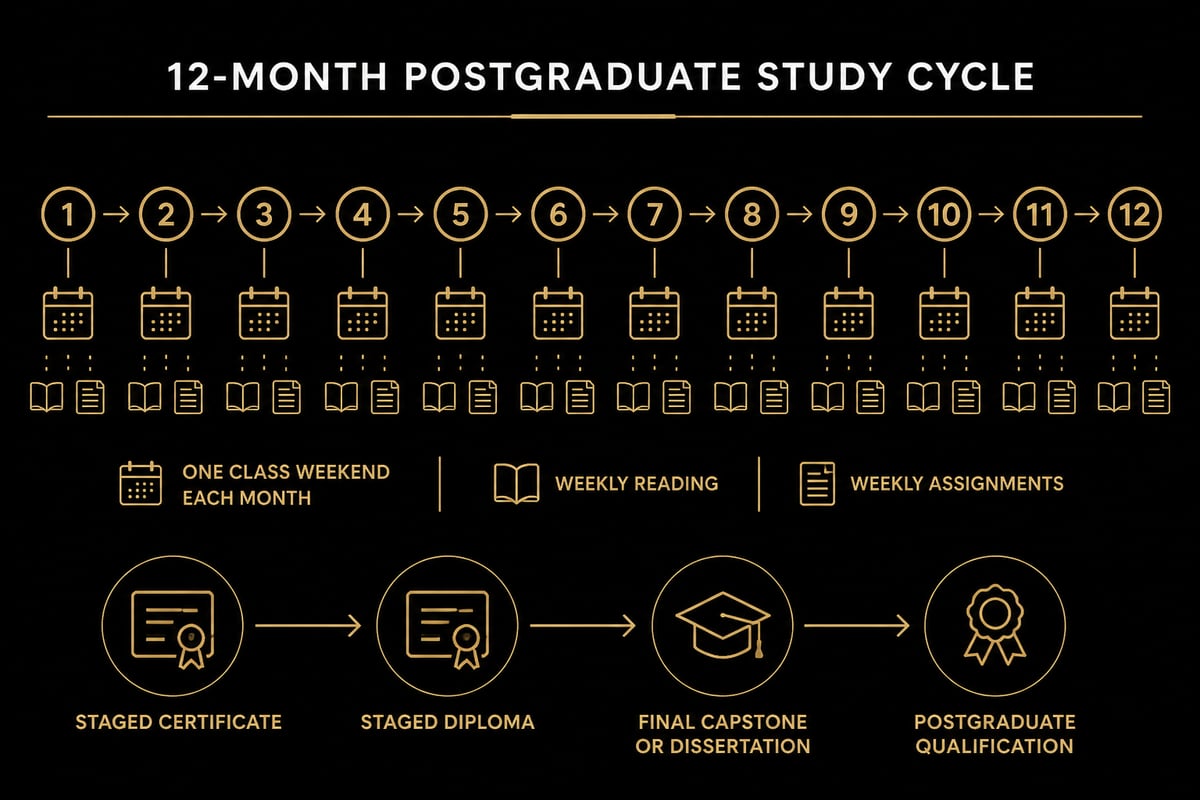
Classes are held one full weekend a month, so you attend intensively and then return to work with the following weeks free for reading, assignments and projects. This pattern removes the need to take leave or reduce your hours.
A monthly weekend rhythm rewards planning. Most successful students handle it in three steps:
- Block the class weekend in your calendar as soon as the schedule is published, and tell your manager and family early.
- Set aside fixed weekly hours between sessions for reading and coursework instead of waiting until the week before a deadline.
- Link assignments to live workplace issues, such as a budgeting problem, a hiring plan or a supply chain bottleneck, so the study produces results at work.
The structure suits professionals who value routine. It does not suit anyone expecting a full-time, campus-based timetable, and the university is not designed for that kind of student.
Staged Awards: Certificate, Diploma and Master's
Some programmes are organized so you earn qualifications in stages on the way to the full degree. The university's MBA in Business Intelligence and Data Analytics is described as a 12-month programme delivered over three trimesters. Its page states that students can earn a postgraduate certificate after four core modules and a postgraduate diploma after eight core modules, while the MBA itself requires core and specialization modules plus a capstone or dissertation.
The MBA in Finance page sets out its own duration and staged milestones, and the postgraduate certificate in management offers a shorter entry point for those who want a recognized credential first.
This staging has a practical benefit that busy professionals often value. Each completed stage is a credential you can list on a CV or use in a promotion discussion, even before the final dissertation is submitted. If a work assignment or family event forces a pause, you hold a qualification rather than nothing.
Professional Recognition and Accreditation
Accreditation determines whether employers, regulators and other institutions will accept your degree. The university holds the Presidential Charter granted by the Government of Ghana, and all its academic programmes are accredited by the Ghana Tertiary Education Commission (GTEC). Its overview page sets out its institutional identity and programme scope. For a professional in Ghana, national accreditation is the baseline that matters most when a ministry, a bank or a multinational reviews your credentials for a hiring or promotion decision, so it is worth keeping your certificate and any accreditation confirmation together in your records.
Some modules may also connect to professional management awards. The university's Chartered Management Institute partnership describes how programme modules may map to professional leadership and management awards. A manager aiming at regional or international roles, for instance, could present both the master's and a management award on the same CV. Confirm the current details with the admissions team before you rely on them for a specific career plan, including which modules count toward an award and whether any separate registration or assessment is involved.
Is a 3.3 GPA Bad for a Master's?
A 3.3 GPA is generally considered solid and is not a barrier to most master's programmes, particularly when you have meaningful work experience. For working professionals, admissions decisions usually weigh your career record, your responsibilities and your motivation alongside your undergraduate results.
If your first-degree classification was modest, strengthen your application in other ways:
- Describe concrete achievements in your current role, such as teams led, budgets managed or projects delivered.
- Explain clearly why you chose this specialization and how it connects to your next career step.
- Obtain references from supervisors who can speak to your performance.
For exact entry requirements for each programme, contact the university directly or review the admissions process before you apply.

Is There Any 1-Year Master's Degree?
Yes, and University of Gold Coast lists several. The generic MBA, the Wrexham MBA, the MBA in Business Intelligence and Data Analytics, the MSc programmes in Accounting and Finance, Communication and International Marketing, Human Resource Management and International Relations, and the LLM in International Law, Diplomacy and Security are all listed with 12-month durations on the university's own pages.
A one-year timeline compresses the workload, so it works best when you commit early to the monthly weekends and keep coursework moving between them. Compared with multi-year part-time routes, it shortens the period of divided attention between work and study and brings forward the point at which your qualification can influence promotion or salary discussions.
Cost, Payment and Planning Your Budget
Tuition varies by programme, so the reliable source for current fees is the university itself. Rather than relying on any outside figure, request the fee schedule for your chosen programme through the admissions team and the programme brochure.
Students can ask the university about payment arrangements when they request fee information. That matters for professionals who would rather spread the cost across the programme than commit a large sum at the start. To judge value, compare the total cost against realistic outcomes, such as a promotion, a move into management or the ability to take on larger responsibilities.
In Ghana, the more useful question is whether the programme's cost fits your income and whether any available payment arrangement keeps monthly outlay manageable.
What the Learning Environment Offers
The learning experience combines academic standards with a Christ-centred environment that emphasizes ethical leadership. For managers, this matters because postgraduate study is also where you rehearse decisions about people, money and integrity. A finance module, for example, can raise questions about reporting honestly under pressure, and an HR module can test how you handle fairness in hiring or dismissal. Working through these cases in a values-oriented setting gives you a reference point to carry back to your own organization.
Lecturers aim to bring practical examples into the classroom, so discussions can draw on practice rather than only on textbooks. That shapes how a weekend session runs: lecturers can describe how a supply chain disruption or a budgeting dispute was actually resolved, and you can compare it with your own situation. Students also have access to an online library and a student portal for study resources, which is useful between class weekends when you are working on assignments outside a campus. In practice, this means you can pull journal articles for a dissertation literature review, check module materials in the evening, and raise academic questions without waiting for the next monthly session.
How to Choose the Right Programme
Choose the programme that matches the role you want in three to five years, not the one with the most familiar title. A simple comparison helps:
| If your goal is… | Consider |
|---|---|
| Moving into senior general management | MBA (generic or Wrexham) |
| Leading finance functions | MBA in Finance or MSc in Accounting and Finance |
| Building a people-management career | MBA or MSc in Human Resource Management |
| Working in data-driven decision making | MBA in Business Intelligence and Data Analytics |
| Roles in diplomacy, policy or international affairs | MSc in International Relations or LLM in International Law, Diplomacy and Security |
If your organization is also investing in its digital presence or growth, studying marketing and communications can pair well with practical work. Agencies such as Red Van Creative show how branding, SEO and campaign work fit together in a business setting, while a specialist like Mos Web Design illustrates how a well-maintained website supports commercial goals. Examples like these give you real-world material to analyze in marketing assignments.
Before applying, confirm the specialization, the duration and the entry requirements with the admissions office, then check the application steps on the programme application page.
FAQ
What is the difference between a postgraduate certificate, diploma and master's?
They are successive levels of the same postgraduate pathway. At University of Gold Coast, the MBA in Business Intelligence and Data Analytics page states that a postgraduate certificate follows four core modules and a postgraduate diploma follows eight, while the full master's adds specialization modules and a capstone or dissertation.
Can I study post graduate classes while working full time?
Yes, the monthly format is designed for this. Classes are held on one weekend a month, which leaves weekdays free for your job, though you will need to schedule regular study time between sessions.
Do I need a business degree to enter an MBA?
The university sets entry requirements for each programme, so confirm them with the admissions team rather than assuming. Many professionals apply with a first degree in another field and relevant work experience, and your application should show how that background supports your chosen specialization.
Your next step is to request the programme brochure and shortlist two specializations that match your career goals, then speak with the admissions team about entry requirements and fees. University of Gold Coast offers accredited MBA, MSc and LLM programmes with weekend classes designed for working professionals, and you can apply now to begin your postgraduate studies without leaving your job.