
Higher education online means earning a recognized diploma, master's degree or doctorate through internet-delivered coursework instead of daily campus attendance, and for working professionals it is now a mainstream route to postgraduate credentials. The right program depends on three checks: accreditation, a schedule that fits your job, and a total cost you can sustain. This guide covers each of them, with a focus on business, law and leadership study for professionals in Ghana.
How Common Is Online Study in Higher Education Today?
Online study is now a standard part of university life, not a niche option. According to NCES IPEDS data, a majority of students at U.S. postsecondary institutions took at least some distance-education courses in fall 2024. A separate NCES IPEDS table shows that 5,218,918 students, or 26.0% of those at Title IV institutions, were enrolled exclusively in distance-education courses that same term.
The pattern differs by level. Only a minority of undergraduates at four-year institutions studied exclusively online, which suggests that younger students still favor campus life. Postgraduate learners, who typically hold full-time jobs and family commitments, are the group most drawn to flexible delivery.
For a manager in Accra, this matters for a practical reason. Employers and regulators have long since encountered online and blended credentials, so the question is no longer whether such a degree is acceptable. The question is whether a specific institution is properly accredited and whether its format fits your life.
Which Degrees and Programs Can You Earn Online?
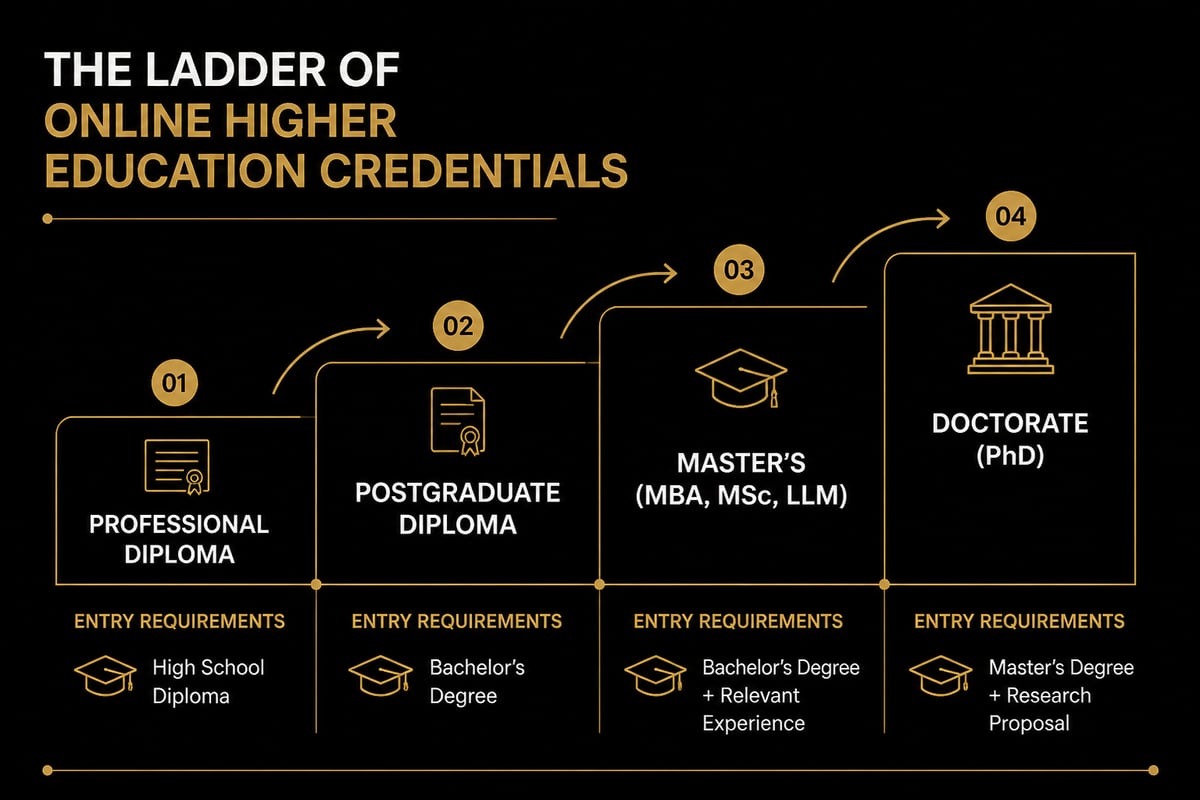
You can earn nearly every postgraduate credential online, including professional diplomas, master's degrees and doctorates, though the best-supported fields are business, law, education, theology and applied sciences. Each level serves a different career purpose.
- Professional diplomas build focused skills in a short period. They suit professionals who want a specific competency, such as project management or theological studies, without committing to a full degree.
- Master's degrees (MBA, MSc, LLM, M.Ed.) are the most popular online choice. An MBA develops general management capability, an MSc deepens technical or analytical expertise, and an LLM prepares legal specialists for practice in areas such as international and commercial law.
- Doctoral programs (PhD) are research-intensive and demand sustained independent work. Online or blended delivery works for them when supervision is strong and library access is reliable.
Education leadership is a growing category as well. Universities now offer a higher education degree pathway for people who want to move into academic administration, and an M.Ed. in higher education administration is a common route for professionals already working in or near universities.
If you are comparing options, start with the outcome you want in five years. A promotion into senior management points toward an MBA. A move into policy or diplomacy points toward an LLM with an international focus. A teaching or research career points toward an M.Ed. or PhD.
What Should You Check Before You Enroll?
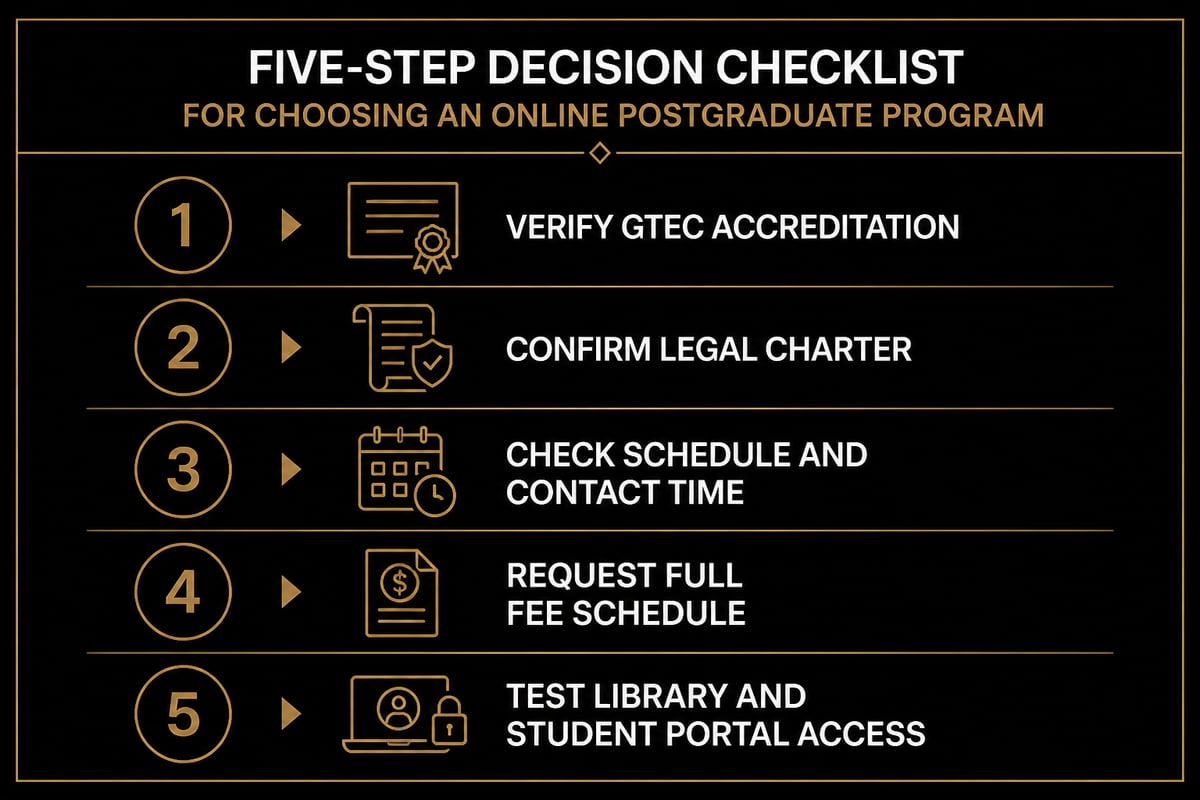
Before enrolling, confirm four things: the institution's accreditation, the legal authority behind its degrees, the contact hours and assessment style, and the support services available to remote students. Skipping any of these is how people end up with credentials that do not hold up.
Accreditation and Legal Standing
In Ghana, the Ghana Tertiary Education Commission (GTEC) is the body that accredits institutions and programs. Ask whether the specific program you want is accredited, not just the institution in general. A charter from the government is another strong signal, since it shows the university was established under national law.
University Of Gold Coast holds the Presidential Charter granted by the Government of Ghana, and all its academic programs are accredited by GTEC. Those are the three facts any prospective student should be able to verify for any institution.
Program Structure and Contact Time
Online programs vary widely. Some are fully asynchronous, meaning you watch lectures and submit work on your own schedule. Others run live sessions at fixed times. A third group blends online learning with short residential periods.
For working professionals, predictability matters more than total flexibility. A program that concentrates teaching into a fixed block, such as one full weekend a month, lets you plan leave, childcare and work deadlines well in advance. That is the model University Of Gold Coast uses, so students can continue in their jobs while they study.
Faculty and Learning Resources
Look at who teaches. Faculty with real industry experience bring practical cases into discussions, which is especially valuable in an MBA or an LLM. Check also for an online library, a student portal for submissions and results, and clear channels for reaching tutors. These resources determine whether remote study feels supported or isolating.
Online, Blended or On-Campus: How Do They Compare?
The three formats trade off flexibility, interaction and cost, and the best fit depends on your schedule and how you learn. The table below summarizes the differences that matter most to working adults.
| Factor | Fully online | Blended (online plus residential sessions) | On-campus |
|---|---|---|---|
| Schedule flexibility | High | Moderate, with fixed contact dates | Low |
| Face-to-face networking | Limited, mostly virtual | Strong during residential periods | Strong and continuous |
| Travel and relocation | None | Occasional | Regular or full relocation |
| Self-discipline required | High | Moderate | Lower, structure is imposed |
| Typical fit for working managers | Good | Very good | Difficult |
Blended models deserve particular attention in Ghana. Internet quality and power supply can be uneven, and some assessments, such as law examinations or viva presentations, benefit from being in the same room. A monthly weekend format gives you the networking and accountability of campus study without asking you to leave your employer.
How Much Does an Online Degree Cost, and How Can You Pay?
Online study is not automatically cheap, but it removes costs that campus study carries, including relocation, daily commuting and, for many students, unpaid leave. Your real expense is the sum of tuition, technology, books or digital resources, and any residential travel.
When comparing programs, ask for a complete fee schedule rather than a headline tuition figure. Check these items:
- Tuition per semester or per module
- Registration, examination and graduation fees
- Dissertation or project supervision charges
- Costs of any required residential sessions
- Whether payment can be spread over the program
Payment structure often matters more than the total. University Of Gold Coast offers flexible payment plans so students can pay as they go, which aligns costs with monthly income instead of requiring a large upfront sum. If cost is your main constraint, a comparison of affordable online graduate programs can help you frame what is reasonable before you request quotes.
Be cautious about the lowest price in any comparison. A fee that looks small can mean limited faculty access, no library, or unaccredited awards. Value is the combination of recognized credentials and real support.

What Does a Postgraduate Qualification Return in Earnings?
Higher qualifications are consistently associated with stronger earnings and job security, though the exact figures come from labor markets outside Ghana. The U.S. Bureau of Labor Statistics reports that, for 2025, full-time workers age 25 and older with a bachelor’s degree earned substantially more per week than those without one and had a low unemployment rate. BLS notes that its annual estimates are 11-month averages that exclude October.
Treat that as direction, not a forecast for Accra. Salary scales, sector demand and employer attitudes to postgraduate credentials differ by country. In Ghana, the clearer returns usually come from specific events: eligibility for senior management roles, qualification for regulated professional practice, or credibility when moving into policy, consulting or academic work.
A useful exercise is to write down the exact role or responsibility you want that your current qualification does not allow. If a postgraduate degree removes that barrier, the investment has a concrete justification.
Who Should Consider a Business or Law Degree Online?
Two groups benefit most: managers who want an MBA without pausing their careers, and legal and policy specialists who want an international or African-focused qualification.
Managers Pursuing an MBA or MSc
If you are already supervising teams or budgets, an MBA formalizes what you have learned on the job and fills gaps in finance, strategy and leadership. Because you remain employed, you can apply each module immediately, which strengthens both learning and your case for promotion. A one-weekend-a-month schedule is realistic for most managers, since it asks for focused blocks of time rather than daily attendance. If speed is a priority, you can review how one-year online master’s programs are structured and judge whether the intensity suits you.
Legal Specialists and Policymakers
An LLM suits lawyers, compliance officers, civil servants and aspiring diplomats who want depth in international law, trade, human rights or regional integration. African perspectives matter here. Treaties, dispute resolution and development policy increasingly require practitioners who understand both global frameworks and the continent's institutions. A university with Ghanaian accreditation and faculty experienced in practice gives that study local relevance.
Leadership Grounded in Ethics
Some professionals want their studies to reflect their values as well as their ambitions. University Of Gold Coast offers a Christ-centred learning environment that combines academic excellence with ethical leadership, and it extends to theology through programs such as the Level 6 extended diploma in theology. For ministry leaders, church administrators and values-driven managers, that combination can be more useful than a purely secular curriculum.
How Do You Succeed as an Online Postgraduate Student?
Success in higher education online depends on routine, communication and early planning, since nobody will notice if you fall behind quietly. These habits separate students who finish from those who stall.
- Protect fixed study hours. Two or three scheduled sessions each week beat occasional long marathons. Put them in your calendar the way you would a client meeting.
- Tell your employer early. Many managers secure time off for residential weekends or assessments simply by asking in advance and linking the degree to company needs.
- Prepare for connectivity problems. Download readings, keep a backup data plan, and know where you can work if power or internet fails.
- Use the student portal and library actively. Online libraries hold journals and case studies you cannot easily find elsewhere, and a portal keeps your results, deadlines and tutor messages in one place.
- Build a study group. Classmates in other industries give you new perspectives and make weekend sessions more productive.
- Plan the dissertation from the first semester. Choose a topic connected to your workplace so your research serves both your degree and your employer.
Data also helps you compare institutions. NCES provides institutional data reports that illustrate how standardized reporting supports college comparison, and the same habit applies in Ghana: ask each university for accreditation documents, completion rates and sample timetables before you decide.
Questions Working Professionals Ask About Online Degrees
Will an online degree be taken seriously by employers? Employers care most about accreditation and the reputation of the awarding institution. A degree awarded by a chartered university and accredited by GTEC carries the same standing as other recognized awards, whatever the delivery format.
How many hours should I expect to study each week? Postgraduate students should plan for substantial weekly reading, assignments and preparation, in addition to scheduled teaching. Heavier assessment periods will need more, so plan buffer time.
Can I switch between programs if my goals change? Often you can, particularly within the same faculty, but credit transfer rules vary. Ask about them before you pay your first installment.
What if I need to pause my studies? Reputable universities have policies for deferral or extenuating circumstances. Read them in advance, because they affect fees and time limits.
Is a diploma worth doing before a master's? For many professionals it is. A diploma can confirm that you enjoy structured study, build credits or confidence, and prepare you for postgraduate academic writing. If you want to compare routes, resources such as an online master's overview can show how entry requirements differ.
Your next step is to list the one credential your career currently lacks, then gather the accreditation papers, fee schedule and class timetable for any program you are considering. University Of Gold Coast offers MBA, MSc, LLM and professional diploma options taught by experienced practitioners, with monthly weekend classes and flexible payment plans designed around working life. When you are ready to move from comparison to action, you can Apply Now and begin your postgraduate studies without leaving your job.