
An undergraduate graduate is someone who has completed a first degree, typically an associate or bachelor's, and is now either entering the workforce or continuing into graduate study such as a master's, MBA, or doctorate. Undergraduate education builds broad foundations in a field, while graduate education deepens that knowledge through specialization, research, and professional training. Understanding where one stage ends and the other begins helps you plan your credentials, budget, and career with confidence.
What Does Undergraduate Mean?
Undergraduate study is the first level of university education, leading to an associate degree or a bachelor's degree. Students at this level combine general education courses with a chosen major, building the knowledge base that graduate programs later assume.
According to Southern New Hampshire University, associate degrees typically require 60 credits and take about two years, while bachelor's degrees typically require 120 credits and take about four years. UCLA sets its own bachelor's requirement higher, at 180 credit units. The numbers differ by institution, but the structure is consistent: a broad, guided curriculum over several years.
For a deeper definition, the University of Gold Coast explains the undergraduate meaning in the context of its own academic framework.
What Does "Grad School" Mean?
Grad school means any program you enter after earning a bachelor's degree, including master's degrees, professional degrees, and doctorates. It is the shorthand most American students use for graduate education as a whole.
Graduate programs are narrower and more demanding than undergraduate ones. Instead of sampling many subjects, you concentrate on one field, such as finance, law, human resource management, or theology. The expectation shifts from absorbing information to producing original analysis, whether through a thesis, a capstone project, or applied professional work.
The term "postgraduate" is used in much of the world, including Ghana and the United Kingdom, to describe the same level. Readers comparing terminology can review the postgraduate degree overview for how the labels line up.
Undergraduate vs Graduate: The Core Differences at a Glance
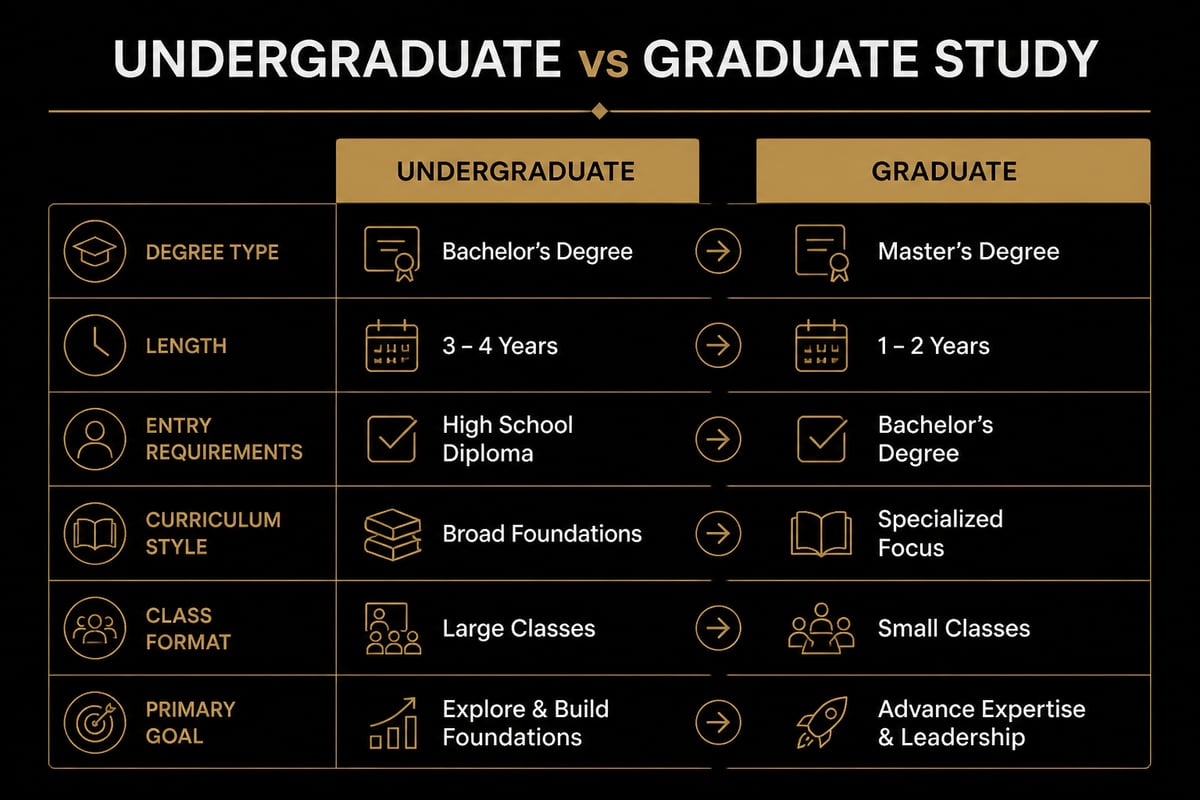
The clearest way to compare the two levels is side by side across the factors that affect your decision.
| Factor | Undergraduate | Graduate |
|---|---|---|
| Typical degrees | Associate, bachelor's | Master's, MBA, LLM, PhD, professional diplomas |
| Typical length | 2 to 4 years | 1 to 2 years for a master's; longer for doctorates |
| Entry requirement | Secondary school completion | A bachelor's degree, plus references and transcripts |
| Curriculum | Broad, structured, general education plus a major | Narrow, specialized, self-directed |
| Class style | Larger lectures, set assignments | Seminars, discussion, research, applied projects |
| Primary goal | Foundation and first career entry | Expertise, advancement, or career change |
The graduate and undergraduate difference guide from University of Gold Coast expands on several of these points for prospective students.
Degree Types and Program Length
Undergraduate programs end in an associate or bachelor's degree, while graduate programs end in a master's, professional degree, or doctorate. Length follows the same pattern, with graduate study usually shorter at the master's level but more intensive per month.
Master's programs commonly require up to 36 credits and take one to two years, depending on the program and course load, according to Southern New Hampshire University. UCLA similarly lists master's programs at a minimum of 36 credit units, taking one to three years. For a broader view of the main types, see our guide to master’s degree types and what each one prepares you for.
Compressed formats exist as well. The University of Gold Coast offers a 12-month MBA and 12-month MSc options in accounting and finance and human resource management, which suit working professionals who cannot pause their careers for two years.
Admission Requirements: How the Application Changes
Undergraduate admission asks you to prove readiness for university study, while graduate admission asks you to prove readiness for advanced work in a specific field. The documents reflect that shift.
Undergraduate applications generally center on secondary school results, entrance assessments, and sometimes a personal statement. Graduate applications add professional and academic evidence. Stanford's graduate application, for example, requires applicants to list every postsecondary institution attended, provide unofficial transcripts, and name academic or professional references.
Typical graduate application materials include:
- A completed bachelor's degree or recognized equivalent
- Official or unofficial transcripts
- Two or three references from professors or employers
- A statement of purpose explaining why you want the specialization
- Relevant work experience, especially for MBA and professional programs
Coursework, Workload, and Classroom Experience
Graduate coursework is more specialized and more self-directed, with fewer classes but heavier reading, writing, and analysis in each one.
In undergraduate study, a typical term might include several courses across different subjects, with clear syllabi, regular quizzes, and exams. Instructors guide the pace. Class sizes are often larger, especially in introductory courses.
Graduate classes tend to be smaller and discussion-led. You are expected to challenge sources, defend arguments, and manage deadlines largely on your own. Many programs culminate in a dissertation, thesis, or applied capstone. Professional programs such as an MBA add case studies, group projects, and practical assessments tied to real business problems.
Time commitment also changes shape. A full-time undergraduate load is spread across many subjects, while a graduate load is concentrated, so hours per course rise even when course count falls.

Is Grad School Cheaper Than Undergrad?
Grad school is usually not cheaper per year, but it can be cheaper overall because master's programs are shorter. Tuition per credit is frequently higher at the graduate level, and funding such as scholarships and assistantships works differently.
The real comparison is total cost and return. A one-year master's costs fewer years of tuition and fewer years out of full-time employment than a four-year bachelor's. Online and part-time delivery cuts relocation and housing costs further. University of Gold Coast has published several resources on this topic, including guides to affordable graduate programs and the cheapest graduate programs.
A practical way to compare costs is to calculate:
- Total tuition for the full program, not just the per-credit rate
- Fees for materials, technology, and examinations
- Income you will forgo if you study full time
- Employer sponsorship or scholarship support available to you
- The salary or role change you realistically expect afterward
Can You Get a Master's in Something Different From Your Bachelor's?
Yes, you can earn a master's in a different field from your bachelor's, and many graduate programs accept applicants from varied backgrounds. The main requirement is usually a completed bachelor's degree, not a matching major.
Business programs are especially open. An MBA typically welcomes graduates in engineering, humanities, health, or education, because the cohort benefits from varied perspectives. More technical programs, such as an MSc in a quantitative discipline, may ask for prerequisite courses or a short bridging module if your first degree is unrelated.
Some universities build this pathway deliberately. The University of Gold Coast's Graduate Access Program in Biblical Studies is designed to help applicants move into graduate-level study when their earlier training took a different route. Reading the graduate access program brochure will clarify the entry conditions.
Career Outcomes and the Value of Graduate Study
Undergraduate degrees open the door to professional careers, while graduate degrees support promotion, specialization, licensing, and career change. Which one carries more weight depends on your field. Humanities graduates weighing this step can compare routes in our master of arts guide, which covers programs, admission and career paths.
Many entry-level roles across business and administration require only a bachelor's degree. Graduate credentials become decisive in fields such as law, academia, senior management, theology, and specialized finance or HR roles, where an LLM, PhD, or MSc signals depth. For working professionals, a master's often accelerates movement into management without requiring a career restart.
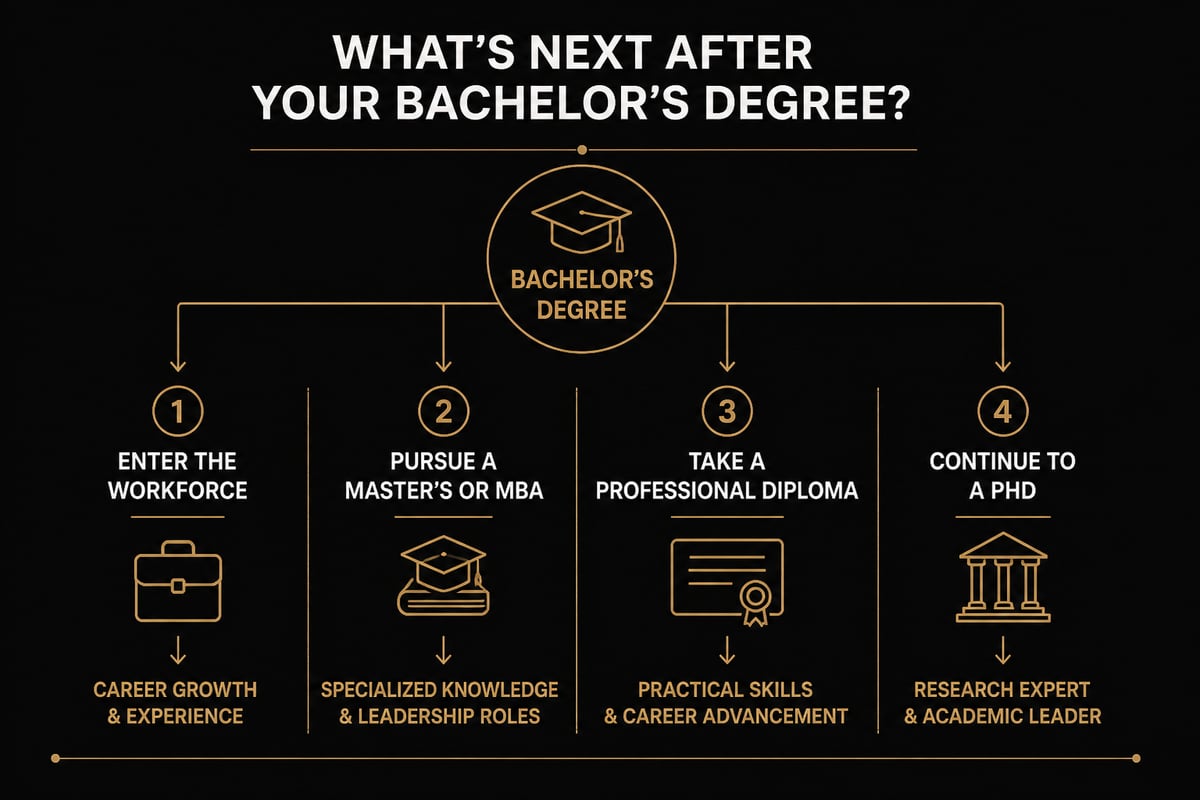
Evaluate the return on your own terms. Ask whether your target role lists a graduate degree as required or preferred, whether your employer funds study, and how the program's schedule fits your current work.
Can You Be 27 and Still in College?
Yes, being 27 and still in college is common, and it is increasingly normal in both undergraduate and graduate programs. Students return to study after working, raising families, or changing careers, and universities design programs around them.
Age at the graduate level skews higher than at the undergraduate level for a simple reason: many master's and MBA programs prefer or require professional experience. A 27-year-old graduate student often brings several years of workplace context, which strengthens class discussion and can improve how quickly the degree translates into advancement. Part-time, evening, and online delivery exist precisely for this audience.
The timeline is also manageable. A 27-year-old who has finished a bachelor's degree can complete a master's in one to two years, according to Southern New Hampshire University, which would mean finishing before 30. Someone starting a bachelor's at 27 faces roughly four years of study at 120 credits, or about two years for a 60-credit associate degree. Because graduate applications ask for references and work history, the years spent in employment between degrees are an asset, not a gap to explain.
How to Choose Between Undergraduate and Graduate Study
Choose based on where you are in your education and what the next role requires, not on which level sounds more prestigious.
- Confirm your starting point. If you have not completed a bachelor's degree, undergraduate study is the required path. If you have, graduate options open.
- Define the outcome. Identify the job, license, or promotion you want and check whether it requires a graduate credential.
- Match the format to your life. Full-time, part-time, and online options change the cost and the disruption to your income.
- Compare total cost. Include tuition, fees, and lost earnings, and review affordability guides such as the most affordable graduate schools list.
- Check admission fit. Gather transcripts, references, and a clear statement of purpose before you apply.
Broader context on how the levels connect is available in this overview of undergraduate and graduate degrees and in the discussion of graduate-level education. Readers looking at cross-sector trends in education and business can also follow industry coverage at Fairmont Post.
FAQ
Is a postgraduate degree the same as a graduate degree?
In practice, yes. "Graduate" is the common American term and "postgraduate" is common in Ghana, the United Kingdom, and elsewhere, but both describe study after a bachelor's degree, such as a master's or doctorate. When you compare programs across countries, look at the entry requirement and the credential awarded rather than the label, since a postgraduate certificate, a master's, and a doctorate all sit at this level but differ in length and depth.
Do I need work experience to apply for graduate school?
Not always. Many master's programs accept recent bachelor's graduates, but MBAs and professional programs often prefer or require a few years of work experience. Even where it is optional, experience helps. Applications typically ask for transcripts and two or three academic or professional references, and an employer who can describe your performance makes a stronger reference than a general character statement. If you have little experience, a clear statement of purpose can show why the specialization fits your goals.
Can I study for a graduate degree online?
Yes. Many universities, including the University of Gold Coast, offer online and flexible graduate programs so you can study while working. Online delivery reduces relocation and housing costs and removes commuting time, which makes a 12-month MBA or MSc realistic for someone with a full-time job. Before enrolling, confirm how assessments are handled, what technical access you need, and whether library and student portal services are available remotely.
Start by listing the role you want in three to five years and checking whether it requires a graduate credential, then gather your transcripts and two references so you are ready to apply. If you have already earned a bachelor's degree, the University of Gold Coast can help you compare MBA, MSc, LLM, PhD, and professional diploma options, and you can request details through the postgraduate brochure before applying. Its online library and student portal support your studies once you enroll. Explore the programs at University Of Gold Coast and take the next step toward your graduate degree.