
A master of arts (MA) is a postgraduate degree, typically lasting one to two years, that focuses on the humanities, social sciences, and related fields through reading, research, writing, and critical analysis. It is awarded after a bachelor's degree and often ends with a thesis, capstone project, or comprehensive examination. For professionals in Ghana weighing further study, the degree is worth understanding in detail, because its title matters less than its curriculum, its accreditation, and the career it supports.
What Is a Master of Arts Degree?
A master of arts is a graduate-level qualification that develops analytical, interpretive, and communication skills in fields such as languages, history, education, political science, international relations, and communication.
The degree sits between the bachelor's and the doctorate. Coursework is usually discussion-based, and assessment relies on essays, research papers, and presentations more than laboratory work or problem sets. Many programs conclude with an original thesis, which makes the degree a common stepping stone toward a PhD, although most graduates enter the workforce directly.
Three features define most MA programs:
- Disciplinary focus. You study one field in depth, such as English, history, or international affairs.
- Research and writing emphasis. You learn to build an argument from evidence and defend it.
- Flexible outcomes. The skills transfer to government, law, education, media, nonprofits, and corporate roles.
The exact structure varies by discipline. The University of Wisconsin-Madison’s music MA shows how one degree title can carry different prerequisites, application materials, and learning outcomes depending on the field.
Master of Arts vs. Master of Science: Which Is Better?
Neither degree is better in general; the right choice depends on your field, your goals, and what employers or doctoral programs in that field expect.
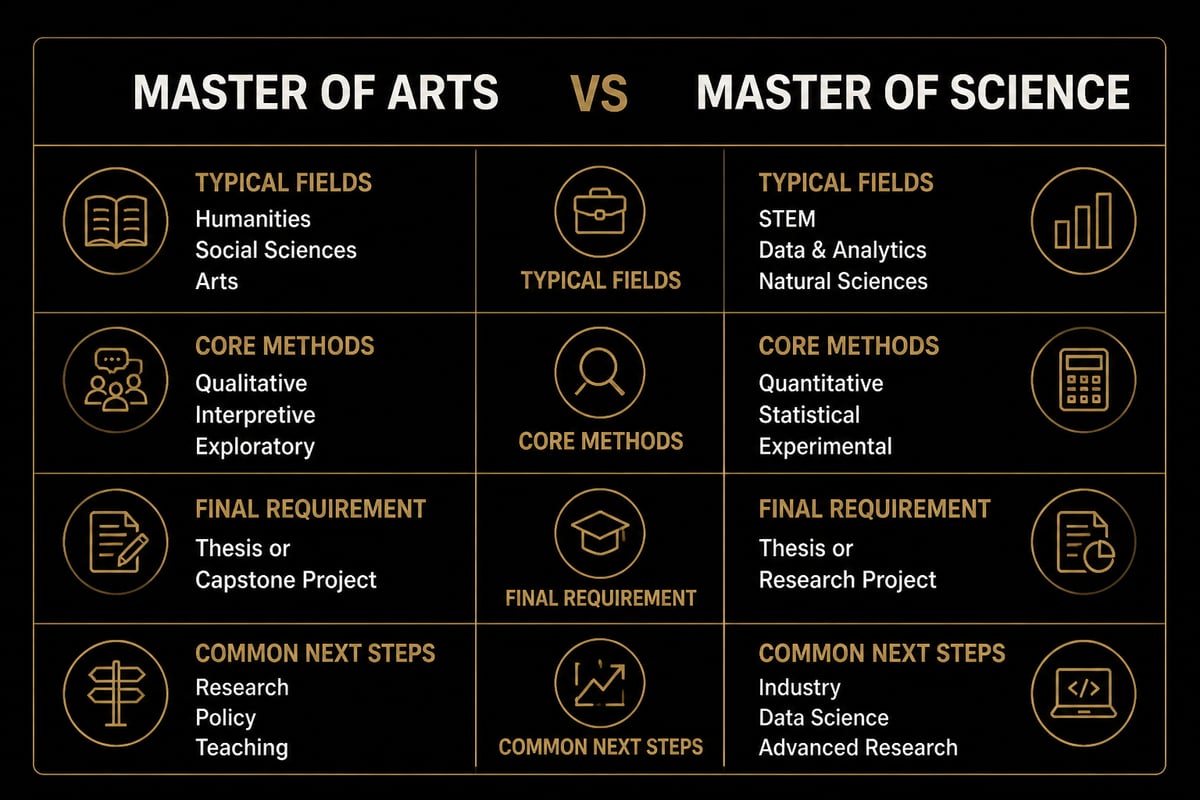
An MA typically emphasizes qualitative analysis, theory, and interpretation. An MS (Master of Science) typically emphasizes quantitative methods, technical skills, and empirical research. The distinction is not always clean. Some universities award an MA in economics or psychology and an MS in the same subject, with the difference lying in the amount of statistics and laboratory work required.
| Feature | Master of Arts (MA) | Master of Science (MS/MSc) |
|---|---|---|
| Typical fields | Humanities, social sciences, education, languages | Natural sciences, engineering, data, health |
| Core method | Critical reading, writing, qualitative research | Experiments, modeling, quantitative analysis |
| Final requirement | Thesis, capstone, or exam | Thesis, project, or exam |
| Common next step | PhD, law, policy, teaching, communication roles | PhD, technical or research roles |
If your target role rewards argument, negotiation, and policy fluency, an MA fits well. If it rewards technical measurement, an MSc is the stronger match. For a deeper look at science-track options, see this overview of the master degree in science.
What Is the Difference Between Arts and Science Degrees?
An arts degree trains you to interpret human behavior, language, and institutions, while a science degree trains you to test hypotheses about the natural and technical world through measurement.
Arts programs tend to ask why events happen and what they mean. Science programs tend to ask how something works and whether it can be demonstrated repeatedly. In practice, the two overlap in fields such as geography, linguistics, and economics, where universities may offer either label.
Curriculum is the more reliable guide. Review the required courses, the research methods taught, and the thesis expectations. Two programs with different titles may be closer than two programs with the same title.
Master vs. Master of Arts: What Is the Difference?
"Master" is the general term for a graduate degree at the second level of higher education, while a master of arts is one specific type of master's degree.
Other types include the Master of Science, Master of Business Administration (MBA), Master of Laws (LLM), and Master of Education. Each title signals the discipline family and the style of study. An MBA, for example, is a professional degree built around management practice, whereas an MA is usually academic and discipline-based.
For working managers in Accra, this distinction shapes the decision. An MBA suits those pursuing senior leadership, finance, or operations roles. An MA or MSc in a policy-oriented field suits those moving toward public service, regulation, advocacy, or international affairs. You can compare professional and academic routes in this guide to professional master degrees.
Types of Master of Arts Programs
Master of arts programs fall into several broad categories, and the label often reflects the discipline or the teaching approach rather than the level of difficulty.
Common categories include:
- Traditional discipline MAs, such as English, history, philosophy, and political science, usually thesis-based.
- Professional or applied MAs, such as the Master of Arts in Teaching or in international education, which combine theory with practice.
- Interdisciplinary MAs, such as liberal studies, which draw from several fields.
- Research MAs, which prepare students for doctoral work through extended independent research.
What Is a Master of Arts in Liberal Studies?
A Master of Arts in Liberal Studies is an interdisciplinary graduate degree that lets students combine courses from several humanities and social science fields instead of specializing in one.
It suits learners who want broad intellectual development, who are changing direction, or who want to connect ideas across history, literature, ethics, and public affairs. It is often offered part-time, which helps working adults. Because the curriculum is flexible, it carries less direct professional signaling than a specialized degree, so graduates benefit from pairing it with clear career goals.
Master of Arts Admission Requirements
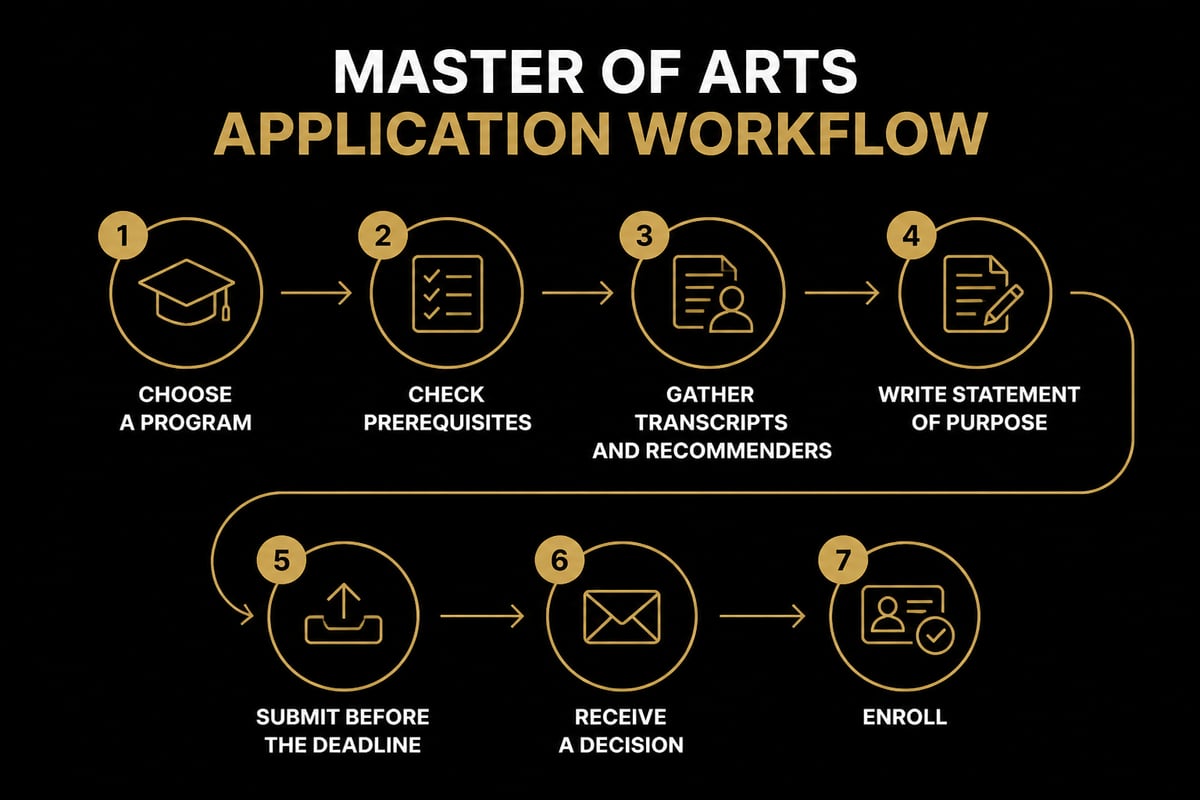
Most master of arts programs ask for a bachelor's degree, transcripts, recommendation letters, written statements, and sometimes a writing sample, with the exact mix set by each department.
Published requirements show how much programs differ:
- One English MA program requires a bachelor's degree in English or a related field, at least 20 semester credits in English courses, and a minimum 3.50 GPA, according to the Michigan State University Department of English.
- The same program asks for a 20 to 25-page writing sample, two statements of 750 to 1,000 words each, a CV, and three recommendation letters, and it sets a December 15 deadline for fall admission.
- NYU Steinhardt’s MA in International Education requires two recommendation letters and does not require GRE scores.
Application fees also vary. Stanford's graduate application fee is nonrefundable, according to Stanford Graduate Admissions, and applicants must apply by the deadline set by their intended program. Stanford also outlines the full process, from choosing a program to enrollment, on its graduate application page.
A Practical Application Checklist
Before applying anywhere, gather these items:
- Official transcripts and, where relevant, a credential evaluation
- Two or three referees who can speak to your academic or professional ability
- A statement of purpose connecting your experience to the program
- A writing sample or portfolio, if the department asks for one
- Proof of English proficiency, if required
- Confirmation that the institution is accredited in its home country
Requirements differ widely by institution, so read the department page rather than assuming. For a general overview of what to prepare, see this guide to master program requirements.
Study Formats: Full-Time, Part-Time and Weekend
Most master of arts programs can be completed full-time in one to two years, while part-time and weekend formats stretch the timeline in exchange for the ability to keep working.
Full-time study moves fastest but usually means pausing a career or reducing hours. Part-time study spreads courses over two to four years. Weekend and modular formats concentrate classes into set blocks, which suits managers and public officials who cannot attend weekday sessions.
For Ghanaian professionals, format often decides whether study is realistic at all. Consider commuting time, employer flexibility, payment structure, and access to library and learning resources. Online libraries and student portals matter more when you study around a full workload. If speed is a priority, these overviews of one-year masters programs and online one-year options outline what accelerated study involves.
Career Paths With a Master of Arts
A master of arts opens careers in government, law and policy, education, communication, nonprofit leadership, and management, because it builds research, writing, and analytical judgment that employers in many sectors value.
Typical directions include:
- Policy and public administration: policy analyst, program officer, regulatory affairs specialist
- International affairs: diplomat, foreign service officer, international organization staff, development consultant
- Education: teacher, curriculum developer, school or college administrator
- Communication and media: editor, communications director, researcher, publications manager
- Legal and compliance support: legal researcher, compliance analyst, contracts specialist, often alongside or before an LLM
- Further study: PhD preparation and academic careers
The degree rarely guarantees a specific job title. Its value depends on how clearly you connect the coursework, your thesis topic, and your prior experience to the role you want. A manager who writes a capstone on regulatory reform in her own industry, for instance, builds a credential and a body of expertise at once.
International Relations and African Perspectives
For aspiring diplomats, legal specialists, and policymakers, international relations is among the most relevant fields in the arts-and-social-science family, because it covers diplomacy, international law, regional integration, and global governance.
Graduates who combine this training with knowledge of African institutions, such as the African Union, ECOWAS, and continental trade frameworks, are positioned for roles where regional context is essential. Employers in ministries, think tanks, development agencies, and law practices value people who can read a treaty, assess a policy, and write a persuasive brief grounded in local realities.
University Of Gold Coast offers an MSc in International Relations, a postgraduate route for readers who want this focus. Classes run one full weekend a month, flexible payment plans let students pay as they go, and the degree is awarded by the University of Gold Coast and accredited by the Ghana Tertiary Education Commission. Faculty bring real-world industry experience into the classroom, and the learning environment is Christ-centred, combining academic excellence with ethical leadership. For specific fees, entry requirements, and schedules, check the program page or the university's contact channels.
How to Choose the Right Program
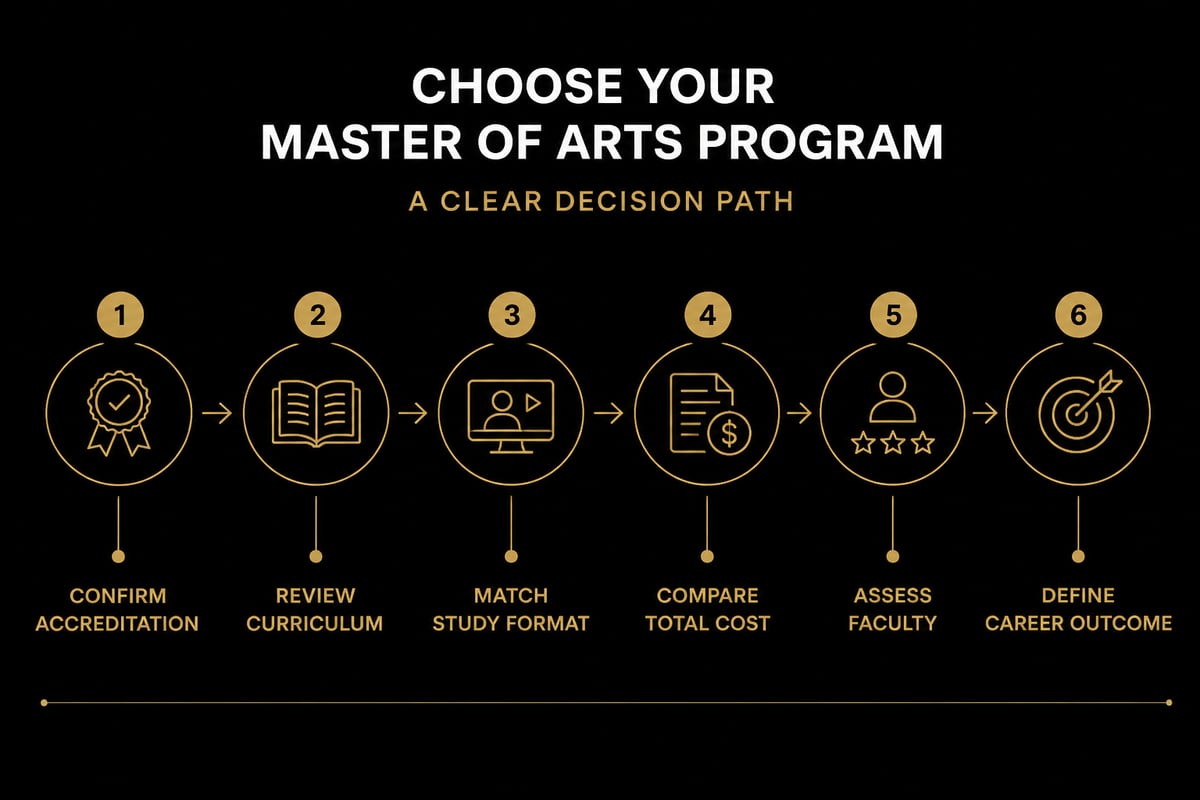
Choose a master of arts program by checking accreditation first, then curriculum fit, format, cost, and the outcomes you want, in that order.
- Confirm accreditation. Your degree should be recognized by the relevant national regulator. In Ghana, programs are accredited by the Ghana Tertiary Education Commission (GTEC), and an institution should be able to show its charter and accreditation status.
- Read the curriculum. Look at required courses, electives, and the final requirement. A thesis suits future researchers; a capstone or exam may suit practitioners.
- Match the format to your life. Weekend, part-time, and online options differ in pace and workload.
- Compare total cost. Include tuition, materials, travel, and any application fees, and ask about payment plans.
- Examine faculty. Practitioners with industry or policy experience can bring applied insight, while research-active faculty can supervise a strong thesis.
- Define the outcome. Write down the role, promotion, or further study you want, and test each program against it.
FAQ
Is a master of arts worth it for working professionals?
It can be, when the program matches a specific career goal such as policy work, international affairs, education leadership, or a move into a regulated field. The return depends on accreditation, the skills you build, and how well you apply them in your current or target role. Part-time and weekend formats reduce the cost of lost income.
How long does a master of arts take?
Full-time programs typically take one to two years, while part-time and weekend formats usually take longer, often two to four years. The length depends on credit requirements and whether a thesis is involved. Check each program's published timeline.
Can I apply for a master of arts without a related bachelor's degree?
Some programs accept applicants from other disciplines, sometimes after prerequisite coursework, while others require a closely related undergraduate background. Michigan State's English MA, for example, expects a degree in English or a related field plus at least 20 semester credits in English courses. Review the department's admission page before applying.
Start by drafting a one-page statement of the career outcome you want and listing two or three programs whose curriculum and format fit it. If international affairs is your direction, review the MSc in International Relations at University Of Gold Coast, where weekend classes and flexible payment plans are built around working professionals, and Apply Now to begin your postgraduate application with a GTEC-accredited institution.