
An under graduate is a student who is studying for a first degree at a college or university, typically an associate degree or a bachelor's degree, and has not yet completed that qualification. An undergraduate degree is the level of higher education that comes after secondary school and before postgraduate study such as a master's degree or a doctorate. For working professionals in Ghana, understanding where this level sits is the first step toward planning an MBA, MSc or other advanced qualification.
What Does Undergraduate Mean?
Undergraduate describes a student, a course or a degree at the first level of university education. The word is built from "under" and "graduate," because the student is working toward graduating for the first time and has not yet earned a degree.
In the United States, an undergraduate student is pursuing either an associate degree or a bachelor’s degree, according to EducationUSA. In Ghana and the United Kingdom, the term most often refers to a student on a bachelor's programme, though foundation degrees and higher national diplomas sit at the same broad level.
The term is used in three common ways:
- As a noun: "She is an undergraduate in her second year."
- As an adjective: "an undergraduate course" or "undergraduate fees."
- As a descriptor of level: "undergraduate-level study" means study at bachelor's level or below postgraduate.
For a more detailed explanation of the term, the University of Gold Coast has published a guide to the undergraduate meaning.
How an Undergraduate Degree Works
An undergraduate degree works as a structured programme of taught modules that a student completes over several years, earning credits toward a final qualification. Most programmes combine core subjects, which every student in the field must take, with electives that allow some specialisation.
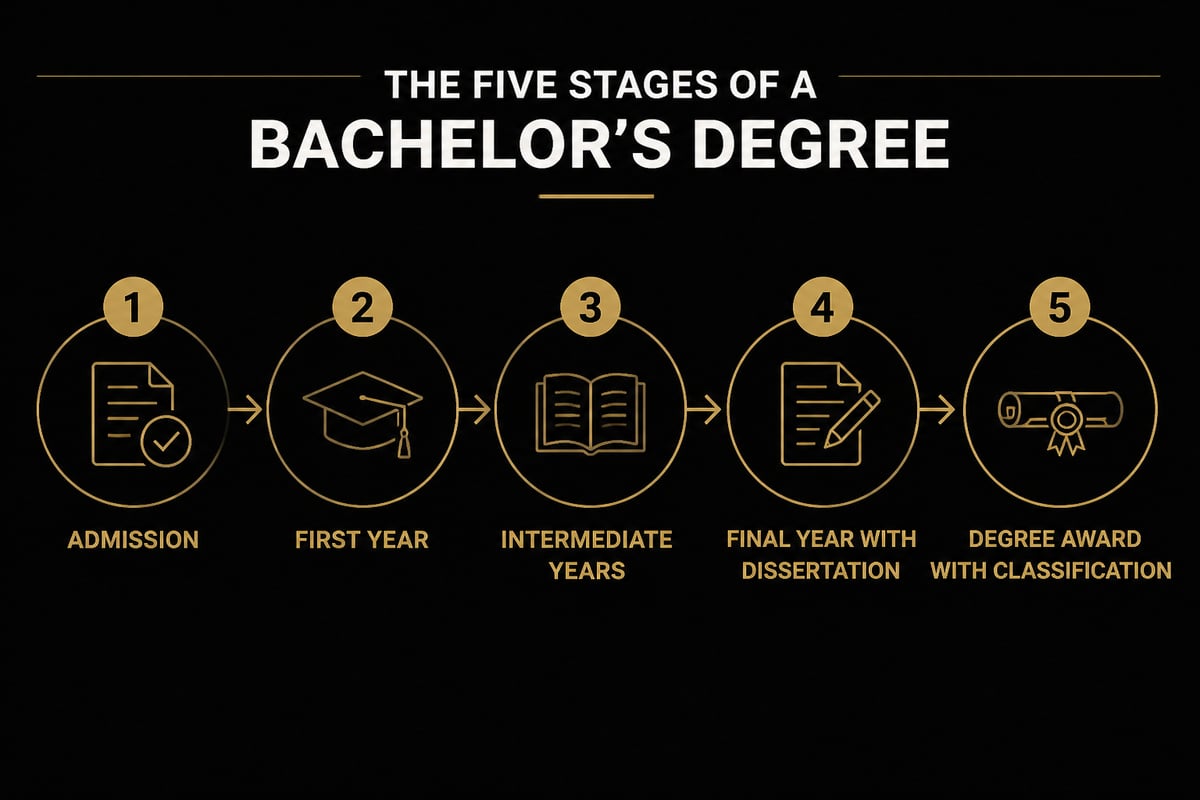
A typical bachelor's programme follows this sequence:
- Admission: The student presents secondary school results or an equivalent qualification.
- Foundation year or first year: Introductory modules build general academic skills and subject basics.
- Intermediate years: Students take deeper subject modules and begin choosing a specialism.
- Final year: Advanced modules are often paired with a dissertation or capstone project.
- Award: The institution confers the degree, often with a classification such as first class, second class or third class honours.
Duration varies. According to Britannica’s overview of the bachelor’s degree, typical study time differs by country and field. Three years is common in the United Kingdom, while four years is common in the United States.
Types of Undergraduate Degrees
The main types of undergraduate degrees are the associate degree, the bachelor's degree and the sub-degree diploma or certificate. Each one differs in length, depth and the doors it opens.
| Qualification | Typical length | What it is |
|---|---|---|
| Certificate or diploma | 6 months to 2 years | Short, practical, job-focused study |
| Associate degree | 2 years | A first-level degree, common in the United States |
| Bachelor's degree | 3 to 4 years | The standard first degree, required for most postgraduate entry |
Within the bachelor's category, the title tells you the field of study:
- Bachelor of Arts (BA): Humanities, social sciences and languages.
- Bachelor of Science (BSc): Sciences, technology and quantitative subjects.
- Bachelor of Commerce or Business Administration (BCom, BBA): Accounting, management and marketing.
- Bachelor of Laws (LLB): The first law degree in many Commonwealth countries.
- Bachelor of Theology or Divinity: Ministry, biblical studies and church leadership.
The scale of this level of study is large. U.S. institutions confer millions of undergraduate degrees each year, including both associate and bachelor’s degrees, according to the National Center for Education Statistics.
Undergraduate vs Graduate: What Is the Difference?
An undergraduate works toward a first degree, while a graduate has already earned one, and the word "graduate" in this second sense often describes postgraduate study. This is the distinction that causes the most confusion, because "graduate" has two meanings depending on context.
Used on its own, a graduate is anyone who has completed a degree. Used in an education system, graduate study means courses taken after a bachelor's degree, such as a master's or doctorate. In Ghana and the United Kingdom, the more precise term is postgraduate.
| Feature | Undergraduate | Postgraduate |
|---|---|---|
| Entry requirement | Secondary school qualification | A bachelor's degree, or in some cases equivalent experience |
| Typical award | Associate or bachelor's degree | Master's, MBA, PhD, postgraduate diploma |
| Teaching style | Lectures, tutorials, broad foundation | Seminars, case studies, research, specialisation |
| Typical student | School leaver or young adult | Working professional or career changer |
| Focus | Building knowledge | Applying and extending knowledge |
The University of Gold Coast explains this contrast further in its guide to the difference between graduate and undergraduate study and its overview of undergraduate and graduate degrees.
Are Undergraduates Called Graduates?
No, a current undergraduate is not called a graduate until the degree has been completed and conferred. A student in the second year of a BSc is an undergraduate. Once the BSc is awarded, that person becomes a graduate, and may then be described as a holder of a bachelor's degree.
There is one overlap worth knowing. In everyday British and Ghanaian usage, "graduate" can mean "someone who has finished a degree," which is why employers advertise "graduate roles" for people holding bachelor's degrees. Meanwhile, in American usage, "graduate student" means someone studying beyond the bachelor's level. Reading the context resolves the meaning.
What Is the Difference Between a Bachelor's Degree and an Undergraduate Degree?
A bachelor's degree is one specific type of undergraduate degree, while "undergraduate degree" is the broader category that also includes associate degrees. Every bachelor's degree is an undergraduate degree, but not every undergraduate degree is a bachelor's degree.
In practice, many people use the two terms interchangeably, and in Ghana that is usually accurate because the bachelor's degree is the dominant first-degree qualification. The distinction matters mainly when comparing international systems. A two-year American associate degree is undergraduate, but it is not a bachelor's degree, and many postgraduate programmes require the latter.
Why an Undergraduate Degree Matters
An undergraduate degree matters because it is the standard entry requirement for most professional careers and for nearly all postgraduate study. It also correlates with stronger employment outcomes, though the figures below come from England and cannot be applied directly to Ghana.
The Department for Education’s graduate labour market statistics report that in England in 2024, 87.6% of working-age graduates, defined as people whose highest qualification is a bachelor's-level degree, were employed, compared with 68.0% of non-graduates. The same release reports a higher median salary for working-age graduates than for non-graduates. The department notes that these figures do not control for factors such as prior academic attainment, so they describe a correlation and not a guaranteed result.
The practical benefits of holding a first degree include:
- Career access: Many roles in management, finance, law and ministry list a bachelor's degree as a minimum.
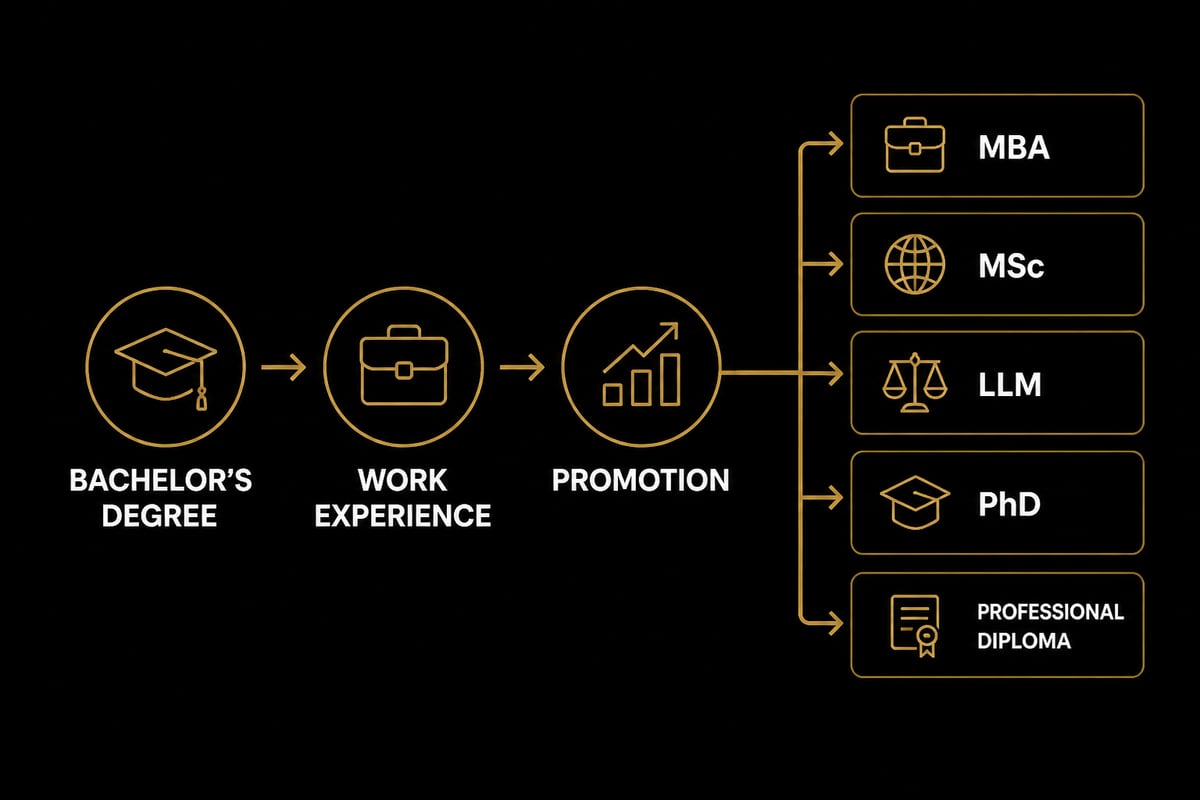
- Progression: A first degree opens the route to an MBA, MSc, LLM or doctorate.
- Transferable skills: Analysis, writing, research and structured problem solving carry across industries.
- Credibility: A recognised qualification signals competence to employers, clients and congregations.
From Undergraduate Degree to Postgraduate Study
Moving from an undergraduate degree to postgraduate study is the usual route to senior management and specialist roles, and it is designed to be possible alongside full-time work. Most postgraduate business programmes ask for a bachelor's degree plus professional experience, and the admission standard for each programme is set by the institution, so confirm it directly.
Many professionals reach this point after several years in employment. They hold a first degree, they have been promoted into management, and they now need formal training in strategy, finance or leadership. That is the situation the University of Gold Coast serves.
The University of Gold Coast offers PhD, MBA, MSc, LLM and professional diploma programmes across business, law and theology. Its postgraduate classes are designed to suit working professionals, and flexible payment plans are available. Degrees are awarded by the University of Gold Coast and accredited by the Ghana Tertiary Education Commission, and the university holds the Presidential Charter granted by the Government of Ghana.
To see how the postgraduate level differs in practice, read the guide to graduate-level education, or explore the postgraduate degree options and the postgraduate brochure. Teaching comes from faculty who bring real industry experience into the classroom, within a Christ-centred learning environment that pairs academic standards with ethical leadership.
How to Check Your Undergraduate Qualification Before Applying Further
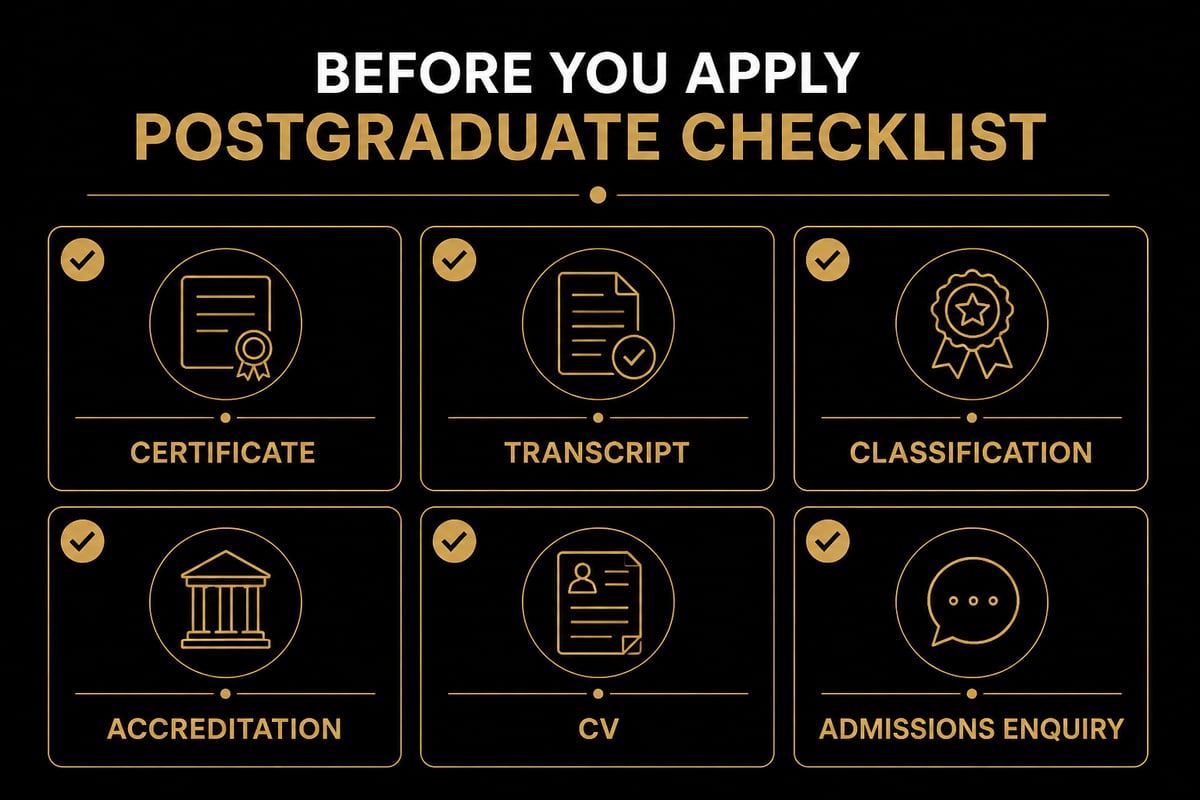
Before applying for postgraduate study, confirm that your undergraduate qualification is recognised, complete and documented. This short check prevents delays at the admissions stage.
- Locate your certificate and transcript. Admissions teams normally ask for both.
- Confirm your classification. Note whether your degree was awarded with honours, and at what class.
- Check accreditation. Your awarding institution should be accredited by the relevant national body, such as the Ghana Tertiary Education Commission for Ghanaian degrees.
- Note your field. Some programmes expect a related discipline, though many MBA programmes accept graduates from any field.
- Prepare your work history. A current CV showing management responsibility strengthens an application.
- Contact the admissions office. Ask which documents and entry conditions apply to your chosen programme.
Applicants who need to sharpen academic writing before returning to study may find support services useful. For students who want help structuring essays or research reports, Essay Service HK offers academic support covering essays, reports and final-year projects.
FAQ
What is the difference between a graduate and a non-graduate?
A graduate is someone who has completed and been awarded a degree, usually at bachelor's level or above. A non-graduate has not earned a degree, though they may hold a certificate, diploma or professional qualification. The distinction is often used in employment statistics and job advertisements.
What are the benefits of a degree?
A degree widens access to professional roles, supports progression to postgraduate study and builds skills in research, analysis and communication. In England, the Department for Education reports higher employment and pay for graduates than for non-graduates, though the figures do not control for prior attainment.
Can I study for a master's degree while working?
Yes, many institutions design postgraduate programmes for employed students. The University of Gold Coast offers classes suited to working professionals and flexible payment plans, so students can continue working. For entry requirements and fees, check the programme pages or contact the admissions office.
Start by gathering your bachelor's certificate, transcript and an updated CV, since these documents form the core of any postgraduate application. If you are ready to move from a first degree to an MBA, MSc or LLM without leaving your job, the University of Gold Coast offers accredited programmes taught one weekend a month, and you can apply now to begin your admission.