
Inexpensive masters programs are generally public university degrees, online or part-time courses, and one-year formats that keep tuition, living costs and lost income low. For a working manager in Ghana, the cheapest route is rarely the one with the lowest sticker price. It is the one that lets you keep your salary, spread payments over time and finish in a reasonable number of months.
This guide explains what graduate study typically costs, which program types reduce the total bill, and how to judge whether a lower price is actually good value. It also covers funding options and the questions to ask before you commit.
What Do Inexpensive Masters Programs Actually Cost?
Most affordable masters programs in the United States cost between roughly $12,000 and $21,000 in tuition and fees, depending on whether the institution is public or private and whether you are a resident. The National Center for Education Statistics reports 2023-24 average graduate tuition and required fees of $11,827 for in-state public institutions, $21,351 for out-of-state public institutions, and $20,856 for private nonprofit institutions.
Those figures are averages, and individual programs vary widely. A business degree at a flagship university can cost several times what a regional school charges for a similar credential.
Published prices also keep climbing. The College Board reports that average in-state tuition and fees at public four-year institutions rose by about $340 from $11,610 in 2024-25 to $11,950 in 2025-26. Across states, that average ranges from $6,360 to $18,090, so location alone can change the bill substantially.
For readers in Accra, these numbers matter in two ways. They show the benchmark that international programs charge, and they highlight why a locally accredited degree delivered part-time can be the more practical choice once travel, visas and relocation are counted.
Which Costs Make a Masters Degree Expensive?
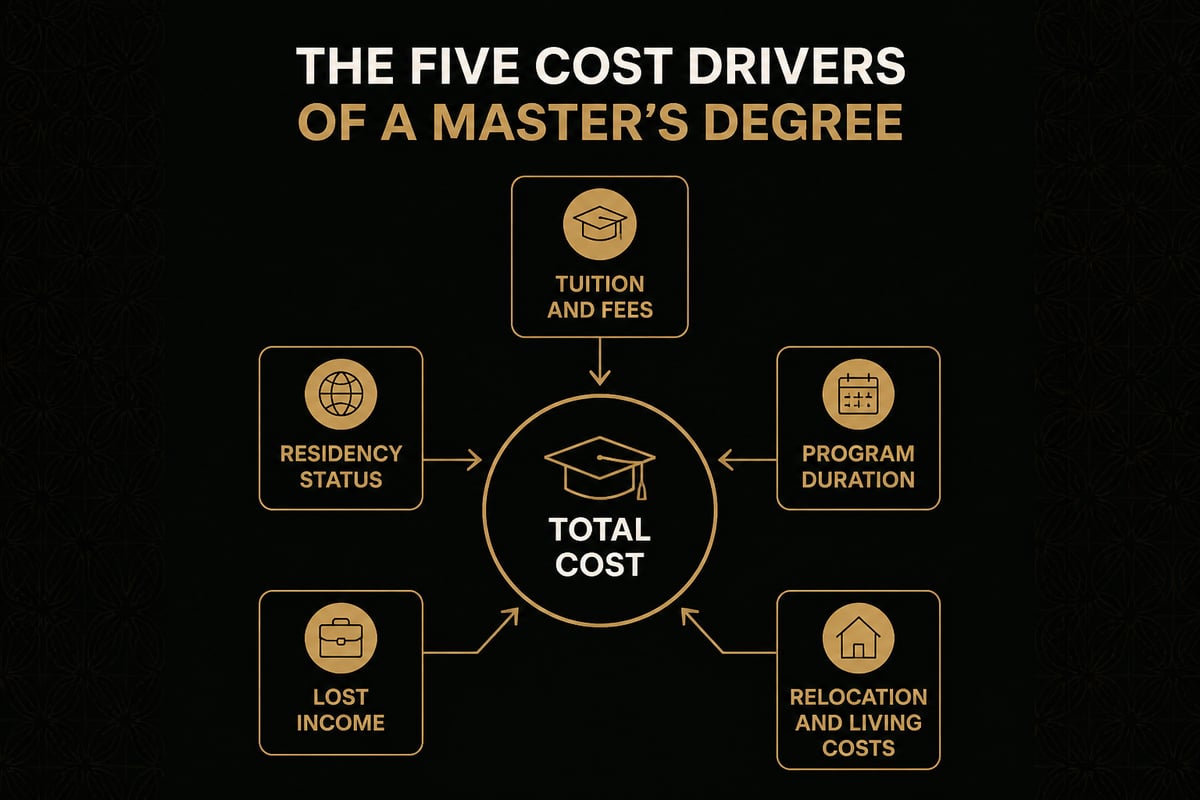
Tuition is only one of five cost drivers, and the others often decide whether a program is truly inexpensive. Before comparing prices, list each of these for every program you consider:
- Tuition and mandatory fees: the published price, which may be per credit or per year.
- Residency status: out-of-state or international rates can nearly double the cost at public universities.
- Duration: a 12-month degree has fewer months of fees and more months of earning than a 24-month one.
- Lost income: leaving a job for full-time study is frequently the largest expense of all.
- Relocation and living costs: housing, travel, visas and health cover when studying abroad.
This is why many professionals find that a full-time overseas degree with a modest tuition figure ends up costing more than a mid-priced program they can complete while employed.
Which Types of Programs Keep the Total Price Low?
Four program types consistently lower the total cost: public university degrees, online delivery, part-time or modular schedules, and one-year formats. Each one reduces a different cost driver, and some can be combined.
Public and regional universities
Public institutions subsidize tuition, so their posted rates sit well below private nonprofit averages for residents. Regional campuses often charge less than flagship research universities for comparable coursework. For international students, the discount shrinks because non-resident rates apply.
Online and distance programs
Online study removes relocation and commuting costs, and some schools charge one flat rate regardless of where you live. If price is your main filter, our overview of the most affordable online graduate programs explains how to compare them fairly. You can also read about the cheapest masters degrees online for a wider list of formats.
Part-time and weekend schedules
Part-time study stretches payments across a longer period and lets you stay employed. A schedule built around one weekend a month suits managers who cannot take weekday leave.
One-year formats
Shorter programs cut the number of billing periods. A one-year masters program is worth it when the credential is a clear requirement for promotion or a career change, since you return to full earning power sooner.
Are Inexpensive Masters Programs Worth the Investment?
An inexpensive masters program is worth it when the credential is recognized by employers and regulators, and when the total cost is small relative to the salary gain or promotion it supports. A low price alone does not make a degree a good purchase.
Use three tests before you enroll:
- Accreditation: confirm the awarding institution and the national accreditor. In Ghana, programs should be accredited by the Ghana Tertiary Education Commission (GTEC).
- Employer recognition: ask your HR department or a hiring manager whether the credential counts toward grading, promotion or professional membership.
- Payback period: divide the total cost by the realistic annual pay increase. A payback under three to four years is a reasonable benchmark for many managers.
The same logic applies to the question of a one-year degree. A 12-month master's is worth it when your industry values the credential rather than the length of study, and when the curriculum is not diluted to fit the calendar.
Is $30,000 a Lot for a Master's Degree?
Yes, $30,000 is above the typical tuition for a public master's program, but it is not unusual for private or business-focused degrees. Compared with the roughly $12,000 to $21,000 averages cited earlier, it sits at the higher end. Whether it is too much depends on your expected income gain and on how much of it you would borrow.
If a program costs that much, ask what the price includes. Check whether it covers learning materials, library access, examinations and any professional certificate fees. Then ask whether a lower-priced, accredited option teaches the same competencies. Often it does.
How Can Working Professionals in Ghana Study Without Leaving Their Jobs?
Working professionals in Ghana can often study without leaving their jobs by choosing a program built around a modular or weekend schedule, which preserves income and avoids relocation. This is the single biggest saving available to most managers, because it removes the lost-salary cost entirely.
Several formats fit this need:
- Weekend programs: one block of classes per month, with independent study between sessions.
- Online programs: flexible, but they require discipline and reliable connectivity.
- Blended programs: a mix of occasional campus contact and distance learning.
The University Of Gold Coast runs classes one full weekend a month, so students can continue working while they study. Its degrees are awarded by the university and accredited by GTEC, and the university holds the Presidential Charter granted by the Government of Ghana. Faculty bring real-world industry experience into the classroom, which is useful for managers who want to apply lessons at work the following Monday. Flexible payment plans allow students to pay as they go. For current fees and plan terms, check the university's course pages or contact its admissions team directly.
For finance professionals, the MBA in Finance is a 12-month program leading to an MBA degree, a CMI Level 7 Certificate and Chartered Manager Status.

How Can You Pay Less for a Masters Degree?
You can pay less by combining employer support, scholarships, assistantships and a payment plan, rather than relying on a single source. Each lowers a different part of the bill.
Employer sponsorship
Some organizations in Ghana may fund part of a postgraduate qualification if you can show how it serves the business. Prepare a short proposal with the cost, the skills gained and a retention commitment. Employers often agree faster when the program does not require you to be absent from work.
Scholarships, fellowships and assistantships
Graduate funding in the United States often comes through teaching or research roles. The Federal Student Aid graduate school checklist covers application preparation, FAFSA timing and scholarship, fellowship and assistantship opportunities. These rules apply to U.S. residents and eligible borrowers, so international students should confirm eligibility separately.
Loans, used carefully
Graduate students receive substantial financial aid, and according to the College Board, federal loans make up a larger share of that aid than grants. The balance matters. Federal rules are also changing, and a summary of the 2025 federal student aid changes describes new graduate borrowing limits and transition rules.
Borrowing is a cost that grows with time, so treat it as the last resort after grants, employer funding and payment plans.
Pay-as-you-go plans
A payment plan spreads tuition across the study period and avoids a large upfront sum. This is often the most accessible option for professionals who earn a steady salary but have limited savings.

Is 25 Too Old to Start a Masters?
No, 25 is not too old to start a master's degree, and it is well within the normal range. Graduate students begin at many different ages, including in their late twenties, thirties and beyond, especially in business programs where work experience is valued. Admissions committees for management degrees often prefer applicants who have several years of professional practice.
If you are weighing the timing of your own application, our guide to doing a masters degree walks through the decision, and the page on requirements for a masters lists what most programs ask for.
How Do You Compare Inexpensive Masters Programs Fairly?
Compare inexpensive masters programs on total cost, accreditation and fit with your schedule, not on tuition alone. A simple side-by-side table keeps the decision objective.
| Factor | What to check |
|---|---|
| Total tuition and fees | Per-credit or flat rate, plus any extra charges |
| Duration | Months to completion and the maximum time allowed |
| Schedule | Weekday, weekend, online or blended |
| Accreditation | Awarding body and national accreditor |
| Payment terms | Upfront, installments or pay-as-you-go |
| Support services | Online library, student portal, advising |
| Recognition | Employer and professional body acceptance |
Fill in the table for three or four programs and the strongest option usually becomes clear. If one program is much cheaper than the rest, look closely at what has been left out of its price.
Warning Signs in Low-Cost Programs
A very low price should prompt closer scrutiny, because some programs reduce cost by reducing quality or recognition. Watch for these signals:
- No clear statement of the awarding institution or accrediting body.
- Pressure to enroll quickly or pay in full before you have seen the curriculum.
- Vague or missing information about faculty qualifications.
- No access to a library, student portal or academic support.
- Promises of guaranteed outcomes such as a specific job or salary.
Verify accreditation directly with the regulator. In Ghana, GTEC is the body to check for accreditation, and any credible university will welcome the question.
FAQ
Who has the cheapest online master's program?
There is no single answer, because prices change each year and depend on residency, credit load and program length. Public universities with flat online rates are often the lowest in the United States, while accredited local programs may be cheaper overall for Ghanaian professionals once currency and travel are considered. Compare total cost, not the headline fee.
Do I need a bachelor's degree to start a master's?
Most programs require a bachelor's degree, though some institutions consider professional experience in its place. Policies vary, so confirm with the admissions office.
Can I get a masters online from the UK without moving?
Yes, several UK institutions offer fully online degrees, though fees are often higher than local options. Review the details in our guide to a UK online masters degree before comparing them with a local weekend program.
Your next step is to shortlist three accredited programs, fill in the comparison table above and request a written fee schedule from each. If you want a degree that fits around a full-time job, the University Of Gold Coast offers monthly weekend classes, flexible payment plans and programs accredited by GTEC, including the MBA in Finance. Review the course options and Apply Now to start your postgraduate qualification without leaving your career.