
Finding the cheapest masters degree online requires careful research and strategic planning. With graduate education costs continuing to rise, prospective students need to balance affordability with academic quality, accreditation standards, and career outcomes. In 2026, numerous institutions offer competitively priced online master's programs across business, law, theology, technology, and other fields, making advanced education more accessible than ever. Understanding the full cost picture, including tuition per credit, fees, required credits, and available financial aid, empowers you to make an informed investment in your professional future.
Understanding the True Cost of Online Master's Degrees
When evaluating the cheapest masters degree online, looking beyond advertised tuition rates is essential. The total program cost includes multiple components that significantly impact your final investment.
Per-credit tuition forms the foundation of most pricing structures, typically ranging from $250 to $800 per credit hour at affordable institutions. A standard master's degree requires 30 to 36 credits, translating to total tuition between $7,500 and $28,800 before any additional expenses.
Hidden Costs to Consider
Beyond base tuition, several factors affect the true price:
- Technology and platform fees (typically $50-$200 per semester)
- Library access and digital resource fees ($25-$100 per term)
- Application and enrollment fees ($50-$150 one-time)
- Textbooks and course materials ($500-$1,500 total program)
- Graduation and certification fees ($100-$300)
Many students overlook these ancillary costs when comparing programs. According to the Trends in College Pricing and Student Aid 2024 report, understanding the net price after aid proves more valuable than focusing solely on sticker prices.

| Cost Category | Budget Programs | Mid-Range Programs | Premium Programs |
|---|---|---|---|
| Per-credit tuition | $250-$400 | $400-$600 | $600-$1,200 |
| Total tuition (36 credits) | $9,000-$14,400 | $14,400-$21,600 | $21,600-$43,200 |
| Fees & materials | $1,000-$2,000 | $1,500-$3,000 | $2,500-$5,000 |
| Total program cost | $10,000-$16,400 | $15,900-$24,600 | $24,100-$48,200 |
Most Affordable Online Master's Programs by Field
Different disciplines offer varying price points for the cheapest masters degree online options. Program costs often reflect market demand, required resources, and institutional priorities.
Business and Management Programs
MBA and business-focused master's degrees represent some of the most competitively priced online programs. State universities frequently offer online MBA programs ranging from $10,000 to $25,000 total cost.
Top affordable options include:
- Online MBA programs at regional public universities ($12,000-$22,000)
- Master of Science in Management degrees ($10,000-$18,000)
- Specialized business master's in finance, marketing, or operations ($11,000-$20,000)
- Master of Professional Studies in business administration ($9,500-$17,000)
Many institutions now offer accelerated pathways through platforms like edX MicroMasters, allowing students to complete graduate-level coursework at reduced costs before enrolling in full degree programs.
Education and Teaching Degrees
Master's programs in education typically rank among the most affordable online options, with many state universities offering reduced rates for in-state residents and educators.
Education-focused programs often cost between $8,000 and $20,000 for the complete degree. These include Master of Education (M.Ed.), curriculum and instruction specializations, and educational leadership degrees.
Technology and Computer Science
Despite high demand, many institutions recognize the need for accessible technology education. Online master's degrees in computer science, data science, and information technology range from $15,000 to $30,000 at affordable institutions, though some programs exceed $40,000.
Theology and Divinity Studies
Religious institutions frequently subsidize their master's programs, offering some of the lowest-cost options available. Master of Divinity (M.Div.) and theology-focused degrees often cost between $7,000 and $18,000, with many programs designed for working ministry professionals.

Accreditation and Quality Considerations
Finding the cheapest masters degree online should never mean sacrificing educational quality or credential recognition. Accreditation serves as the critical indicator of academic standards and employer acceptance.
Regional vs. National Accreditation
Regional accreditation from bodies like the Higher Learning Commission or Middle States Commission represents the gold standard for traditional universities. Degrees from regionally accredited institutions transfer more readily and receive broader employer recognition.
National accreditation through organizations like the Distance Education Accrediting Commission may suit specific vocational or distance-learning focused programs. Understanding these distinctions helps you evaluate whether a low-cost program meets your professional needs.
Programmatic Accreditation
Specialized accreditation adds value in certain fields:
- AACSB for business programs
- ABA for law-related degrees
- ABET for technology and engineering programs
- ATS for theological studies
Programs holding both regional and specialized accreditation typically command higher tuition but deliver stronger career outcomes. The FREOPP whitepaper analyzing ROI for graduate degrees demonstrates that program quality and field selection significantly impact earnings potential more than institutional prestige alone.
Financial Aid and Funding Strategies
Even the cheapest masters degree online requires strategic financing. Multiple funding sources can reduce your out-of-pocket costs substantially.
Federal Student Aid
Graduate students qualify for federal Direct Unsubsidized Loans up to $20,500 annually. The Federal Student Aid resources provide comprehensive information about eligibility, application processes, and repayment options. Unlike undergraduate aid, graduate students do not qualify for Pell Grants, making loans and scholarships crucial.
Employer Tuition Assistance
Many employers offer educational benefits covering $2,000 to $5,250 annually (the IRS tax-free limit). Some organizations provide unlimited tuition reimbursement for job-related degrees.
Steps to maximize employer benefits:
- Review your employee handbook for education policies
- Discuss career development plans with your supervisor
- Apply formally through HR channels before enrollment
- Maintain required grade minimums (typically 3.0 GPA)
- Complete service commitment agreements when required
Institutional Scholarships and Assistantships
Online programs increasingly offer merit-based scholarships, alumni discounts, and military benefits. Some institutions provide graduate assistantships for virtual roles in research, teaching support, or administrative functions.
| Funding Source | Typical Annual Amount | Repayment Required | Application Timing |
|---|---|---|---|
| Federal Direct Loans | $20,500 | Yes, after graduation | Before semester start |
| Employer tuition aid | $2,000-$5,250 | Sometimes (service commitment) | Per company policy |
| Institutional scholarships | $1,000-$10,000 | No | With application or by deadline |
| Graduate assistantships | $5,000-$15,000 + tuition waiver | No | Early, competitive |
Comparing Cost vs. Career Return
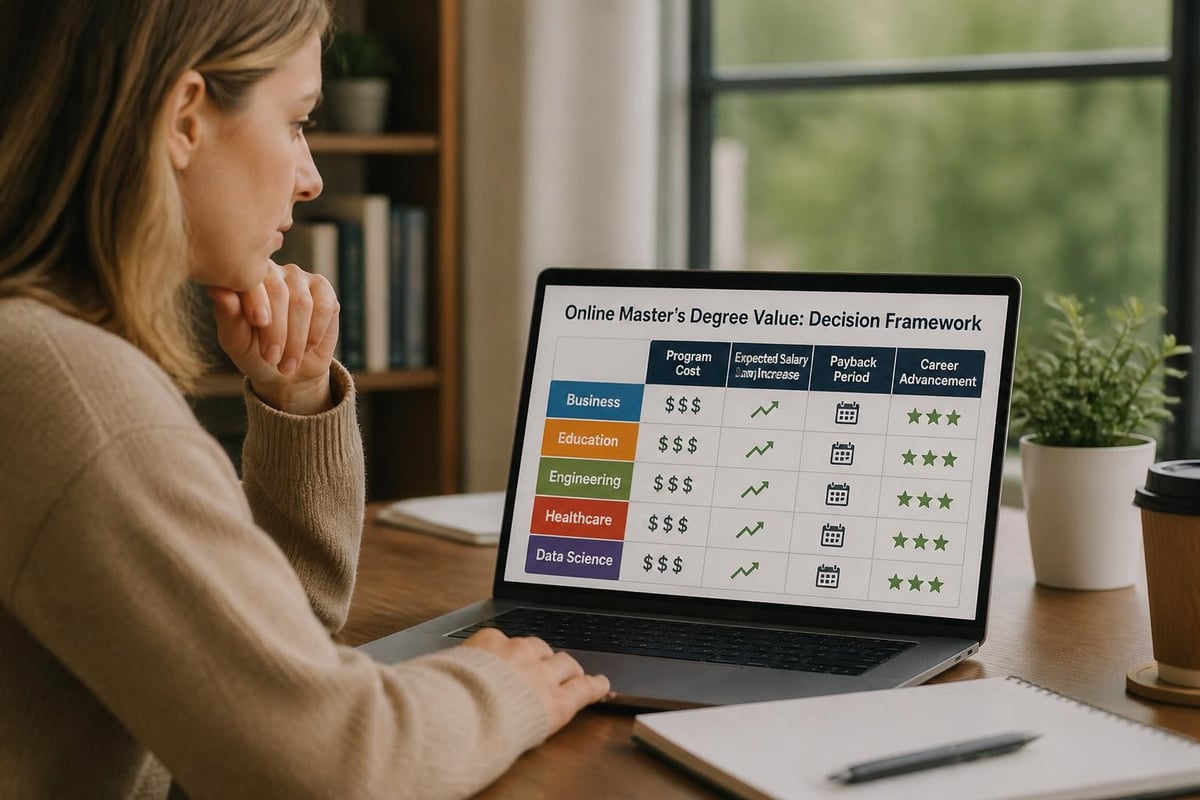
The cheapest masters degree online only delivers value when it advances your career goals. Research from Brookings confirms that graduate degree returns vary significantly by field, with some programs offering minimal salary increases while others deliver substantial earnings growth.
High-ROI Affordable Programs
Certain fields consistently demonstrate strong returns even at lower program costs:
Computer science and data analytics degrees costing $15,000-$25,000 typically generate salary increases of $20,000-$40,000 annually, achieving payback in under two years.
Healthcare administration master's programs in the $12,000-$22,000 range often lead to management roles with $15,000-$30,000 salary jumps.
Business analytics and finance degrees priced at $14,000-$26,000 frequently result in career advancement and compensation growth of $18,000-$35,000.
Calculating Your Personal ROI
Before committing to any program, calculate expected returns:
- Research average salaries in your target role
- Subtract your current compensation to find potential increase
- Divide total program cost by annual salary increase for payback period
- Consider non-monetary benefits like career satisfaction and advancement opportunities
A program costing $15,000 that increases earnings by $10,000 annually has a 1.5-year payback period, representing excellent value regardless of whether it's the absolute cheapest option available.
Selecting the Right Affordable Program
Identifying the cheapest masters degree online that meets your specific needs requires systematic evaluation across multiple dimensions.
Program Format and Flexibility
Synchronous programs require attendance at scheduled times, offering more structure and interaction. Asynchronous programs allow complete schedule flexibility, ideal for working professionals across time zones.
Accelerated options (12-18 months) reduce total costs by minimizing fee periods, though they require intense commitment. Extended programs (3-4 years) spread costs over time, making budgeting easier but potentially increasing total expenses.
Faculty Credentials and Support
Quality instruction matters regardless of price point. Evaluate:
- Faculty educational backgrounds and professional experience
- Student-to-faculty ratios in online courses
- Availability of academic advising and career services
- Access to online resources, libraries, and learning platforms
Many affordable institutions provide the same faculty teaching on-campus programs, ensuring comparable educational quality at reduced costs due to lower overhead.
Technology and Learning Platform
The online learning experience depends heavily on platform quality. Modern learning management systems should offer:
- Mobile compatibility for studying anywhere
- Integrated video conferencing for live sessions
- Discussion forums fostering peer collaboration
- Digital library access and research databases
- 24/7 technical support services
Institutions like the University of Gold Coast invest in comprehensive digital resources and student portals, ensuring that online learners receive full academic support regardless of program cost.
State Universities and Public Institutions
Public universities consistently offer the cheapest masters degree online options, particularly for in-state residents. State funding allows these institutions to maintain lower tuition while upholding rigorous academic standards.
In-State vs. Out-of-State Pricing
Residency status dramatically affects costs:
- In-state tuition: $250-$450 per credit ($9,000-$16,200 for 36 credits)
- Out-of-state tuition: $450-$750 per credit ($16,200-$27,000 for 36 credits)
Some states now offer regional tuition agreements or online-specific rates that reduce out-of-state premiums. Establishing residency before enrollment can generate savings of $5,000-$15,000 over a complete program.
Establishing Residency for Tuition Purposes
Requirements vary by state but typically include:
- Physical presence in the state for 12 consecutive months
- Proof of intent to remain (lease, employment, driver's license)
- Financial independence from out-of-state parents (for younger students)
- Voter registration and vehicle registration in-state
Planning residency establishment before graduate school enrollment represents a strategic cost-reduction approach for motivated students.
International and Alternative Credentials
The online education landscape extends beyond traditional U.S. institutions, offering additional affordable pathways to graduate credentials.
International Programs
Universities in countries with lower operating costs sometimes offer English-language master's degrees at prices below $10,000. While these programs can represent genuine value, verify:
- Recognition by U.S. employers in your field
- Credential evaluation services accepting the degree
- Language of instruction and support services
- Time zone compatibility for any live components
Professional Certificates and Stackable Credentials
Alternative pathways provide cost-effective skill development:
Graduate certificates (12-18 credits) cost $3,000-$9,000 and often stack toward full master's degrees. These allow career advancement while minimizing financial risk.
Professional diplomas offer specialized training at $4,000-$12,000, sometimes providing direct pathways into degree programs with transfer credit.
The landscape of post-university credentials continues evolving, with more institutions recognizing prior learning and professional certifications for graduate credit.
Application Strategies for Cost Savings
Beyond selecting affordable programs, strategic application approaches reduce total investment in your cheapest masters degree online.
Application Fee Waivers
Many institutions waive $50-$150 application fees for:
- Alumni of the same institution
- Military service members and veterans
- Members of professional organizations
- Applicants meeting specific diversity criteria
- Early applicants or those attending virtual information sessions
Accelerating Time-to-Degree
Faster completion directly reduces costs:
Transfer credit policies may accept up to 6-12 credits from previous graduate coursework, saving $1,500-$4,800.
Prior learning assessment converts professional experience into academic credit at some institutions, potentially reducing required coursework.
Course load optimization balances full-time enrollment (qualifying for certain aid) with work commitments, minimizing program extension.
Timing Enrollment Strategically
Starting during summer terms or mid-year cohorts sometimes offers:
- Reduced tuition rates during slower enrollment periods
- Scholarship opportunities with less competition
- Faster progression to graduation by avoiding summer breaks
Program Completion and Success Factors
The cheapest masters degree online only delivers value when you complete it successfully. Online graduate programs report completion rates of 55-75%, lower than on-campus equivalents, making student success strategies essential.
Time Management and Discipline
Online learning demands self-motivation and organization:
- Dedicate 15-20 hours weekly per course for reading, assignments, and participation
- Establish consistent study schedules matching your energy patterns
- Create designated workspace free from distractions
- Use project management tools to track deadlines across multiple courses
Building Virtual Community
Despite physical separation, successful online students develop peer networks:
- Actively participate in discussion forums
- Form virtual study groups through video conferencing
- Attend optional synchronous sessions when offered
- Connect via LinkedIn with classmates in your field
Strong peer relationships improve learning outcomes, increase accountability, and build professional networks that enhance career value beyond the degree itself.
Leveraging Support Resources
Take full advantage of included services:
- Academic advising for course selection and degree planning
- Writing centers providing feedback on papers and projects
- Career services offering resume review and job search support
- Technical support resolving platform and access issues
- Library services including research consultations and resource tutorials
These support systems, already included in your tuition, maximize learning quality and degree completion likelihood.
Pursuing the cheapest masters degree online in 2026 requires balancing cost, quality, accreditation, and career outcomes. By understanding total program costs, exploring financial aid options, and selecting programs aligned with your professional goals, you can invest strategically in graduate education that delivers measurable returns. The University Of Gold Coast offers accessible master's programs across business, law, theology, and other disciplines, combining academic excellence with comprehensive student support through online libraries and dedicated portals. Explore our program options today to advance your career with a credential that fits your budget and professional aspirations.