
An international business university is an institution that prepares students to work across borders, through curricula in global trade, cross-cultural management, finance, marketing and law, often with a student body and faculty drawn from several countries. For working professionals in Ghana, the best fit is usually a postgraduate programme that teaches these skills while allowing you to keep your job.
The demand for this kind of training is easy to explain. In an ACCA survey, 28% of respondents expected their organizations' global trade to increase significantly over the next three to five years, and another 28% expected it to increase somewhat. Managers who understand international markets, contracts and regulation are positioned to lead that growth. This guide explains what to look for, how to compare options, and how to study without stepping away from your career.
What Is an International University?
An international university is a degree-awarding institution that draws students and faculty from many countries, teaches with a global outlook, and issues qualifications recognized beyond its home market. The label does not describe a single legal category. It describes a pattern: diverse cohorts, curricula that address cross-border issues, and credentials that employers abroad can verify.
Higher education has grown rapidly. UNESCO reports that global enrollment reached 269 million in 2024, more than doubling over two decades. Nearly 7.3 million students studied abroad in 2023, up from 2.1 million in 2000. Even so, internationally mobile students account for only about 3% of the global higher-education cohort. In other words, most students never relocate, and many institutions now bring an international education to learners where they live.
That matters if you are employed in Accra or elsewhere in Ghana. An international outlook does not require a flight, a visa or a career break. It requires a programme whose content, faculty and accreditation meet global standards.
What Does an International Business University Teach?
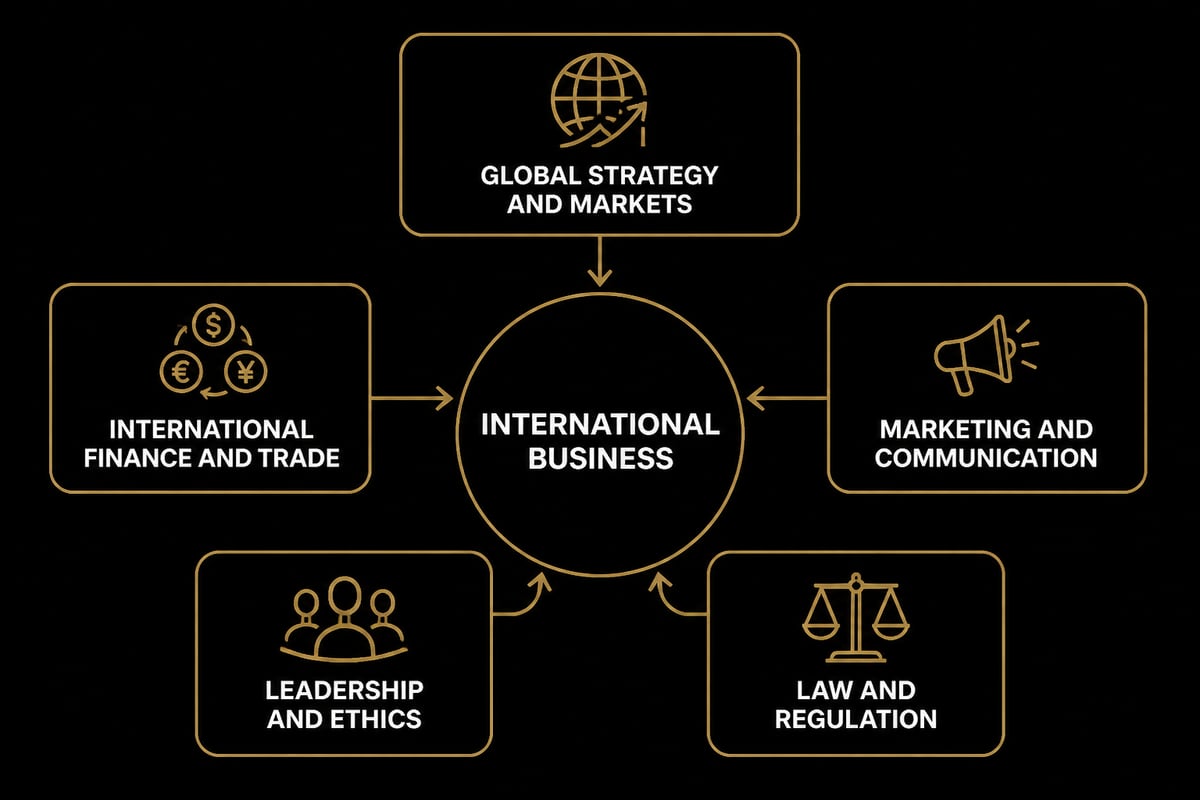
An international business university teaches the skills needed to manage organizations that operate, sell or source across borders. Programme titles vary, but the core subject areas are consistent.
- Global strategy and markets: entry modes, competitive positioning and risk assessment in emerging and developed economies.
- International finance and trade: currency exposure, trade finance, tariffs and supply chain economics.
- Marketing and communication: brand building across cultures, digital channels and stakeholder messaging.
- Leadership and ethics: managing multicultural teams, governance and responsible decision-making.
- Law and regulation: contracts, compliance, dispute resolution and the legal frameworks that govern trade.
The last item is often underweighted in business degrees, yet it shapes real outcomes. A manager who negotiates a cross-border supply agreement without understanding jurisdiction, arbitration or sanctions exposure takes on risk that no spreadsheet reveals. Programmes that pair business content with international law and diplomacy give graduates a broader toolkit for roles in trade bodies, regulators, multinationals and public institutions.
What Is the Best School for International Business?
The best school for international business is the one whose accreditation, curriculum, faculty and schedule match your career goals and your life circumstances. Global rankings tend to reward research output and campus reputation, which are useful signals but poor predictors of whether a programme will work for a manager with a full-time job and family commitments.
A practical comparison rests on six criteria:
- Accreditation and legal standing. Confirm that the institution is recognized by the national regulator and that each programme is accredited.
- Curriculum relevance. Check whether modules cover trade, finance, marketing, law and leadership, and whether they reflect African and emerging-market realities.
- Faculty experience. Instructors who have worked in industry bring live cases and contacts into the classroom.
- Delivery format. Look for weekend, evening or blended formats that fit around work.
- Total cost and payment terms. Tuition matters, but so does the ability to spread it over time.
- Credential value. Some programmes add professional recognition, such as a chartered management designation, on top of the degree.
Rankings are best used as one input among these. If you are weighing cost and mobility as well, the University of Gold Coast has published guidance on choosing a university as an international student and on affordable universities for international students.
Which University in the USA Is the Cheapest for International Students?
There is no single cheapest option, because the total cost of a US degree depends on the state, the programme, the living costs and the visa requirements, and these change from year to year. Public universities generally charge international students less than private ones, but tuition is only part of the bill. Housing, health insurance, travel and the income you give up while studying abroad often exceed the fees themselves.
For a manager already earning a salary in Ghana, this last point is decisive. A full-time degree overseas can mean one or two years without income, which is a far larger expense than tuition. A part-time programme delivered in Ghana removes relocation costs altogether and keeps your earnings and seniority intact. Before comparing foreign tuition tables, calculate the full cost of leaving your job, then compare it with the cost of a local weekend programme.
How Can Working Professionals Study at an International Business University in Ghana?
Working professionals can study for a postgraduate business qualification in Ghana by choosing a programme built around a modular, weekend-based schedule rather than daily attendance. This format is designed for people who cannot take leave for long periods.
The University of Gold Coast runs its programmes around monthly weekend sessions, which lets students study without leaving their jobs. Flexible payment plans let students pay as they go, which spreads the financial commitment across the programme instead of concentrating it at enrollment. Faculty bring real-world industry experience into the classroom, so lessons can be applied at work.
For professionals whose goal is marketing leadership, the MBA in Marketing & Communication is a 12-month programme that carries a CMI Level 7 Certificate and Chartered Manager Status. That combination gives graduates both an academic degree and a recognized management credential, which is valuable when applying for senior roles at multinational employers.
A realistic study plan for a working manager includes:
- Blocking the programme weekends in your calendar at the start of the year.
- Telling your employer early, since many organizations support relevant postgraduate study.
- Using the online library and student portal for reading between sessions.
- Applying each module to a live work problem so the learning has immediate value.
The university provides online libraries and student portals to support academic and professional development.
Postgraduate Options: MBA, MSc and Executive Certificates
The main postgraduate routes into international business are the MBA, specialist MScs and shorter executive certificates, and each suits a different stage of career.
| Qualification | Best suited to | Typical focus |
|---|---|---|
| MBA | Managers moving into senior leadership | General management, strategy, finance, leadership |
| MSc in Communication and International Marketing | Marketing and communications professionals | Cross-cultural branding, global campaigns |
| MSc in International Relations | Policy, public-sector and development practitioners | Global politics, institutions, foreign policy |
| Executive Certificate in Business Administration | Professionals who want structured business grounding first | Core business functions in a shorter format |
The University of Gold Coast offers programmes in each of these areas, including a 12-month MSc in Communication and International Marketing, a 12-month MSc in International Relations and an Executive Certificate in Business Administration. Entry requirements, fees and durations for each course are listed on the individual programme pages, so check those before you plan your budget.
An MBA suits you if you already manage people or budgets and want a broader strategic foundation. An MSc suits you if your career depends on depth in one discipline. A certificate suits you if you want to test postgraduate study before committing to a full degree.
International Law, Diplomacy and Security as a Business Pathway
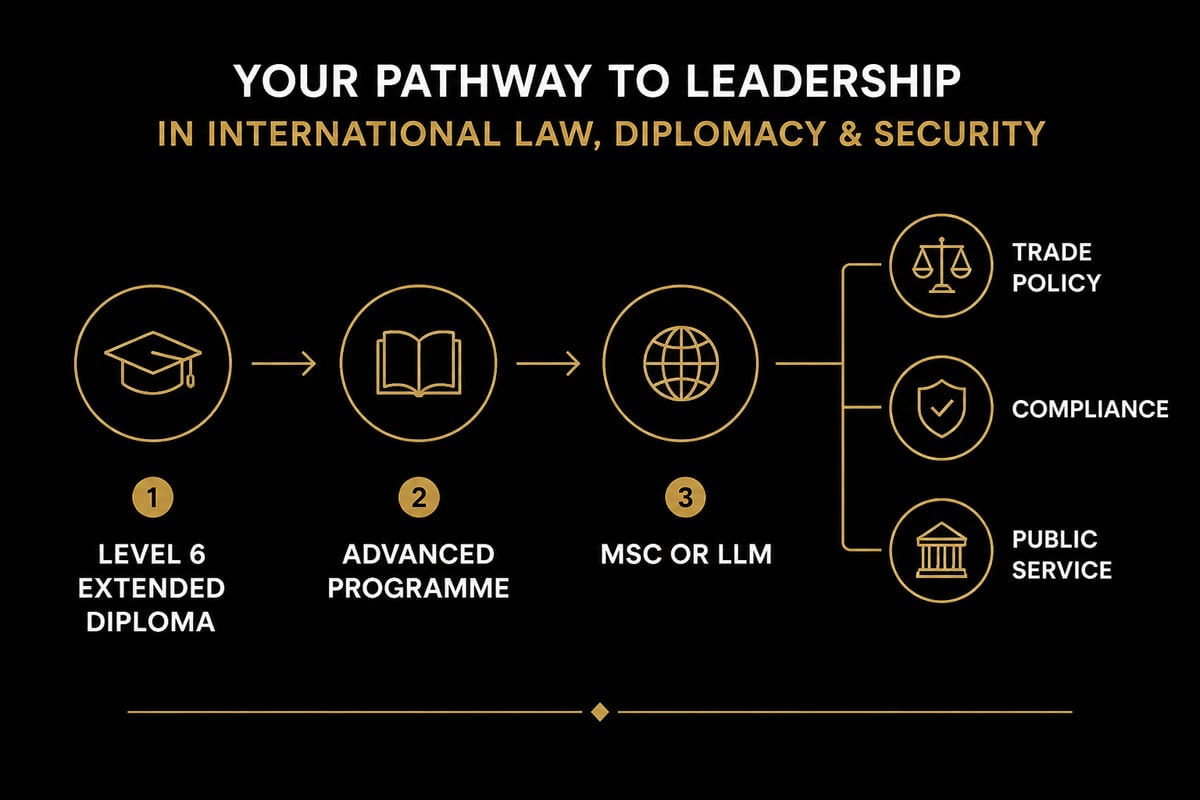
International law, diplomacy and security form a postgraduate pathway that complements business study and opens roles in trade policy, compliance, regulation and public service. Anyone drawn to legal specialisation, treaty work or policy design should consider it alongside a conventional MBA.
Cross-border commerce depends on rules: investment protections, customs regimes, dispute resolution mechanisms and security arrangements that keep trade routes open. People who can interpret these rules are in demand at ministries, regional bodies, law firms and corporations. They also bring an African perspective to debates that have long been shaped elsewhere, which is increasingly valued as the continent's trade integration deepens.
The University of Gold Coast lays out a graded route in this field:
- A Level 6 Extended Diploma in International Law, Diplomacy and Security for those building foundations.
- An Advanced Programme in International Law, Diplomacy and Security for professionals who want focused postgraduate-level study.
- An MSc in International Law, Security and Diplomacy and an LLM in International Law, Security and Diplomacy for those who want a full master's qualification.
What Is the Easiest Business School to Get Into?
No reputable business school is "easy" to enter in a way that helps you, and the more useful question is which programme admits applicants whose experience matches its design. Selective admission is a quality signal. A programme that accepts anyone, regardless of background, rarely produces a cohort that learns much from one another.
For mid-career applicants, admission is typically judged on prior qualifications, work experience and motivation rather than on entrance exam scores alone. Prepare a current CV, certified copies of your degree and a clear statement of why you want the qualification and how you will apply it. If you are applying to universities abroad as well, an admissions consulting service such as Unive offers personalized application strategy, essay support and scholarship matching.
For programmes at the University of Gold Coast, review the admissions process and use the application form when you are ready. Contact the admissions team directly for current entry requirements.
Accreditation, Recognition and Ethical Leadership
Accreditation is the single most important check before you enroll, because it determines whether your degree will be recognized by employers, professional bodies and further-study institutions. A qualification from an unaccredited provider can cost years of effort and deliver no usable credential.
The University of Gold Coast holds the Presidential Charter, granted by the Government of Ghana. All of its academic programmes are accredited by the Ghana Tertiary Education Commission (GTEC).
The learning environment also emphasises ethical leadership alongside academic excellence. For students who want their postgraduate study to reflect their values, and who see integrity as a business asset in markets where trust shapes every transaction, that framing is a deliberate part of the programme rather than an add-on. Readers who want to know who guides the institution can review its leadership team and its international advisory board.
For wider context on how student access and mobility are changing worldwide, UNESCO IESALC publishes a summary of higher-education trends that is useful background for anyone planning a long-term education strategy.
Building a Plan Before You Apply
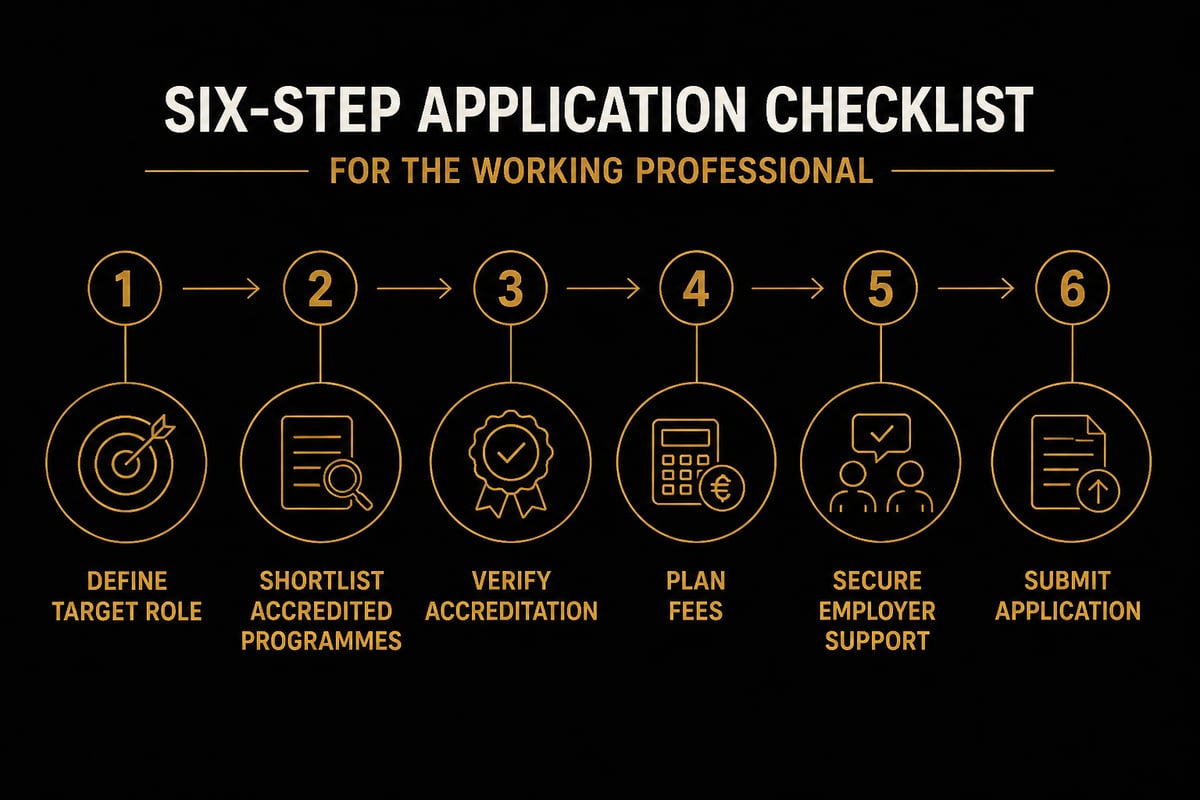
A good application plan starts with your career target and works backward to the qualification, not the other way around. Decide what role you want in three to five years, identify the skills that role demands, and choose the programme that supplies them.
Follow these steps:
- Write down your target role and the gaps between it and your current position.
- Shortlist two or three accredited programmes that fit your schedule.
- Confirm accreditation status with the national regulator.
- Request the programme calendar and fee schedule, and plan your cash flow around the payment options.
- Speak with your employer about study leave for the monthly weekends.
- Gather your documents and submit the application well before the intake closes.
Professionals who run their own firms or manage client communication should also consider the practical side of studying while working. Reliable connectivity matters for online library access and virtual sessions, and business telecom providers such as SolaaS.IT offer flexible month-by-month communication services that can support a home-office setup.
FAQ
What is the difference between an international business degree and a general MBA?
An international business degree concentrates on cross-border trade, global markets and multicultural management, while a general MBA covers management across all functions without a specific geographic focus. Many MBAs include international modules, so the gap narrows when the programme is well designed. Choose by comparing module lists, not titles.
Can I earn a recognized management credential alongside my degree?
Yes, some programmes pair the academic award with a professional designation. The University of Gold Coast's MBA in Marketing & Communication includes a CMI Level 7 Certificate and Chartered Manager Status. Check each programme page for the credentials attached to it.
How long does a postgraduate business qualification take?
Duration depends on the programme. Several of the University of Gold Coast's master's options are structured as 12-month programmes, while diplomas and certificates differ. Confirm the current length and schedule on the relevant programme page or with the admissions team.
Your next step is to shortlist one programme that matches your target role and request its fee schedule and calendar before the next intake closes. If marketing leadership is your goal, start with the MBA in Marketing & Communication, which pairs a 12-month degree with Chartered Manager Status. The University of Gold Coast offers MBA, MSc, LLM and diploma routes taught one weekend a month by faculty with industry experience, with flexible payment plans to spread the cost. When you are ready to move from research to action, you can apply now to the University of Gold Coast and begin building the qualification your career needs.