
A one year MSc is a full master of science degree completed in about 12 months, usually through a condensed schedule of taught modules followed by a dissertation or capstone project. It is the fastest route to a postgraduate qualification that carries the same academic standing as longer programs, provided the institution is properly accredited. For working professionals in Ghana, the real question is not whether a 12-month degree exists, but which format fits a demanding job and a realistic budget.
Are Master's Degrees Really Only One Year?
Yes, a master's degree can take one year, though the length depends on the country, the discipline and the study mode. Many programs in the United Kingdom, parts of Europe, Australia and Ghana are structured as 12-month taught master's degrees. In the United States, a master's more commonly runs two years, although accelerated options exist.
The difference comes down to how the credits are packed. A typical master's carries around 180 credits in the UK system. A one-year program delivers those credits in continuous study with no long summer break, which means the workload per month is heavier than in a two-year format.
Three features define most one-year programs:
- Continuous terms. Teaching blocks run back to back, often with the dissertation starting before the final exam period ends.
- Focused curriculum. There are fewer electives, and the modules are chosen to build toward a clear specialism.
- Fixed intake dates. Missing a start date usually means waiting a full year, so planning ahead matters.
The shorter duration does not mean a shorter qualification. Degree level, assessment standards and award title are the same. What changes is the pace and the amount of independent work expected between teaching sessions.
Which One Year MSc Programs Fit Business and Law Careers?
The most useful one-year specialisms for Ghanaian professionals sit in finance, human resources, marketing, international relations and international law. These fields reward applied knowledge, and they map directly onto roles in banking, public administration, multinational firms, diplomacy and regulatory work.
The University of Gold Coast offers a range of postgraduate programmes across business, law and related fields. Business-minded professionals can review its accounting, human resource and marketing options, and readers drawn to global affairs can explore its international relations offerings.
For aspiring diplomats, legal specialists and policymakers, the MSc International Law is a postgraduate program built around international legal frameworks, diplomacy and security. It suits lawyers moving into treaty and policy work, civil servants dealing with cross-border issues, and graduates who want an African perspective on global legal questions. Readers can find more details on the university's postgraduate pages.
A broader overview of every postgraduate route is available on the MSc programmes page, which helps when you are still deciding between a business and a law specialism.
How Does a One Year MSc Work for People Who Are Employed?
A one year MSc suits employed professionals when the teaching is condensed into scheduled blocks rather than daily attendance. Weekend-based teaching formats are designed to let working students keep their jobs while completing taught modules. Between weekends, students read, prepare assignments and work on their research project.
This format changes how you manage time. Instead of attending lectures several evenings a week, you carry a larger independent workload. Most students in this situation find a weekly routine more reliable than relying on weekend marathons.
A practical approach to the study rhythm:
- Block fixed study hours on weekday evenings and one weekend day.
- Start the dissertation topic search by month three, not month eight.
- Tell your manager early, so leave for exam periods is arranged in advance.
- Use the online library and student portal for reading rather than waiting for campus access.
- Submit assignments a few days before deadlines to leave room for technical problems.
The workload is real. Professionals who treat the degree as a second part-time job, with defined hours, tend to finish on time. Those who study only when work allows often fall behind in the dissertation stage.
What Does a One Year MSc Cost?
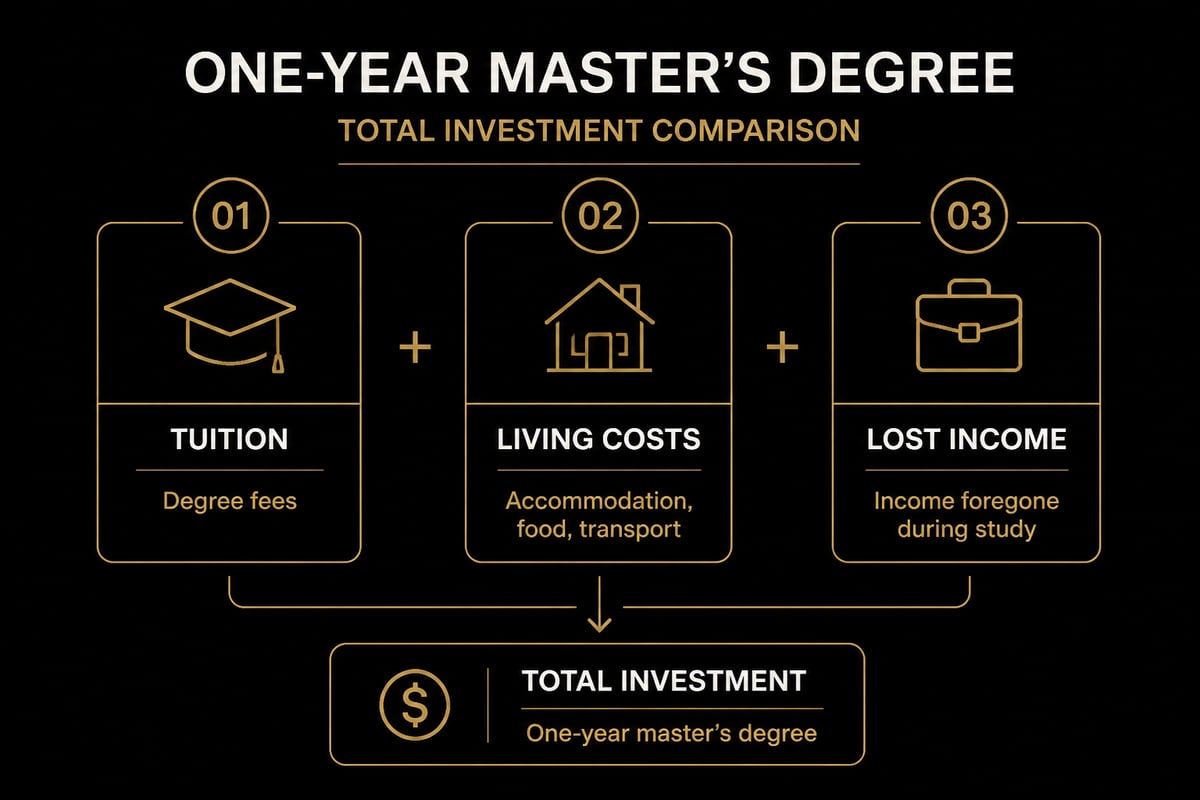
The total cost of a one year MSc combines tuition, living expenses, study materials and, for international study, visa and funding requirements. Tuition varies widely by country and institution, so the sensible way to compare is total cost over 12 months rather than the headline fee.
For local, work-compatible study, the main variable is how fees are paid. The University of Gold Coast offers flexible payment plans that let students pay as they go, which spreads the cost across the program instead of requiring a lump sum. For current fees, contact the admissions team or use the help desk, since this article cannot state exact figures on the university's behalf.
Studying abroad adds layers of cost. For a UK Student visa, GOV.UK states that applicants generally need to show course fees for one academic year, up to nine months, and for a course shorter than one year the full course fees are required. The maintenance requirement shown there is £1,529 per month in London and £1,171 per month outside London, for up to nine months. The application itself costs £558, according to the GOV.UK Student visa overview.
| Cost item | Studying locally (work-compatible) | Studying in the UK |
|---|---|---|
| Tuition | Set by the institution; payment plans may spread it | Full course fees usually shown as proof of funds |
| Living costs | Existing household budget | £1,171 to £1,529 per month required, depending on location |
| Visa | Not applicable | £558 application fee |
| Lost income | Minimal, since you keep your job | Often full salary for 12 months |
The last row is the one that changes the comparison most. A professional earning a steady salary in Accra who leaves work for a year abroad absorbs a large hidden cost. Staying employed while studying often makes the total financial burden far lighter.
Is $30,000 a Lot for a Master's Degree?
Whether $30,000 is above the cost of many one-year master's programs depends on the country, institution and study mode. Whether it is reasonable depends on salary expectations, the length of the program and what you give up in income while studying.
A useful test is payback time. Divide the total cost, including lost earnings, by the realistic annual salary increase the qualification could bring. If recovery takes more than five or six years, a cheaper program or a work-compatible format deserves a serious look.
Several factors move the real figure up or down:
- Duration. Twelve months of fees and living costs is usually far less than twenty-four.
- Study mode. Weekend-based study avoids relocation and rent.
- Funding. Employer sponsorship, payment plans and scholarships can cut out-of-pocket spending.
- Accreditation. A degree that your employer or regulator does not recognize delivers little value at any price.
For readers comparing budget-conscious options locally, the University of Gold Coast's guide to affordable master’s degrees walks through what to compare beyond tuition.
What Are the Admission Requirements for a One Year MSc?
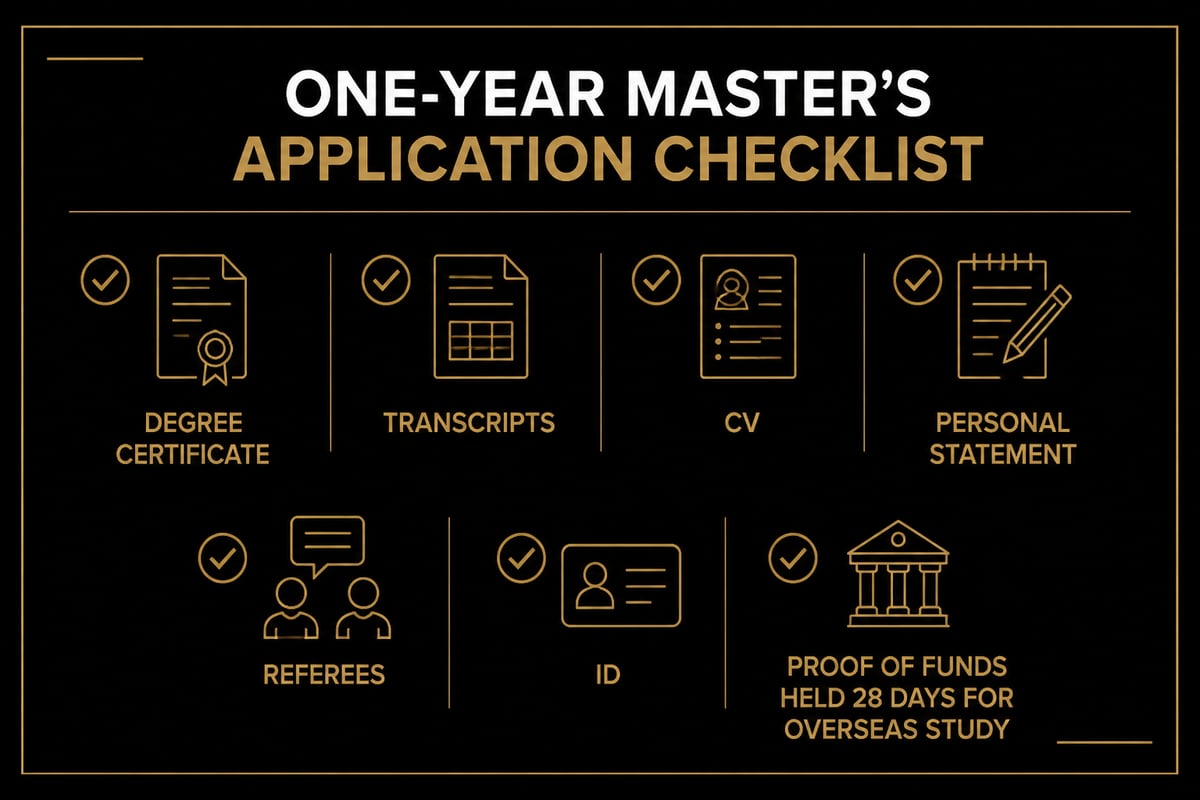
Most one-year programs require a recognized bachelor's degree, a completed application form, academic transcripts, identification and proof of English proficiency where the language of instruction is not your first language. Professional experience often strengthens an application, especially for business and law specialisms.
Admission tends to be tighter on timing than on grades. Because intakes are fixed and the course is compressed, late documents can push you into the next cycle. Prepare these items first:
- Certified copies of your degree certificate and transcripts
- An up-to-date CV showing relevant work history
- A short personal statement linking your career goals to the specialism
- Referee details, usually one academic and one professional
- Valid identification and passport-style photographs
Applicants can check the University of Gold Coast's postgraduate pages for programme-level detail on what to prepare.
If you plan to study abroad instead, the UK process begins with an offer from a licensed student sponsor, plus enough money for fees and living costs, as GOV.UK outlines. Applicants must generally hold the required funds for 28 consecutive days, and that period must end within 31 days of the visa application. The government's financial evidence guidance lists which documents count. Building that 28-day record well before you apply prevents last-minute refusals.
How Long Is the Quickest Master's Degree to Complete?
The quickest widely recognized master's degrees take about nine to twelve months, while some competency-based or heavily accelerated online formats claim shorter completion. For most professionals, twelve months is the realistic floor if the degree includes a proper research component and is accredited.
Be cautious with promises of six-month master's degrees. Fast completion usually depends on prior learning credit, a narrow curriculum or a very high weekly workload. A degree that skips assessed research may also limit options for a later PhD.
Accreditation should be the first check on any accelerated claim. The University of Gold Coast holds a Presidential Charter granted by the Government of Ghana, and its academic programmes are accredited by the Ghana Tertiary Education Commission (GTEC). Degrees are awarded by the University of Gold Coast itself. Confirming this kind of status protects both your investment and your professional standing.
What Are the Benefits and Drawbacks of a One Year MSc?
A one year MSc saves time and often money, but it compresses the learning curve and leaves little margin for disruption. Weighing both sides honestly helps you decide whether the pace matches your circumstances.
Benefits
- Faster return to full career momentum, or in your case, no break at all
- Lower total cost than a two-year degree
- A clear finish line that keeps motivation steady
- Immediate application of coursework to your current job
Drawbacks
- Heavy workload in a short period
- Limited time for networking and extracurricular activity
- Less room to recover from illness, family emergencies or work crises
- Dissertation pressure arriving early in the program
The teaching quality matters as much as the speed. Faculty who bring real-world industry experience into the classroom can help bridge the gap that a short program creates, because case discussions draw on live professional problems rather than textbook examples alone. A values-based learning environment can also combine academic work with ethical leadership, which many managers and public servants look for in a postgraduate experience.
How Do You Finish a One Year MSc Successfully?
Finishing a one year MSc on time depends on early planning, steady weekly effort and a dissertation started well before the final term. The students who struggle are rarely short of ability; they typically underestimate how quickly twelve months passes.
Follow this sequence:
- Before enrolment: agree your study schedule with your employer and family.
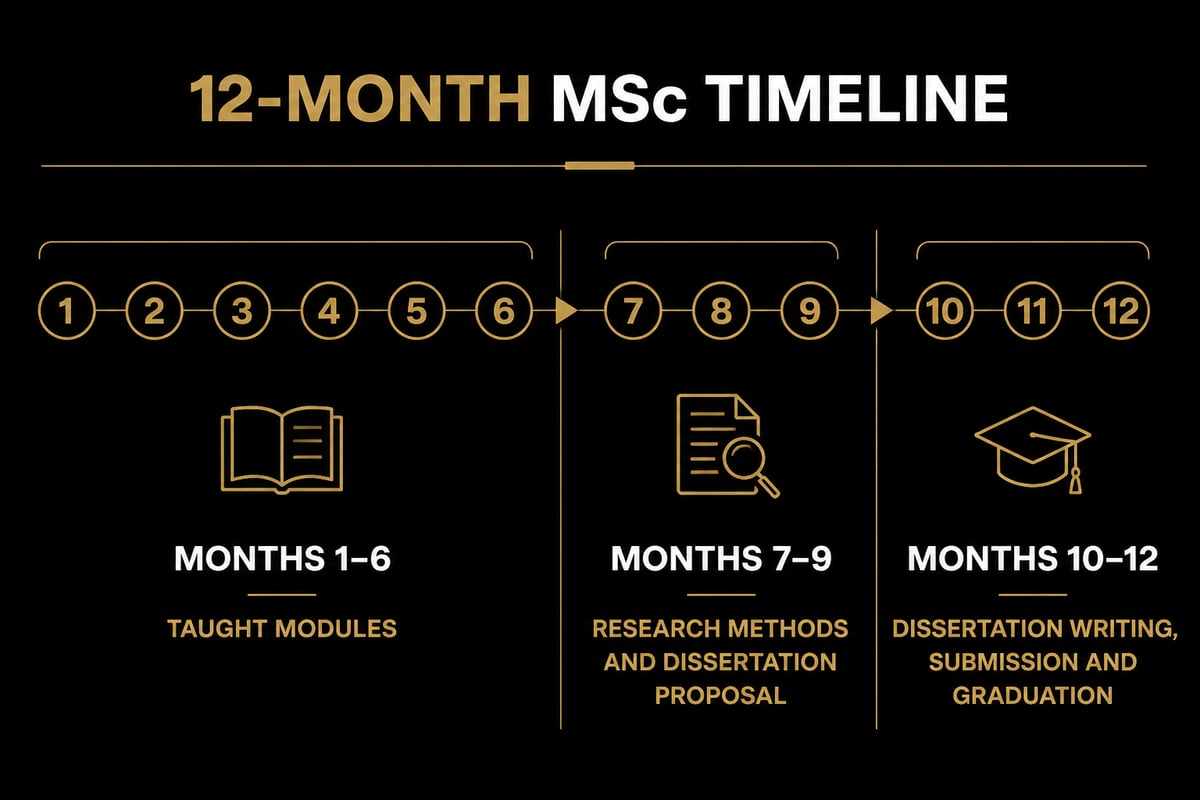
- Months 1 to 3: settle into reading habits and shortlist two or three dissertation topics.
- Months 4 to 6: finish most taught assessments and confirm your supervisor.
- Months 7 to 9: collect data or complete the main research and draft chapters.
- Months 10 to 12: revise, proofread and submit, leaving a buffer before the deadline.
Keep a single document of sources from the first week. Referencing errors found at the end are among the most time-consuming problems in a compressed schedule. For a wider look at program formats, the University of Gold Coast's pages on one-year master’s programs and online master’s options describe how short formats are organized.
FAQ
How long is a special master's program?
Special or specialist master's programs usually last between 12 and 24 months, depending on the field and whether the study is full-time or part-time. Programs with a heavy research or professional practice component often sit at the longer end. Confirm the exact duration and credit load with the admitting institution before applying.
Can I work full time during a one-year master's?
Many students do, provided the program is designed for it. Weekend-based formats, such as one full weekend of classes a month, make full-time employment realistic, but you should expect to dedicate regular weekday hours to independent study. Skipping that routine is the most common reason students fall behind.
Do employers respect a one year MSc?
Employers generally care more about accreditation, the awarding institution and the relevance of the specialism than the length of study. A degree accredited by the national regulator, such as GTEC in Ghana, carries credibility with employers and professional bodies. Presenting the practical skills you gained alongside the qualification strengthens its value further.
Start by listing the specialism you want and checking that the awarding institution is accredited, then gather your transcripts and CV so you are ready when an intake opens. If international law, diplomacy or security policy is your direction, the MSc International Law at the University of Gold Coast is designed for working professionals. Take the next step toward your postgraduate qualification and Apply Now with the University Of Gold Coast.