
An undergraduate class is a single course taken as part of a bachelor's degree, typically earning a set number of credits and led by a lecturer through lectures, tutorials, assignments and exams. For working professionals in Accra, understanding how an undergraduate class is structured also clarifies what comes next: postgraduate study, which is where University of Gold Coast focuses its programmes.
This guide explains how undergraduate classes work, what the terms credit, major, minor and elective mean, how undergraduate study differs from postgraduate study, and how to move from a first degree to a business qualification without leaving your job.
What Is an Undergraduate Class?
An undergraduate class is one course within a first-degree programme, such as a bachelor's degree, usually run over a semester and worth a fixed number of credits. Examples include Introduction to Accounting, Principles of Management or Business Law.
Most bachelor's degrees combine dozens of these classes. Each one has a syllabus, a lecturer, scheduled sessions and a method of assessment. Passing the class earns you credits, and a required total of credits earns the degree.
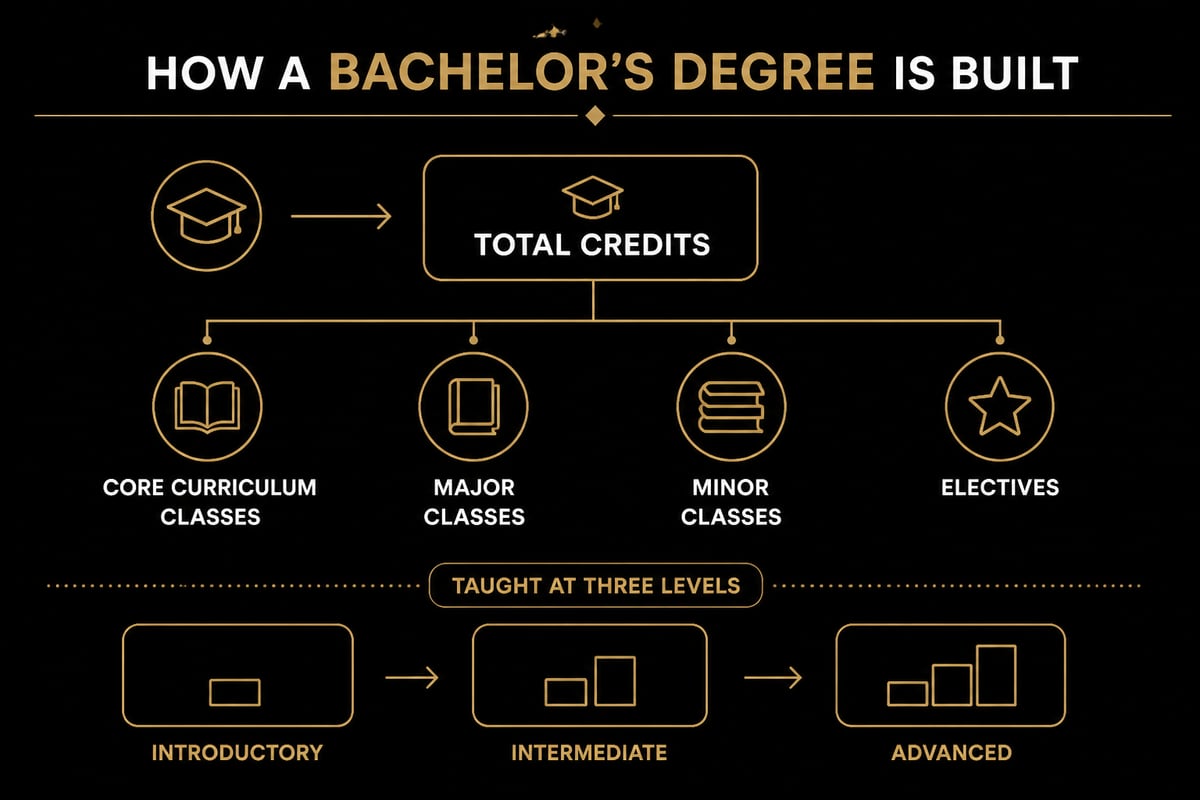
Undergraduate classes generally fall into three levels of difficulty:
- Introductory classes (often numbered 100 or 1000) cover foundations and assume no prior knowledge.
- Intermediate classes (200 to 300 level) build on the basics and begin to apply them to cases.
- Advanced classes (400 level) involve independent research, projects and specialised topics.
If you already hold a bachelor's degree, you have completed this stage. For a plain-language definition of the term itself, University of Gold Coast offers a short explainer on the meaning of undergraduate.
How Credits, Majors, Minors and Electives Work
A bachelor's degree is built from credits, and those credits are organised into a major, an optional minor, core requirements and electives.
Credits measure the workload of a class. Universities set a total credit requirement for graduation, which varies by country and system.
A major is your main field of study, such as accounting, marketing or economics. It accounts for the largest share of your classes. A minor is a smaller cluster of classes in a second subject, completing a secondary specialisation without becoming a full second degree.
Electives are classes you choose freely, often outside your major. They broaden your skills and let you explore subjects such as ethics, data analysis or communication.
The core curriculum is the set of classes every student must take regardless of major. It usually covers writing, quantitative reasoning and foundational humanities or social sciences. Some universities use an open curriculum instead, which removes most requirements and lets students design their own path. The theredpen guide to undergraduate courses in the US explains the difference between these two models in more detail.
What a Typical Undergraduate Class Looks Like Week to Week
A typical undergraduate class combines scheduled teaching with independent study, and the balance between the two is what defines the experience.
Most classes include some mix of the following:
- Lectures, where a lecturer presents concepts to a large group.
- Tutorials or seminars, smaller sessions for discussion and problem solving.
- Assignments, such as essays, case analyses, problem sets or group projects.
- Continuous assessment, usually quizzes or mid-semester tests.
- Final examinations, which commonly carry the largest share of the grade.
Grading usually follows a weighted formula. A class might assign 30 percent to coursework, 20 percent to a mid-semester test and 50 percent to the final examination. Attendance, participation and academic integrity policies vary by institution and are set out in each class syllabus.
For a working adult, the key point is the time commitment. A full-time undergraduate load can occupy a large share of the week once reading is included, which is one reason full-time undergraduate study is hard to combine with a career.
Undergraduate Class vs. Postgraduate Class
A postgraduate class is taught after you have earned a bachelor's degree, and it differs from an undergraduate class in depth, independence and purpose.
| Feature | Undergraduate class | Postgraduate class |
|---|---|---|
| Entry requirement | Secondary school qualification | A bachelor's degree |
| Focus | Foundations and broad knowledge | Specialisation and application |
| Teaching style | Lectures with set content | Discussion, case work, research |
| Class size | Often large | Usually smaller cohorts |
| Assessment | Exams and coursework | Projects, dissertations, applied work |
| Typical student | School leaver | Working professional |
Postgraduate classes assume you already know the fundamentals and ask you to apply them to real organisational problems. That is why experience in the workplace is an asset rather than a distraction in a master's classroom.
University of Gold Coast has published several guides that compare the two stages, including the difference between graduate and undergraduate study and an overview of undergraduate and graduate degrees.
Which Undergraduate Classes Are Considered the Hardest?
The hardest undergraduate classes are generally those that combine heavy quantitative content with abstract reasoning, and difficulty depends on your background as much as the subject.
Frequently cited examples across universities include organic chemistry, advanced calculus, thermodynamics, quantum mechanics and constitutional or contract law. Organic chemistry, for instance, asks students to memorise reaction patterns and then predict outcomes for molecules they have never seen. Contract law demands close reading of case judgments and the ability to apply a precedent to a new set of facts. In business degrees, students often find financial accounting, corporate finance, statistics and econometrics the most demanding, because they stack new concepts on top of earlier ones. A student who misses the logic of discounting in one week will struggle with valuation a few weeks later.
Difficulty rankings are subjective. A class that feels punishing to one student can feel natural to another with prior workplace exposure. A manager who has reviewed budgets for years may find management accounting straightforward, while someone from a marketing background may struggle with it. The reverse is also true when the subject is consumer behaviour or brand strategy. Workload matters too: a class with weekly problem sets and a heavily weighted final exam feels harder than one assessed through steady coursework, even when the content is similar.

How Undergraduate Course Catalogues Are Organised
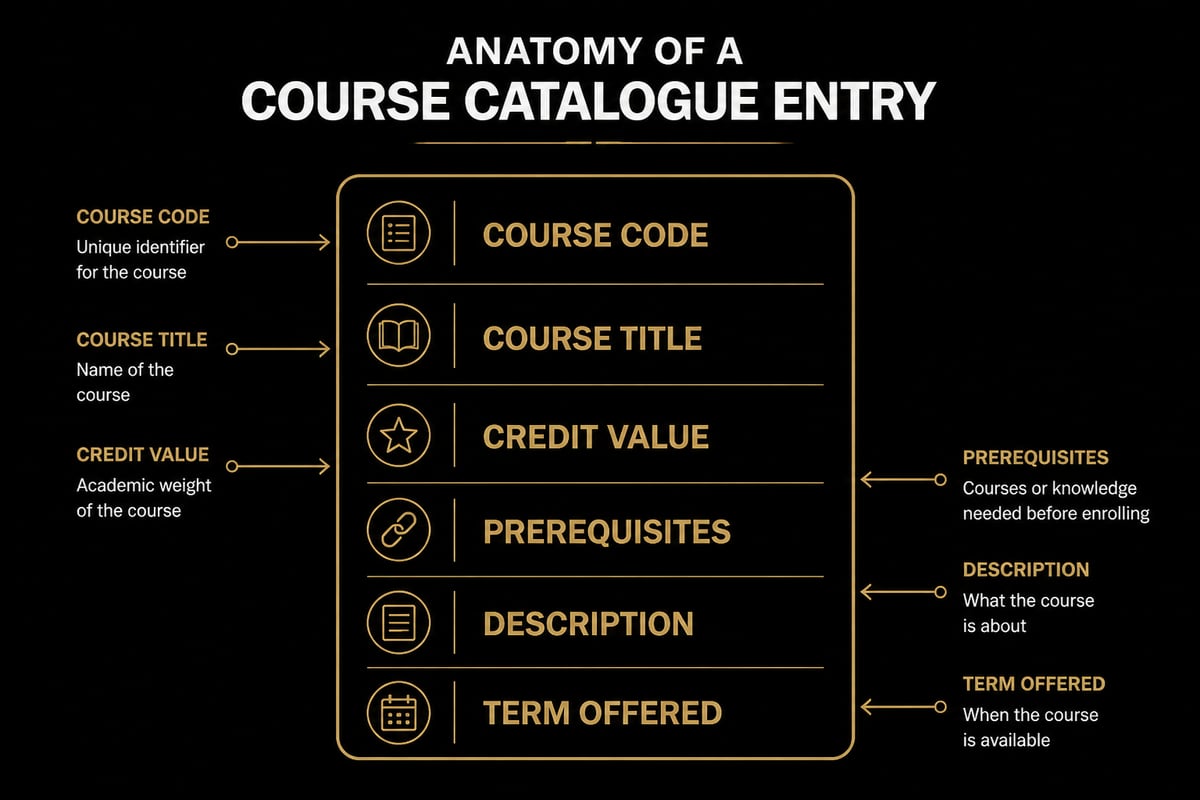
A university course catalogue lists every undergraduate class by department, level and credit value, and learning to read one saves time when planning a degree.
Most catalogues group programmes by school or college, then list the classes required for each major. Each entry typically shows a course code, title, credit value, prerequisites and a short description. Many large universities publish searchable catalogues. The University of Illinois undergraduate program index is one example of how programmes are presented by college, with links to each major's required classes.
When reading any catalogue, check three items first: prerequisites, which tell you what you must complete before enrolling; credit value, which tells you the workload; and whether the class is offered every semester or only in certain terms.
From Undergraduate Class to Postgraduate Study While Working
If you have finished a bachelor's degree and want a business qualification, the practical route is a postgraduate programme designed around a working schedule rather than a return to a full-time campus routine.
University of Gold Coast is built for this reader. Its classes run one full weekend a month, so working professionals and managers can study without leaving their jobs. Flexible payment plans let students pay as they go, which spreads the cost across the programme. Its academic programmes are accredited by the Ghana Tertiary Education Commission (GTEC), and it holds the Presidential Charter granted by the Government of Ghana.
Teaching is delivered by faculty who bring real-world industry experience into the classroom, in a Christ-centred learning environment that combines academic excellence with ethical leadership. For a manager, this means classroom discussion tied to the decisions you already make at work.
University of Gold Coast does not offer full-time, campus-based undergraduate study. If you are still looking for a first degree, a different institution will suit you better. If you already hold one, the programmes page shows the postgraduate options available, including pathways such as the Postgraduate Certificate in Management and the MSc in Accounting and Finance.
What You Need Before Moving Beyond an Undergraduate Class
Moving on from undergraduate study requires a completed bachelor's degree, supporting documents and a clear idea of how postgraduate study fits your career.
Typical preparation includes:
- Your bachelor's degree certificate and academic transcript
- A current CV showing management or professional experience
- Identification and any referee details the programme requests
- A realistic plan for protecting one weekend each month for study
Gather the documents early, because certificates and transcripts can take time to obtain from a former institution. Check that names and dates match across every document, since small inconsistencies can slow an application. Your CV should show scope as well as titles: the size of the team you lead, the budgets you handle and the decisions you own give an admissions team a clearer picture than a list of job names. For referees, choose people who have seen your work recently, such as a line manager or senior colleague, and tell them in advance so they can respond promptly.
The study plan deserves equal attention. Because classes run one full weekend a month, agree the dates with your employer and family before you enrol, and block out reading time between sessions.
Exact entry requirements differ by programme, so confirm them directly with the university.
Skills From an Undergraduate Class That Carry Into Postgraduate Work
The strongest foundations built in an undergraduate class are analytical writing, quantitative reasoning and disciplined time management, and each one transfers directly to postgraduate business study.
Analytical writing matters because master's assignments ask you to build an argument from evidence, not summarise a textbook. Quantitative reasoning supports finance, operations and data-driven decisions. Time management becomes critical when study shares space with a full-time role.
Professionals who need to sharpen these skills before enrolling can use simple tools. A quiet, dedicated workspace supports focused study and remote work, an idea worth replicating with a fixed study corner at home or in the office. Whatever setting you choose, a consistent routine matters more than the location.
FAQ
What are undergraduate courses?
Undergraduate courses are the individual classes that make up a bachelor's degree, taken after secondary school and before any master's or doctoral study. Each course carries credits, and completing the required total earns the degree.
What undergraduate programs are typically offered at large universities?
Large universities usually offer programmes across business, engineering, sciences, humanities, law-related studies and education. The exact list is published in each university's course catalogue, organised by school or college.
Can I take a postgraduate programme if my undergraduate degree was in a different field?
Many business postgraduate programmes accept applicants from varied academic backgrounds, particularly when they have relevant work experience. Requirements differ by programme, so check the specific entry criteria on the university's programme page or contact the admissions team.
Start by gathering your bachelor's degree certificate and transcript, then check them against the entry criteria for the programme you are considering. If you want to study for a postgraduate business qualification while staying in your role, University of Gold Coast offers one-weekend-a-month classes in business, law and theology, and you can apply now to begin your application.