
Finding the cheapest masters online doesn't mean sacrificing quality or career advancement potential. With tuition costs rising across higher education, prospective graduate students are increasingly searching for affordable pathways to earn advanced degrees without accumulating overwhelming debt. The landscape of online graduate education has evolved dramatically, with accredited institutions now offering rigorous, competitively priced programs across business, law, theology, and other fields. Understanding how to evaluate cost alongside program quality, accreditation standards, and potential earnings outcomes is essential for making a smart investment in your future.
Understanding the True Cost of Online Master's Programs
When searching for the cheapest masters online, the sticker price tells only part of the story. Total program cost includes tuition per credit hour, technology fees, course materials, and sometimes residency requirements that add travel expenses.
Most online master's programs range from 30 to 48 credit hours. A program charging $300 per credit hour totals $9,000 to $14,400, while one at $700 per credit reaches $21,000 to $33,600. These differences compound significantly over the duration of your studies.
Breaking Down Cost Components
Understanding what drives program pricing helps you identify genuine value:
- Tuition per credit hour – The primary cost factor, typically ranging from $250 to $1,200
- Technology and platform fees – Annual charges from $100 to $500 for learning management systems
- Course materials – Textbooks, software licenses, and digital resources averaging $500 to $1,500 annually
- Application and enrollment fees – One-time charges between $50 and $150
- Graduation fees – Final processing costs ranging from $100 to $300
According to the College Scorecard technical documentation, analyzing net price rather than published tuition provides a more accurate picture of what students actually pay after financial aid.

Financial aid availability varies dramatically between institutions. Some schools reserve their best aid packages for on-campus students, while others offer identical support for online learners. Federal student aid applies to accredited online programs, but institutional scholarships may have different eligibility criteria.
Identifying Legitimately Affordable Programs
The cheapest masters online programs cluster in several categories, each with distinct characteristics and tradeoffs. Public universities typically offer lower tuition, especially for in-state residents, though some extend resident rates to all online students regardless of location.
Regional public institutions often provide the best value. Their online master's programs range from $8,000 to $18,000 total cost, combining affordable tuition with established reputations and regional employer recognition.
Price Ranges by Program Type
| Program Category | Typical Total Cost | Credit Hour Rate | Duration |
|---|---|---|---|
| Public University (In-State) | $8,000 – $15,000 | $250 – $500 | 18-24 months |
| Public University (Out-of-State) | $15,000 – $30,000 | $500 – $850 | 18-24 months |
| Private Non-Profit | $20,000 – $45,000 | $650 – $1,200 | 12-24 months |
| For-Profit Institution | $15,000 – $40,000 | $400 – $1,100 | 12-30 months |
Recent analysis from Higher Ed Dive highlights innovative models delivering complete online master's degrees for under $10,000, though these ultra-low-cost options often come with specific limitations or specialized focus areas.
Business schools have responded to market demand with competitively priced online MBA programs. The 2026 AACSB business school finances and tuition trends report shows that accredited business programs increasingly offer online formats at price points below their campus equivalents, with some flagship programs under $20,000.
Red Flags and Warning Signs
Not all cheap programs deliver equivalent value. Watch for these concerning indicators:
- Lack of proper accreditation from recognized regional or national bodies
- No clear career services or alumni networking support
- Faculty without terminal degrees or relevant professional experience
- Minimal student support services beyond basic course access
- Poor graduation rates or excessive time-to-completion metrics
Programs at the University Of Gold Coast maintain rigorous academic standards across their MBA, MSc, LLM, and professional diploma offerings while remaining accessible to working professionals through flexible online delivery and comprehensive support services.
Evaluating Return on Investment
Price alone doesn't determine value. The cheapest masters online program may or may not provide the career advancement or salary increase that justifies even a modest investment.
Third Way’s analysis of financial returns from online graduate programs reveals significant variation in post-graduation earnings across fields and institutions. Master's graduates in business, technology, and healthcare typically see faster ROI than those in other fields.
Calculate your expected ROI using this framework:
Total Program Cost ÷ Expected Annual Salary Increase = Years to Break Even
A $15,000 MBA that increases your salary by $10,000 annually breaks even in 1.5 years. A $35,000 program with the same outcome takes 3.5 years. However, if the more expensive program offers stronger alumni networks, better career services, or greater employer recognition, the long-term value may justify the higher initial cost.

Field-Specific Considerations
Different disciplines offer varying ROI potential:
- MBA programs – Average salary increase of $15,000 to $30,000, with top programs delivering more
- MSc in Technology/Data Science – Strong demand often yields $20,000 to $40,000 increases
- Education master's degrees – Modest increases ($5,000 to $12,000) but required for advancement
- Healthcare administration – Competitive increases of $12,000 to $25,000 in growing field
- Legal studies (LLM) – Variable returns depending on specialization and current credentials
BestColleges research on master’s degree costs provides comprehensive data showing that program prestige and cost don't always correlate with outcomes, particularly in professional fields where certifications and experience matter as much as credentials.
Strategies for Reducing Graduate School Costs
Even among the cheapest masters online options, students can employ additional cost-reduction strategies without compromising educational quality.
Employer Tuition Assistance
Many employers offer graduate tuition benefits ranging from $2,000 to $10,000 annually. Some cover full tuition for programs relevant to your role. Before enrolling, investigate:
- Annual reimbursement limits and eligible expenses
- Service commitment requirements after degree completion
- Whether reimbursement requires specific grades or completion milestones
- Tax implications of employer educational benefits
Corporate partnerships between universities and major employers sometimes provide additional discounts. Programs at University Of Gold Coast are designed to accommodate working professionals, making it easier to leverage employer support while maintaining career momentum.
Accelerated Completion
Finishing faster reduces overall costs by limiting the duration you pay fees and carry student status expenses. Accelerated strategies include:
- Taking maximum credit loads each term to shorten program length
- Year-round enrollment using summer and winter sessions
- Transfer credits from prior graduate coursework (typically up to 6-9 credits)
- Prior learning assessment for professional certifications or experience
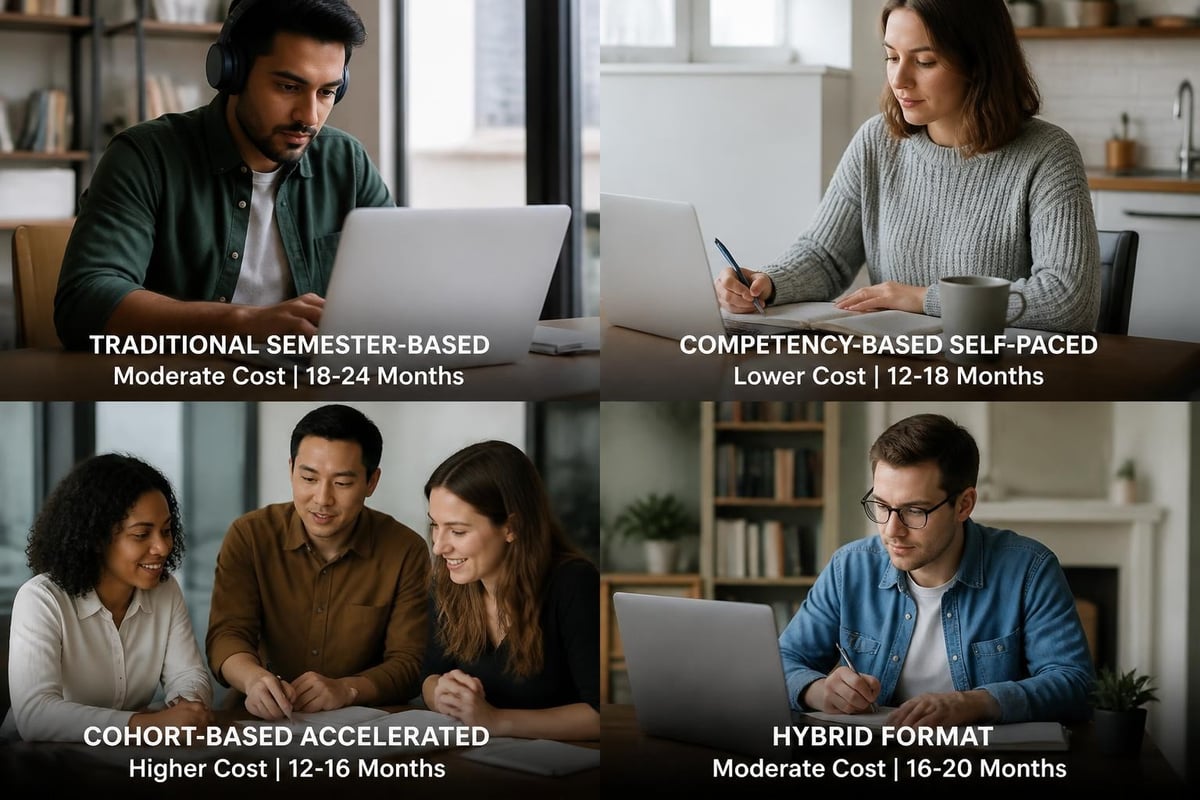
- Competency-based programs that let you advance as you demonstrate mastery
An accelerated path turning a 24-month program into 15 months saves a full year of technology fees, reduces opportunity costs, and delivers your credential faster for career advancement.
Financial Aid Optimization
The Brookings analysis of college costs emphasizes that net price after aid matters more than published rates. Maximize aid by:
- Completing the FAFSA annually for federal loan access and potential grants
- Researching institutional scholarships with specific criteria you meet
- Applying for professional association scholarships in your field
- Investigating state-specific graduate aid programs
- Seeking departmental assistantships or fellowships, even in online programs
Some institutions reserve special funding for underrepresented populations, first-generation graduate students, or those in high-need fields.
Comparing Specific Low-Cost Options
The cheapest masters online programs in 2026 come from diverse institutional types, each with unique advantages.
| Institution Type | Example Price Point | Strengths | Considerations |
|---|---|---|---|
| State Flagship Online | $12,000 – $22,000 | Brand recognition, resources | May have residency requirements |
| Regional Public | $8,000 – $16,000 | Excellent value, local connections | Less national recognition |
| Specialized Online | $10,000 – $20,000 | Focus on working professionals | Limited program variety |
| Competency-Based | $6,000 – $15,000 | Self-paced, fast completion | Requires high self-direction |
Western states have led innovation in affordable online graduate education through shared online programs and reciprocity agreements. Several consortiums offer accredited master's degrees under $15,000 by pooling resources across multiple institutions.
Professional master's programs in business administration represent the largest category of affordable online options. Accredited online MBA programs now start around $9,000 total cost, though program features vary considerably at different price points.
Balancing Cost with Program Quality
Finding the cheapest masters online shouldn't mean accepting inferior education. Certain quality indicators remain non-negotiable regardless of price.
Essential Quality Markers
Accreditation stands as the foundation of program legitimacy. Regional accreditation from bodies like HLC, MSCHE, or WASC ensures basic academic standards. Programmatic accreditation from AACSB (business), ABA (law), or field-specific bodies signals additional rigor.
Faculty credentials directly impact learning quality. Look for:
- Terminal degrees (PhD, EdD, JD) from respected institutions
- Active research or professional practice in their field
- Substantial teaching experience, particularly online
- Accessibility for student consultation and mentoring
- Industry connections that benefit student networking
Student support services separate quality programs from degree mills. Comprehensive support includes academic advising, career counseling, technical assistance, library access, and active alumni networks.
Detailed cost analysis from OnlineMastersDegrees.org shows that the most affordable programs often invest heavily in student services, recognizing that completion and success drive long-term institutional reputation more than raw enrollment numbers.
Assessing Program Reputation
Even budget-conscious students should consider program standing:
- Employer recognition in your target industry or region
- Alumni outcomes measured by employment rates and salary data
- Specialty rankings in your specific field of interest
- Industry partnerships providing internships or job placement
- Accreditation history showing consistent standards compliance
Programs offering specialized master's degrees in emerging fields like data science, cybersecurity, or healthcare informatics often provide strong value despite modest tuition because demand exceeds supply for qualified graduates.
Making Your Final Decision
Selecting from the cheapest masters online options requires systematic comparison across multiple dimensions beyond simple price.
Decision Framework
Use this structured approach to evaluate programs:
- Verify accreditation and confirm degree recognition in your field
- Calculate total cost including all fees, materials, and hidden expenses
- Assess program format for compatibility with your schedule and learning style
- Research faculty credentials and their professional backgrounds
- Examine support services available to online students
- Review outcome data on graduation rates, time to completion, and career placement
- Connect with alumni to gather firsthand experiences and insights
- Evaluate ROI potential based on realistic salary expectations in your market
The University Of Gold Coast provides transparent information about program costs, structure, and outcomes across its MSc, MBA, LLM, and diploma offerings, enabling prospective students to make informed comparisons.
Questions to Ask Admissions Teams
Direct inquiry reveals program details not apparent from marketing materials:
- What percentage of students receive financial aid, and what forms?
- How do online students access career services and networking events?
- What is the average time to completion for part-time online students?
- Are there any mandatory on-campus residencies or synchronous requirements?
- How recent is the curriculum, and how often is it updated?
- What technology platform delivers coursework, and what technical support exists?
- Can you connect me with current students or recent graduates?
Programs confident in their value proposition readily answer these questions and connect prospective students with current participants.
Specialized Fields and Niche Programs
The cheapest masters online degrees span virtually every academic and professional discipline, though pricing patterns vary by field.
Business and management programs dominate the affordable online landscape. MBA concentrations in general management, marketing, finance, and operations are widely available under $20,000. Specialized business master's in areas like project management or business analytics often cost less than comprehensive MBA programs while providing focused credential development.
Education master's degrees represent another affordable category, with many programs targeting working teachers. Curriculum and instruction, educational leadership, and special education programs frequently cost $10,000 to $18,000 complete. These programs often lead to salary increases through district pay scales that reward advanced degrees.
Technology-focused master's degrees in computer science, information systems, and data science have become increasingly available online at competitive prices. While some prestigious programs charge premium rates, regional universities now offer solid technical master's degrees for $12,000 to $22,000.
Emerging Field Opportunities
Newer disciplines sometimes offer better value as institutions build enrollment:
- Healthcare informatics – Blending medical knowledge with data analysis
- Cybersecurity – High demand driving both program creation and competitive pricing
- Sustainability management – Growing field with limited competition
- Digital marketing – Professional master's programs under $15,000
- Applied data science – Practical programs more affordable than theoretical ones
These specialized programs often deliver strong ROI because they address specific employer needs in growing sectors.
International and Alternative Options
Students seeking the cheapest masters online sometimes consider international programs or alternative credentials that may cost less than traditional U.S. degrees.
European and Commonwealth universities offer one-year master's programs at lower total costs than typical U.S. two-year formats. However, considerations include:
- Recognition of international degrees by U.S. employers
- Quality variation across international institutions
- Different academic calendars and teaching methodologies
- Time zone challenges for synchronous components
- Currency exchange rate fluctuations
Alternative credentials like graduate certificates, professional diplomas, and micro-credentials provide specialized knowledge at fraction of full master's cost. A 12-15 credit graduate certificate typically costs $3,000 to $8,000 and can sometimes apply toward a full master's degree later. If you want a shorter credential first, our breakdown of graduate certificate costs compares the price of stacking certificates toward a full degree.
The University Of Gold Coast offers professional diploma programs alongside traditional master's degrees, providing flexible pathways for professionals seeking targeted skill development or stepping stones toward comprehensive graduate credentials.
Identifying the cheapest masters online requires balancing affordability with quality, accreditation, and career outcomes to ensure your investment delivers real value. Whether you pursue an MBA, MSc, LLM, or specialized professional credential, thorough research into total costs, program reputation, and expected ROI will guide you toward the right choice for your goals and budget. University Of Gold Coast combines academic rigor with accessibility across diverse graduate programs in business, law, theology, and professional fields, supported by comprehensive online resources and student services designed to help working professionals advance their careers without compromising their current commitments.