
King Saud University is a public research university in Riyadh, Saudi Arabia, and by its own reporting it is the highest-ranked Saudi and Arab institution in several major global tables. Founded as the kingdom's first university, it combines a large research output with a broad program catalog spanning medicine, engineering, pharmacy, sciences and humanities. This review covers its rankings, the courses it offers, student services, costs, and how it fits readers who are weighing postgraduate study in business, law or policy.
King Saud University at a Glance
King Saud University (KSU) is a large, research-intensive public university whose reputation rests on science, engineering and health disciplines. Its official site states that the university published 23% of academic research in Saudi Arabia, which signals how central it is to the national research base (King Saud University).
The university serves a predominantly Saudi student body, teaches in both Arabic and English depending on the college, and operates as a full-time, campus-based institution. That last point matters for working professionals: its core model assumes residence in Riyadh and daily attendance rather than part-time study around a career.
Key facts to hold in mind:
- Type: Public, government-funded research university
- Location: Riyadh, Saudi Arabia
- Strengths: Engineering, pharmacy, agricultural sciences, mathematics and medicine
- Study mode: Primarily full-time and on campus
How High Is King Saud University Ranked?
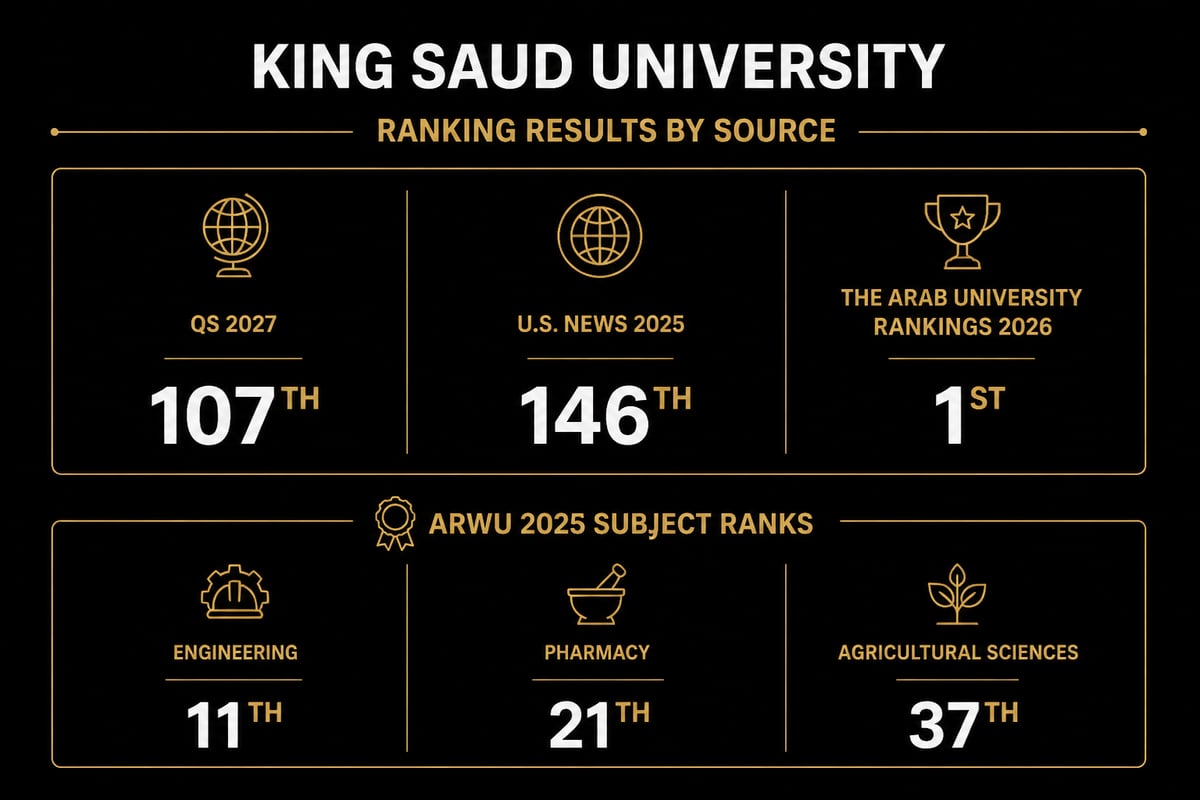
King Saud University ranks among the top 150 universities worldwide in several major tables, and first among Arab institutions in some of them. According to the university's 2025 rankings summary, it placed 116th globally and first among Arab and Saudi universities in its 2025 achievements, and the same page reports a 107th-place global ranking in QS 2027 with second place among Saudi universities.
The table below collects the ranking results the university reports, so the figures can be read side by side.
| Ranking | Reported result |
|---|---|
| QS 2027 | 107th globally; second among Saudi universities |
| U.S. News & World Report 2025 | 146th globally |
| Times Higher Education Arab University Rankings 2026 | First for the third consecutive year |
| Times Higher Education Interdisciplinary Science Rankings 2026 | 20th globally |
| ARWU 2025, Engineering | 11th globally |
| ARWU 2025, Pharmacy | 21st globally |
| ARWU 2025, Agricultural Sciences | 37th globally |
Subject-level results add detail. The same source reports that KSU ranked fourth in Toxicology and Pharmacy and 15th in Mathematics in the U.S. News listing. These are institution-reported figures, so readers who need them for formal decisions should confirm them against the ranking bodies' own publications.
Is King Saud a Good University?
Yes, King Saud University is a strong university by international research measures, particularly in engineering, pharmacy and the sciences. Its placement near the top 120 in QS and its first place in the Times Higher Education Arab University Rankings support that view, as does its share of national research output.
The subject-level results give that view more shape. In ARWU 2025 the university ranked 11th globally in Engineering, 21st in Pharmacy and 37th in Agricultural Sciences, and U.S. News placed it fourth in Toxicology and Pharmacy and 15th in Mathematics. Its 20th place in the Times Higher Education Interdisciplinary Science Rankings 2026 points to research that crosses departments rather than sitting in a single field. A prospective pharmacy or engineering student can read these as evidence that the strongest departments are internationally visible, which matters for later doctoral applications and research collaboration.
A fair assessment also needs context on fit. Rankings of this kind weight research citations, reputation surveys and international collaboration heavily. They say less about whether a program suits a mid-career manager in Accra who needs to keep a salary while studying, or whether the teaching format works around a demanding job. A top-ranked research university can still be the wrong choice if its schedule, language of instruction or location does not match your circumstances.
What Courses Are Offered at King Saud University?
King Saud University offers undergraduate and postgraduate programs across health sciences, engineering, sciences, education, business, languages and humanities. Its strongest international visibility comes from engineering, pharmacy and agricultural sciences, which is consistent with the subject rankings above.
In practical terms, applicants can expect:
- Health and medical sciences: Medicine, dentistry, pharmacy, nursing and applied medical sciences
- Engineering and computing: Multiple engineering disciplines and computer and information sciences
- Sciences: Mathematics, physics, chemistry, biology and related fields
- Business and humanities: Business administration, languages, arts and education programs
Entry requirements, tuition for international applicants, language prerequisites and the current course list change from year to year. The university's own admissions pages are the reliable source for those details, and they should be checked before any planning.
Campus Life and Student Services
Campus life at King Saud University is organized around a structured student-services system covering academic support, extracurricular activities and skills development. The university's student-services page describes services intended to foster students' skills and creativity, and the Deanship of Student Affairs outlines its remit, including counseling and sports entities, on its official site.
For full-time residential students, this means access to:
- Academic advising and learning support
- Counseling services
- Sports and recreational facilities
- Clubs and extracurricular programs
These services reflect a traditional, in-person experience. They are valuable for a student living near campus and less relevant to a professional studying part-time from another country.
Because the system is built around daily presence, the benefits compound with time on campus. A first-year student can use advising to plan a course load, join a club to build a peer network, and use sports facilities to balance a heavy lab or studio schedule. Counseling is useful during exam periods and the adjustment to living in a new city. Students who live off campus can still use these services, but they depend on commuting in Riyadh traffic and on being available during the working day. Prospective applicants should ask about hours, eligibility and how services apply to international students before they arrive.

Is University Free in Saudi Arabia?
Public university education in Saudi Arabia is generally tuition-free for Saudi citizens, with the government funding most costs. International students face different rules, and the terms vary by university, program and scholarship availability.
For readers in Ghana, the practical point is that eligibility for free tuition should not be assumed. Scholarship places for international applicants exist but are competitive, and living costs in Riyadh, relocation expenses and time away from work remain real considerations. Confirm current terms directly with the university before budgeting.
A realistic budget separates what a scholarship might cover from what it usually does not. Even where tuition is waived, an applicant should plan for flights, a visa, accommodation if campus housing is not offered, health coverage and everyday costs. Equipment is a smaller but real item: a laptop such as the MacBook Air 13 M3 (reported at a $1,099 starting price, or $999 at the education price) is a typical purchase for coursework, and basics like a 21-ounce Hydro Flask Standard Mouth bottle or a 400-thread-count sheet set for a twin XL bed add up quickly in a new city. For a working professional, the largest cost is rarely tuition. It is the salary forgone while living abroad for the length of a degree.

What King Saud University Does Not Offer: Study Around a Full-Time Career
King Saud University does not offer a model built for working professionals who want to keep their jobs. Its programs assume full-time residence on a Riyadh campus, and a research university of this scale organizes its calendar around weekday teaching rather than part-time or weekend delivery.
This gap is worth stating plainly for managers in Accra and Ghana. A postgraduate business qualification only improves your career if you can complete it without giving up the income and seniority you already have. Relocating abroad for one to two years means forgoing salary, pausing professional momentum and absorbing relocation costs. For many working professionals, that trade-off outweighs the prestige of a high global ranking.
A useful way to compare options is to ask four questions of any program:
- Can I attend without leaving my job?
- Is the delivery schedule compatible with my work calendar?
- Is the qualification accredited and recognized where I work?
- Can I spread the cost over time rather than paying upfront?
A Local Alternative for Working Professionals and Aspiring Diplomats
For professionals who answer "no" to the first question above, a Ghana-based program built around work schedules is a more practical route. The University of Gold Coast offers PhD, MBA, MSc, LLM and professional diploma programs across business, law and theology, and it structures study so that students can keep working.
Specific features relevant to this audience:
- Weekend format: Classes run one full weekend a month, so working professionals can study without leaving their jobs.
- Payment flexibility: Flexible payment plans let students pay as they go.
- Accreditation: Degrees are awarded by the University of Gold Coast and accredited by the Ghana Tertiary Education Commission. The university also holds the Presidential Charter, granted by the Government of Ghana. Details are on the accreditation and recognition page.
- Faculty: Teaching staff bring real-world industry experience into the classroom.
- Learning environment: A Christ-centred setting that combines academic excellence with ethical leadership.
Readers focused on management can read the case for the UGC MBA, while those interested in law, diplomacy and policy can look at the LLM and related options. Students also get access to online libraries and a student portal to support their academic work. Fees, intake dates and entry requirements are not covered here, so check them on the university's admissions page or through its contact channels.
Verdict: Who Should Choose King Saud University and Who Should Not
King Saud University is an excellent choice for full-time students who can relocate to Riyadh and want a research-focused degree in engineering, pharmacy, the sciences or medicine. Its rankings are credible, its research output is substantial, and its student services suit a residential community.
It is a weak fit for a working manager or aspiring legal specialist in Ghana who needs to keep a career going while studying. In that case, a program with a monthly weekend schedule, staged payments and Ghanaian accreditation will deliver more usable value than a prestigious but distant full-time degree.
Pros
- Top-120 global placement in QS, by the university's own reporting
- First in the Times Higher Education Arab University Rankings 2026, by the university's own reporting
- Strong subject rankings in engineering, pharmacy and agriculture
- Large research output and structured student support
Cons
- Full-time, on-campus model that does not suit working professionals
- Relocation to Riyadh required, with associated costs
- Tuition terms for international students vary and should not be assumed free
- Strengths lean toward science and health rather than business or international law
Frequently Asked Questions
What are the top universities in the Middle East?
King Saud University appears near the top of several regional tables, including first place in the Times Higher Education Arab University Rankings 2026, as reported by the university. Other leading institutions in the region also feature in the QS and ARWU lists, so the most reliable approach is to check the current edition of each ranking.
Do rankings tell me whether a program suits a working professional?
No. Rankings measure research performance and reputation, not delivery format, schedule or cost structure. A working professional should weigh accreditation, class timing and payment terms alongside any ranking.
If you are weighing postgraduate study while staying in your job, start by listing the schedule and payment terms you need, then compare programs against that list. The University of Gold Coast runs MBA, MSc, LLM, PhD and professional diploma programs on a monthly weekend format with flexible payment plans, so you can Apply Now and begin a degree that fits around your career.