
Going to uni as a working professional means fitting postgraduate study around a career, a household and a budget, and the students who succeed plan those three things before the first class. This guide covers the preparation, routines and support that matter most for managers and professionals in Accra and across Ghana who want a business qualification without leaving their jobs.
What Changes When You Return to Study Mid-Career
Returning to study mid-career changes your relationship with time more than anything else. Undergraduates can build their days around lectures. You will build study around a full working week, which means your calendar, not your motivation, decides how far you get.
Three adjustments tend to matter most:
- Your role shifts from employee to student for set periods. You will read, write and present on subjects that may sit outside your current job title.
- Your experience becomes course material. Postgraduate business study rewards people who connect theory to real decisions they have made or watched others make.
- Your support network needs to know the plan. Employers, spouses and colleagues all absorb some of the cost of your study time.
At University of Gold Coast, classes are scheduled around working professionals' weekends, which suits this pattern. Programmes include the MBA, MSc, LLM, PhD and professional diplomas, and you can browse the full range on the programmes page.
Is Part-Time Postgraduate Study Right for You?
Part-time postgraduate study suits you if you can commit steady hours each week, have a clear reason for the qualification, and can count on some flexibility from your employer and family. It does not suit anyone expecting a daily campus routine, since weekend classes mean much of the learning happens independently between sessions.
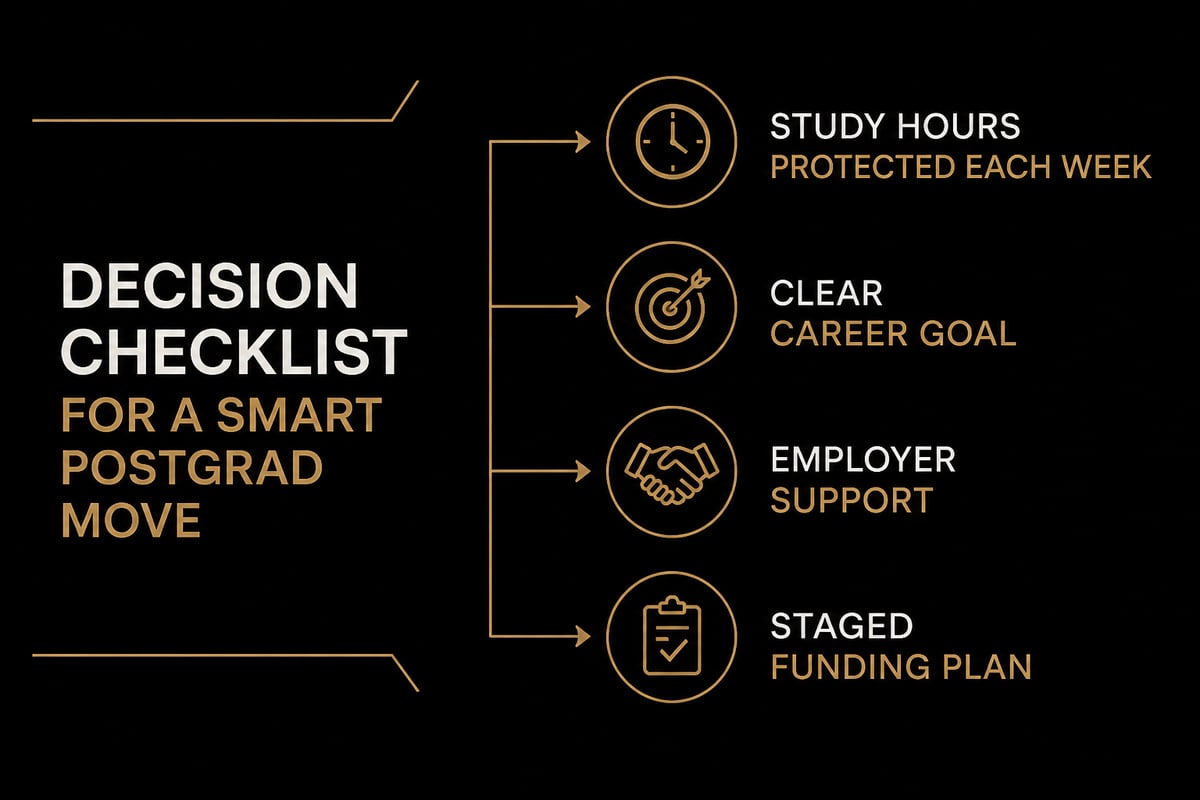
Ask yourself these questions honestly before applying:
- Can I protect several hours of study each week for the length of the programme?
- Does this qualification connect to a specific career goal, such as a promotion, a move into senior management or a new sector?
- Will my employer support the study, even informally, through leave around assessment dates?
- Can I fund the programme in stages, and does my budget survive an unexpected expense?
If your answers are mostly yes, you are in a good position. If not, resolve the weakest point first. A shaky plan usually fails at the hardest moment of a course, not at the start.
Entry Requirements and Applications: What to Prepare
Applying to a postgraduate programme requires evidence of your prior education and some account of your professional background. Exact documents and criteria differ by programme, so confirm them with the admissions team through the application form page rather than relying on assumptions.
A sensible preparation sequence looks like this:
- Collect your academic certificates and transcripts early, since obtaining official copies can take longer than expected.
- Update your CV so it shows responsibility and results, not only job titles.
- Write down your reasons for studying in two or three sentences. This will sharpen any statement you are asked to submit.
- Check the accreditation of any institution you consider. University of Gold Coast holds the Presidential Charter granted by the Government of Ghana, and its programmes are accredited by the Ghana Tertiary Education Commission (GTEC). The accreditation and recognition page sets this out.
Accreditation matters because employers and professional bodies look for it. A degree from an accredited institution is far easier to defend on a CV and in a promotion discussion.
How Much Time Going to Uni Really Takes
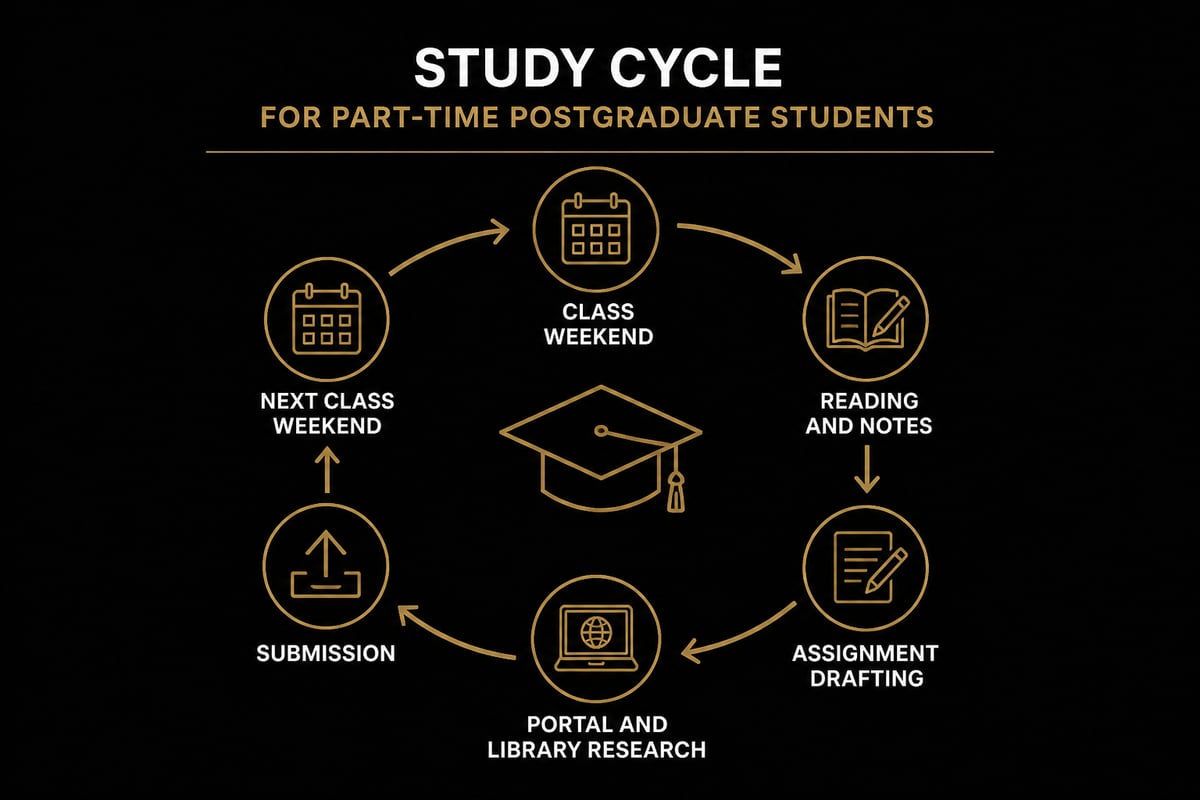
Studying part-time at postgraduate level takes more hours than most new students expect, because the class weekends are only the visible part. Reading, assignments, group work and revision happen in the gaps of ordinary life.
Here is a realistic way to think about it. Class weekends give you the framework: key concepts, discussion with faculty and peers, and the direction of upcoming assessments. The weeks between sessions are where you build understanding and produce the work that earns the grade.
One planning habit worth borrowing is to divide the day into blocks for sleep, work and everything else. For a working professional the "everything else" block must cover family, commuting, meals, exercise and study. Seen that way, study hours are limited, and protecting them in advance matters more than hoping they appear.
Build a Weekly Rhythm
Fixed study blocks work better than open-ended intentions. Many working students use early mornings before the office, a protected evening or two, and a longer block on a free weekend between class weekends.
Plan Around Your Work Calendar
Map your busiest work periods, such as year-end reporting, audits or budget season, against your assessment deadlines. Where they clash, start the coursework earlier instead of hoping for a quiet fortnight.
Paying for Your Degree Without Strain
The most manageable way to pay for a postgraduate degree while working is to spread the cost across the programme and budget for it like any other fixed commitment. University of Gold Coast offers flexible payment plans that let students pay as they go, which reduces the need to find a large sum up front.
Practical steps to protect your finances:
- Ask for current fees and payment schedules through the application form page or the university's contact channels. Do not rely on figures quoted by third parties.
- Add hidden costs to your budget. Transport to class weekends, printing, data for online research and occasional childcare all add up.
- Hold a small reserve. An unexpected expense is the most common reason working students pause their studies.
- Discuss sponsorship with your employer. Some organisations contribute to fees when the qualification is tied to their needs.
Transport can be a meaningful line in any student budget, so in Accra plan your own commute costs for each class weekend in advance.
Using Online Libraries and the Student Portal
Online libraries and the student portal give you access to reading, coursework materials and academic services outside class weekends, which is exactly when a working professional needs them. University of Gold Coast provides these resources to support both academic and professional development.
Make the portal part of your routine from week one:
- Log in early and explore every section before you need something urgently.
- Save the library's research tools and learn how to search for journal articles, not only general web pages.
- Check announcements regularly for assessment dates and class schedules.
- Keep a folder structure for each module so notes, readings and drafts are easy to retrieve.
Login steps and portal guidance are covered in the university's student portal overview, and the student login guide helps with access issues.
What Is the Hardest Year of University?
For most students the hardest year is the one where independent work first outweighs guided teaching, which at postgraduate level is usually the dissertation or major research project stage. Taught modules give you structure and deadlines. A dissertation asks you to define a question, find evidence and sustain momentum largely on your own.
Working professionals face a specific version of this challenge. Your job competes for the same energy, and the project has no weekly rhythm to hold you in place. You can reduce the strain in three ways:
- Choose a topic connected to your workplace, so research and professional insight reinforce each other.
- Agree milestone dates with your supervisor and treat them as firm appointments.
- Write a little every week, even when the work feels messy. Revising a rough draft is easier than starting a blank page.

Habits That Keep You on Track
Strong study habits for working students come down to a small number of routines done consistently. They matter more than any single burst of effort.
- Review soon after each class weekend. Spend an hour turning notes into a summary while the discussion is fresh.
- Study in one place. A consistent desk or corner signals to your brain that it is time to work.
- Limit your phone during study blocks. Put it in another room or use a focus mode.
- Start assignments early. Even an outline written the week you receive the brief reduces later pressure.
- Ask questions in class. Faculty bring real-world industry experience into the classroom, and a specific question from your own workplace often prompts the most useful answers.
Group work deserves attention too. Your classmates are managers and professionals with their own schedules, so agree meeting times and communication channels at the first session.
Managing Stress and Asking for Help
Feeling anxious at some point in a postgraduate programme is normal, and the best response is to act early rather than wait until a deadline is at risk. Most problems become easier when raised with a lecturer, programme coordinator or student support contact before they become emergencies.
Warning signs to take seriously include missing readings for several weeks, skipping the portal, avoiding classmates and sleeping poorly because of coursework. Responses that help:
- Tell your lecturer if illness or a work crisis will delay a submission.
- Scale back other commitments temporarily, such as volunteer roles.
- Keep exercise and rest on the calendar, since study quality drops when both disappear.
- Lean on classmates. Peers in a monthly cohort often share the same pressures.
University of Gold Coast describes a Christ-centred learning environment that combines academic excellence with ethical leadership. For many students, that setting provides a values framework that supports resilience and a sense of purpose through demanding periods.
Making Your Degree Count at Work
Your qualification delivers the most value when you apply it at work while you study, not only after graduation. Employers notice colleagues who bring frameworks and fresh analysis to real problems.
Ways to turn coursework into visible results:
- Use a live workplace problem as the subject of an assignment, with your employer's permission.
- Share a short summary of a relevant module with your team.
- Tell your manager which skills you are building, such as financial analysis, strategy or leadership, so new responsibilities can follow.
- Build a professional network within your cohort and among faculty.
Over time, this approach also strengthens your case for promotion. A qualification backed by documented results is more persuasive than a certificate alone.
Working Abroad or Studying Overseas Instead?
If you are weighing study overseas against a programme in Ghana, work rules are worth checking carefully. In Australia, for example, student visa holders can work up to 48 hours every two weeks while their course is in session, with unlimited hours during study breaks. That structure suits full-time students, but work rights of that kind rarely replace a senior salary or an established role.
For a manager with a career, family and professional standing in Ghana, relocating is a significant cost. A programme that runs one weekend a month lets you keep your income and your position while you study. You can compare options in the university's overview of universities in Ghana.
Safety information is another practical consideration wherever you study. Some cities publish live updates on weather warnings, road conditions and alerts through official dashboards. Wherever you live, learn which official channels your area uses.
FAQ
Will a 2.5 GPA get me into a postgraduate programme?
Admission decisions depend on the programme, and a GPA is only one factor. Contact the admissions team to confirm the criteria for the programme you want.
Why does Gen Z not go to college?
Rising costs, doubts about whether a degree guarantees a job and alternatives such as skills courses and entrepreneurship all play a part. Many people also choose to work first and study later, once their goals are clear. For working professionals, part-time postgraduate study offers a way to add credentials without giving up income.
Your next step is simple: write down the programme you want, your career goal and the study hours you can protect each week, then take that list to an admissions conversation. University of Gold Coast offers MBA, MSc, LLM, PhD and professional diploma options with monthly weekend classes and flexible payment plans, and you can apply now to start your postgraduate journey while keeping your job.