
A government university in Australia is a public institution established or funded under federal or state legislation, and the right one for you depends on accreditation, course fit, study format, total cost, and the career outcome you want. For working professionals in Accra and across Ghana, the decision also involves a practical question: can you complete the qualification without leaving your job? This guide sets out how to verify any institution, how to compare options, and how to test them against the demands of a full-time career.
What Is a Government University in Australia?
A government university in Australia is a public institution that operates under legislation passed by a federal or state parliament and receives public funding. Most of the country's long-established universities fall into this category, and they are regulated by national quality bodies.
Many readers ask whether public universities are government agencies. They are not. Public universities are legally independent bodies with their own councils, academic boards, and management. They receive government funding and follow government regulation, but they set their own curricula, admit their own students, and award their own degrees. A council appoints senior leadership, and an academic board decides what is taught and how it is assessed, which is why two public universities can offer very different versions of the same qualification.
This distinction matters when you compare institutions. "Government" describes the funding and legal basis, not the quality of a specific programme. A public charter or national recognition tells you the institution is legitimate. It does not tell you whether a particular MBA suits a manager who works fifty hours a week. Two programmes at public universities can differ in delivery mode, class schedule, assessment style, and the industry experience of their lecturers. Judge each course on its own record, using the official course register, rather than assuming that public status settles the question.
Why Ghanaian Professionals Look to Australian Universities
Australia attracts postgraduate students from Ghana because of its recognised qualifications, English-language instruction, and wide range of business and law programmes. A degree from a public Australian institution carries weight with employers in many markets.
There are also real constraints to weigh before you commit:
- Cost of relocation. Tuition is only part of the budget. Visa fees, health cover, accommodation, and flights add substantially to the total.
- Time away from work. Campus-based study often means pausing a career, which is difficult for managers with team and family responsibilities.
- Visa conditions. Student visas carry work-hour limits and compliance rules that affect how much you can earn while studying.
- Entry requirements. Postgraduate admission usually asks for a prior degree, English proficiency evidence, and sometimes work experience.
Treat these as part of your selection criteria rather than afterthoughts. A prestigious name is of limited use if the study format forces you to abandon the career you are trying to advance.
How to Verify That an Institution Is Legitimate
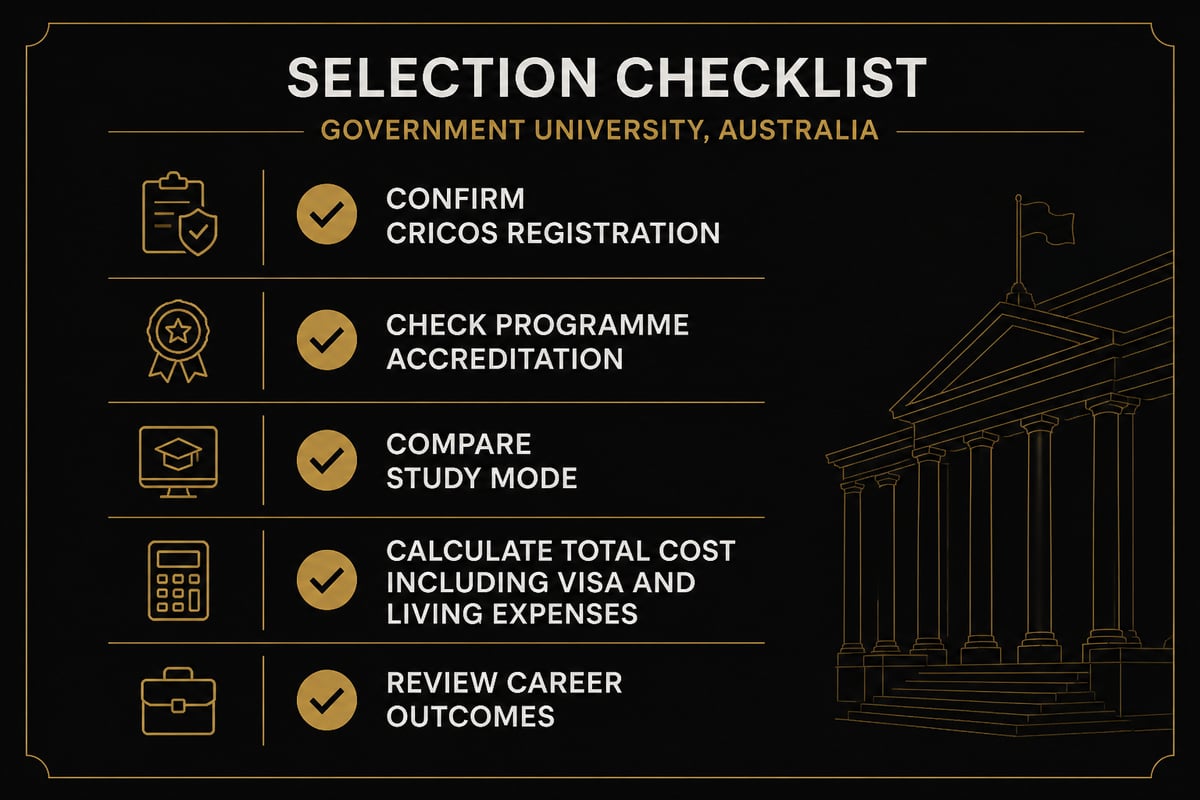
The most reliable way to verify an Australian institution is to check it against official government registers before you pay any fee. Two tools do most of the work.
The Australian Government's Study Australia Course Search lets prospective students compare thousands of courses from CRICOS-registered providers. For international applicants, the official CRICOS course search allows you to check registered courses and providers by qualification type and by Australian state or territory.
Follow these steps in order:
- Search the provider on the CRICOS register and confirm it is registered to teach international students.
- Confirm the specific course, not just the institution, appears on the register.
- Note the course duration, qualification level, and campus location listed.
- Compare these details against the offer letter or marketing material you received.
- Contact the provider directly if anything does not match.
Any mismatch between a brochure and the official record is a warning sign. Agents and advertisements are not substitutes for the register.
Criteria for Comparing Postgraduate Options
Compare postgraduate programmes on the same set of attributes so that differences become visible. The table below organises the factors that matter most to a manager planning a master's-level qualification.
| Factor | What to check | Why it matters |
|---|---|---|
| Accreditation | CRICOS registration and programme-level approval | Confirms legal standing and recognition |
| Study mode | Full-time on campus, part-time, online, or blended | Determines whether you can keep working |
| Duration | Total months to completion | Affects cost and career timing |
| Total cost | Tuition, visa, health cover, living costs | Reveals the true financial commitment |
| Faculty | Industry experience alongside research credentials | Shapes how practical the teaching is |
| Recognition at home | Acceptance by Ghanaian employers and regulators | Protects the value of your investment |
Weight these factors according to your situation. A manager with a family in Accra might rank study mode and recognition at home above prestige. A professional planning to emigrate might weight visa pathways more heavily.
Score each shortlisted programme from one to five on every factor, then multiply by the weight you gave that factor. Doing this on paper exposes trade-offs that are easy to rationalise in your head. A programme that looks cheaper on tuition may score lower once living costs and forgone salary are added. Duration deserves the same scrutiny, because a longer programme extends the time before any promotion or salary gain arrives. When two options score closely, let study mode break the tie, since it decides whether the plan survives contact with your actual working week.
Does a Government University Suit a Working Manager?
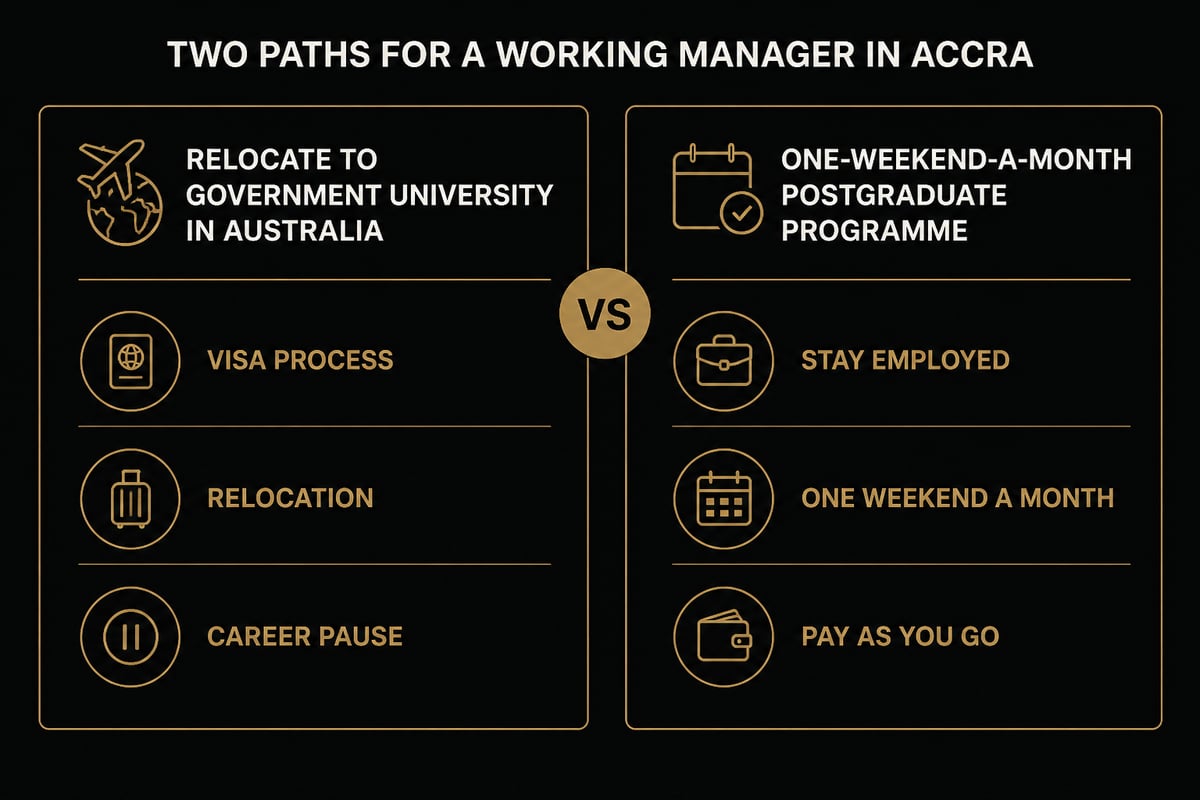
For most working managers in Ghana, a campus-based degree at a government university in Australia is a poor fit unless you are prepared to relocate and pause your career. The model assumes presence in the classroom for weekdays across a semester.
That model works well for full-time students. It works badly for someone who leads a department, serves clients, or supports a household. The cost is not only tuition. It is also forgone salary, interrupted promotion timelines, and time away from family.
Consider these questions before applying overseas:
- Can your employer grant a long leave, and will your role be waiting for you?
- Does your household income remain stable without your salary?
- Will the qualification change your earning power enough to offset the break?
- Is a degree you can complete while working a better risk-adjusted choice?
If the honest answers point away from relocation, the more useful comparison is between overseas campus study and local, work-compatible programmes that hold proper recognition.

A Work-Compatible Alternative: University Of Gold Coast
If your priority is a postgraduate business qualification without leaving your job, University Of Gold Coast offers a structure built around that need. Its structure is built around professionals who need to keep working while they study.
Several features are relevant to the checks described above:
- Recognised standing. The university holds the Presidential Charter, granted by the Government of Ghana, and all its academic programmes are accredited by the Ghana Tertiary Education Commission. You can review the details on the accreditation and recognition page.
- Programme range. Offerings include MBA, MSc, LLM, PhD, and professional diplomas across business, law, and theology.
- Practical teaching. Faculty bring real-world industry experience into the classroom.
- Flexible payment. Payment plans are available to help students spread the cost.
- Values-led environment. The learning environment is Christ-centred and combines academic excellence with ethical leadership.
Managers weighing an MBA can read the case for the UGC MBA to see how the programme is positioned. For specific fees, intake dates, and entry requirements, contact the university directly or consult its admissions pages rather than relying on third-party summaries.
How to Judge Recognition and Quality Beyond the Brochure
Quality shows up in verifiable facts rather than in marketing language. Start with the governing framework, then examine the people and the support systems behind it.
Look at who leads the institution. A credible university publishes the names and backgrounds of its governing officers, as UGC does on its leadership page. Look for an advisory structure that brings in outside perspectives, such as an international advisory board.
Then test the student experience:
- Ask how coursework, libraries, and assessments are delivered.
- Ask whether there is a student portal and what it covers.
- Ask how faculty are selected and what industry background they hold.
- Ask graduates how the qualification was received by their employers.
Finally, confirm the accreditation chain end to end. For a Ghanaian qualification, that means the national regulator. For an Australian one, it means the national register. In both cases the check is public and free.
Mistakes to Avoid When Choosing a University Abroad
The most costly errors come from skipping verification and underestimating total cost. Avoid these patterns:
- Relying on an agent's word alone. Confirm every claim against the official register. A provider can appear legitimate in a brochure yet be missing from the CRICOS course search, or be registered for different courses than the ones advertised. Check by qualification type and by Australian state or territory, and keep a record of what the register shows on the day you search.
- Comparing tuition only. Add visa, health cover, accommodation, and the salary you will forgo. For a manager earning a full salary in Accra, a year or more of lost income can exceed the tuition itself, so the real price of a campus programme is the sum of every line.
- Ignoring recognition at home. A qualification that your employer or regulator does not value has limited return. Ask your HR department or professional body whether they accept the specific award before you apply, not after you graduate.
- Choosing by name rather than fit. A well-known institution with an unsuitable format will not serve a working manager. Weekday attendance across a semester is a poor match for someone leading a team.
- Overlooking payment structure. A programme that allows staged payments can be easier to sustain than one demanding large upfront sums. Ask when each instalment falls due and what happens if your circumstances change mid-programme.
Reading a guide to what makes a university different can help you articulate which qualities matter most to you before you shortlist.
FAQ
How do I know if a university in Australia is government-recognised?
Check the provider and the specific course on the official CRICOS register, which lists institutions registered to teach international students. If either the provider or the course is missing, treat the offer with caution and ask for written clarification before paying anything.
Can I study for a postgraduate business degree without leaving my job?
Yes, if you choose a programme designed for working professionals. Some institutions schedule classes on weekends or online, which allows you to continue your career. Confirm the format, accreditation, and recognition of the programme before enrolling.
Is an overseas degree always more valuable than a local one?
No. Value depends on accreditation, recognition by employers, and how well the programme matches your goals. A properly accredited local qualification that you can complete while employed may deliver a stronger return than an overseas degree that requires a career break.
Your next step is to write down the three criteria that matter most to you, such as study format, total cost, and recognition at home, and test every shortlisted institution against them. If a monthly weekend schedule and pay-as-you-go fees fit your life, University Of Gold Coast offers MBA, MSc, LLM, PhD, and diploma programmes backed by a Presidential Charter and GTEC accreditation, and you can submit your application there to begin your postgraduate journey.