
Pursuing a graduate degree represents a significant investment in your professional future, but the financial burden doesn't have to be overwhelming. In 2026, prospective students have access to numerous cheapest online graduate programs that deliver quality education without the six-figure debt load. Understanding how to identify, evaluate, and select affordable online graduate options requires looking beyond sticker prices to examine the true cost of attendance, available financial aid, and long-term return on investment.
Understanding the True Cost of Online Graduate Education
The price tag advertised on a university's website rarely tells the complete story. When evaluating the cheapest online graduate programs, you must distinguish between published tuition rates and the actual amount you'll pay after financial aid, institutional grants, and scholarships.
Breaking Down Tuition Versus Net Price
Sticker price represents the full cost before any financial assistance. Net price, however, reflects what students actually pay after subtracting grants, scholarships, and other aid that doesn't require repayment. According to the NACUBO Tuition Discounting Study, institutional aid practices significantly affect the actual cost students incur, making published rates potentially misleading when comparing programs.
Key cost components to evaluate:
- Base tuition per credit hour
- Required fees (technology, registration, graduation)
- Course materials and textbooks
- Software licenses or specialized tools
- Residency or immersion requirements
Many online programs charge the same tuition regardless of residency status, eliminating the traditional in-state versus out-of-state differential. This creates opportunities for students to access affordable programs nationwide without geographic constraints.

Hidden Costs and Unexpected Expenses
Even the cheapest online graduate programs carry expenses beyond tuition. Technology requirements may demand computer upgrades, reliable internet service, or specific software subscriptions. Some programs require brief on-campus residencies or synchronous meeting times that necessitate travel or adjusted work schedules.
The College Affordability and Transparency Center provides comprehensive data on institutional costs, allowing you to compare the total cost of attendance across institutions. This federal resource breaks down not just tuition but also estimated living expenses, books, and other mandatory fees.
Categories of Affordable Online Graduate Programs
Different graduate degree types carry vastly different price tags. Understanding these categories helps you identify realistic options within your budget and career goals.
Master's Degrees by Discipline
Business programs, particularly MBA degrees, typically command premium prices. However, several institutions offer competitively priced online MBA programs with total costs under $15,000. Education master's degrees often represent the most affordable category, with many public universities pricing programs for working teachers at under $400 per credit hour.
| Discipline | Average Low-Cost Range | Typical Program Length |
|---|---|---|
| Education (MEd, MAT) | $8,000 – $18,000 | 30-36 credits |
| Business (MBA) | $12,000 – $25,000 | 36-48 credits |
| Computer Science (MSc) | $15,000 – $30,000 | 30-36 credits |
| Public Administration | $10,000 – $20,000 | 36-42 credits |
| Social Work (MSW) | $15,000 – $28,000 | 60 credits |
Healthcare-related master's programs, including nursing and public health degrees, fall in the middle range. These programs balance affordability with specialized accreditation requirements that sometimes increase costs.
Professional Certificates and Graduate Diplomas
Graduate certificates and professional diplomas offer specialized credentials at a fraction of master's degree costs. These programs typically require 12-18 credits and can be completed in less than a year. The University Of Gold Coast offers professional diplomas across business, law, and theology that provide targeted expertise without the commitment of a full master's program.
Advantages of certificate programs:
- Lower total investment ($3,000 – $8,000 typical range)
- Faster completion timelines
- Focused skill development
- Often stackable toward full degrees
- Immediate workplace application
Doctoral Programs and Terminal Degrees
Doctoral programs present a unique affordability landscape. Many PhD programs offer full funding through assistantships, fellowships, or research positions. Professional doctorates like EdD or DBA programs, however, typically require students to self-fund. The cheapest online graduate programs at the doctoral level often range from $30,000 to $60,000 total, significantly below the six-figure costs of many residential programs.
Strategies for Identifying the Most Affordable Programs
Finding genuinely affordable online graduate education requires systematic research and careful evaluation beyond surface-level price comparisons.
Regional and State University Systems
Public regional universities frequently offer the cheapest online graduate programs without sacrificing quality. These institutions serve their state populations with accessible, affordable options and often extend in-state tuition rates to all online students.
State university systems in particular provide economies of scale. When a university system develops one high-quality online MBA or MSc program and shares it across multiple campuses, development costs are distributed, keeping tuition lower. Students benefit from established reputations and strong alumni networks while paying substantially less than private institutions.

Competency-Based and Self-Paced Programs
Competency-based education (CBE) models charge by subscription period rather than credit hour. Students who can accelerate through material they already know can complete degrees faster, reducing total costs dramatically. Some CBE programs allow completion of an entire master's degree in 6-12 months for $6,000-$12,000 total.
This model particularly benefits working professionals with relevant experience. A business professional pursuing an MBA might already possess substantial knowledge in management, marketing, or finance, enabling rapid progression through those competencies.
Employer Partnerships and Corporate Tuition Programs
Many employers partner with universities to offer discounted tuition rates. Corporate partnerships can reduce graduate program costs by 20-30% or more. Additionally, employer tuition assistance programs contribute $5,250 annually tax-free under current federal law, substantially offsetting graduate education costs.
Research whether your employer maintains partnerships with specific universities or participates in consortium arrangements. Professional organizations in fields like nursing, education, and technology also negotiate member discounts with select institutions.
Financial Aid and Funding Mechanisms
Even the cheapest online graduate programs require strategic financing for most students. Understanding available funding sources maximizes affordability.
Federal Student Loans for Graduate Students
Graduate students can borrow up to $20,500 annually in Direct Unsubsidized Loans, plus additional amounts through Graduate PLUS loans up to the full cost of attendance. The Federal Student Aid program provides official guidance on eligibility, terms, and recent policy changes affecting graduate borrowers.
Graduate loan considerations:
- Unsubsidized loans accrue interest during enrollment
- Graduate PLUS loans require credit checks
- Income-driven repayment plans available post-graduation
- Public Service Loan Forgiveness (PSLF) may apply
- Interest rates reset annually based on federal policy
Research from the Philadelphia Federal Reserve examines how federal borrowing rules affect graduate access and affordability, highlighting the importance of borrowing strategically.
Institutional Scholarships and Assistantships
Many online programs offer merit-based scholarships, though these are less common than in residential programs. Graduate assistantships in online programs may involve virtual responsibilities like discussion moderation, course development support, or research assistance.
Target programs that explicitly advertise scholarship opportunities for distance learners. Some institutions reserve specific funding for online students to ensure competitive aid packages regardless of attendance mode.
Alternative Funding Sources
Beyond traditional financial aid, consider these funding mechanisms:
- Professional development grants from employers
- Industry-specific scholarships and fellowships
- Veterans' benefits (GI Bill coverage for graduate programs)
- State-based aid programs for high-demand fields
- Income share agreements (ISAs) at select institutions
The ETS guidance on net price helps students understand cost-of-attendance concepts and how various aid sources combine to determine actual out-of-pocket expenses.
Balancing Cost with Quality and Return on Investment
The absolute cheapest option isn't always the wisest choice. Graduate education represents an investment that should generate positive returns through enhanced earnings, career advancement, or professional fulfillment.
Accreditation and Program Quality Indicators
All legitimate graduate programs must hold institutional accreditation from recognized regional agencies. Programmatic accreditation in specialized fields (AACSB for business, CACREP for counseling, CCNE for nursing) signals additional quality standards.
Quality indicators beyond accreditation:
- Faculty credentials and industry experience
- Student support services and technical infrastructure
- Job placement rates and alumni outcomes
- Retention and completion statistics
- Employer recognition of the credential
Low cost combined with poor completion rates or limited career impact represents false economy. Research program outcomes through institutional data and third-party reviews.
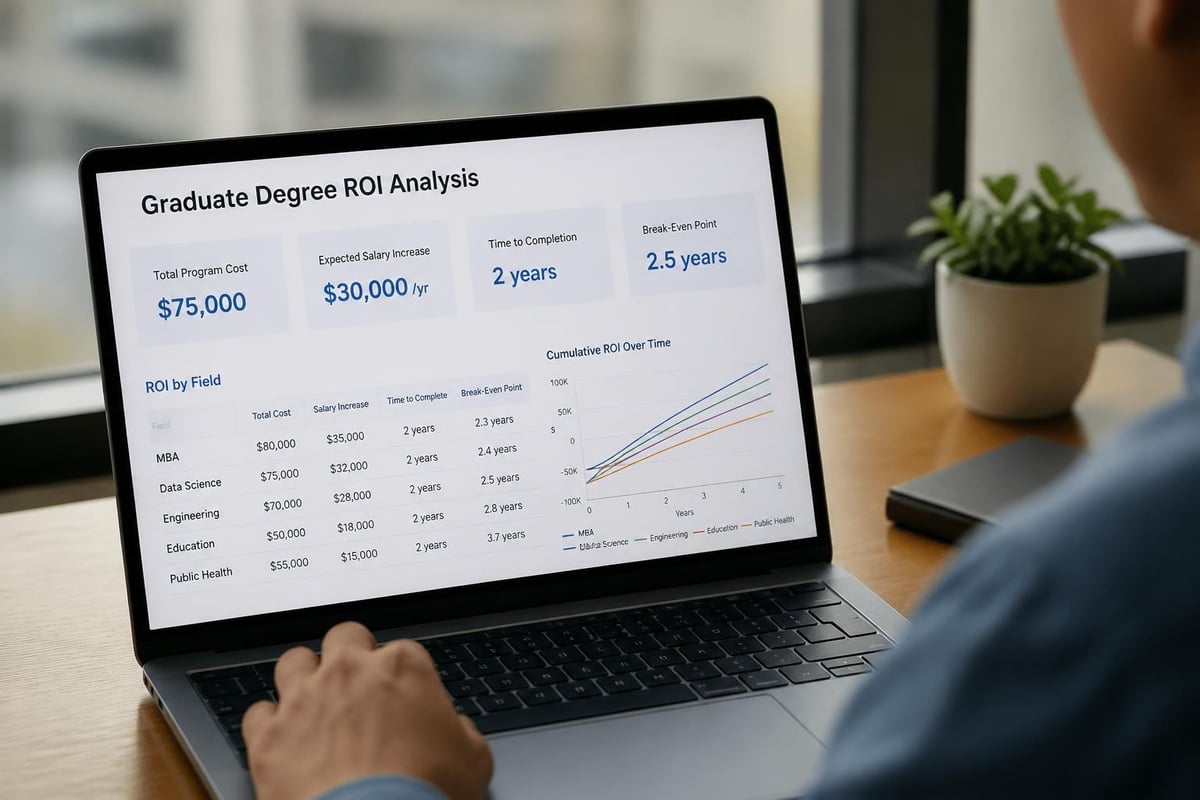
Calculating Return on Investment
According to Brookings Institution analysis, graduate degrees generate returns, but outcomes vary substantially across programs and fields. An affordable online MSc in computer science typically delivers strong ROI through salary increases, while some humanities master's degrees may not generate sufficient earnings gains to justify even modest costs.
| ROI Calculation Factor | Consideration |
|---|---|
| Total program cost | Include all fees, materials, and opportunity costs |
| Expected salary increase | Research field-specific data, not general averages |
| Time to completion | Faster completion improves ROI |
| Career switching costs | Account for potential initial salary reduction |
| Non-monetary returns | Professional satisfaction, intellectual growth |
Calculate your break-even point: how long will it take for increased earnings to offset your total investment? Most positive-ROI graduate programs reach break-even within 3-7 years.
Field-Specific Considerations
Some professions require graduate credentials for advancement or licensure, making the degree non-optional regardless of cost. Teachers pursuing administrative credentials, nurses advancing to nurse practitioner roles, and social workers seeking clinical licensure face mandatory graduate education.
In these cases, finding the cheapest online graduate programs that meet accreditation requirements becomes paramount. The credential itself matters more than institutional prestige, especially when professional licensing boards recognize all accredited programs equally.
Top Categories of Affordable Online Graduate Programs in 2026
Current market analysis reveals several categories consistently offering strong value propositions for cost-conscious students.
Public University Online Programs
State flagship universities increasingly compete in the online graduate market with competitively priced programs. These institutions leverage established reputations while pricing programs to remain accessible to working professionals.
Programs from public universities in states with lower costs of living often provide the best value. Southern and Midwestern institutions frequently price online master's degrees 30-50% below coastal counterparts while maintaining comparable quality.
Specialized Online Institutions
Universities purpose-built for online delivery often achieve cost efficiencies that translate to lower tuition. Without maintaining extensive physical campuses, these institutions focus resources on instructional technology, faculty development, and student support services.
Western Governors University pioneered the affordable competency-based model, while institutions like University of the People offer tuition-free models with minimal per-course assessment fees.
Non-Profit Professional Schools
Professional graduate schools in business, law, and theology often balance mission-driven accessibility with financial sustainability. The University Of Gold Coast exemplifies this approach, offering MBA, MSc, LLM, and professional diploma programs with robust student support through online libraries and dedicated portals.
These institutions prioritize student success through comprehensive resources while maintaining affordability through operational efficiency and scale.
Consortium and Shared Programs
Some state systems or institutional consortia develop shared online programs, distributing development costs across multiple universities. Students benefit from collaborative resources and reduced per-student costs while accessing high-quality curricula developed through pooled expertise.
Practical Steps for Selecting Your Program
Armed with knowledge about affordable options and funding strategies, take systematic action to identify and enroll in the right program.
Step 1: Define Your Goals and Requirements
Begin by clarifying what you hope to achieve through graduate education. Career advancement, credential requirements, intellectual exploration, and professional networking each suggest different program priorities.
Essential questions to answer:
- What specific credential do you need?
- Which accreditations are mandatory for your field?
- What is your realistic budget and timeline?
- Do you require complete flexibility or can you accommodate some synchronous requirements?
- What support services matter most to you?
Step 2: Research and Compare Options
Create a comparison spreadsheet tracking tuition, fees, total program cost, accreditation status, program length, and any unique features. The Department of Education’s College Affordability and Transparency Center provides standardized data enabling apples-to-apples comparisons.
Use filters to identify programs within your target price range, then evaluate quality indicators for those finalists. Don't dismiss slightly higher-priced options until reviewing their financial aid availability.
Step 3: Calculate True Net Price
Contact financial aid offices directly to understand available scholarships, assistantships, and aid packages. Ask about typical award amounts for students with your profile and whether aid remains consistent across all program years.
Factor in employer contributions, tax benefits from education expenses, and opportunity costs of time commitment. A slightly more expensive program completed in 12 months may cost less overall than a cheaper option requiring 24 months due to additional fees and delayed salary increases.
Step 4: Evaluate Program Fit and Support
Request information sessions, connect with current students, and review program structures carefully. The cheapest online graduate programs must still provide adequate support, responsive faculty, and alignment with your learning preferences.
Assess whether the program offers career services, technical support, library access, and networking opportunities that justify the investment beyond course content alone.
Step 5: Apply Strategically
Apply to multiple programs within your target range. Acceptance to several options creates negotiating leverage for financial aid and lets you make informed comparisons once you know actual costs after aid packages.
Submit applications well before deadlines to maximize scholarship consideration. Many institutions award merit aid on a first-come, first-served basis until funds are exhausted.
Emerging Trends in Online Graduate Education Affordability
The landscape of affordable online graduate education continues evolving. Understanding current trends helps you anticipate future opportunities and challenges.
Increased Competition and Price Pressure
As more institutions launch online programs, competition intensifies, creating downward price pressure. According to trends in college pricing from the College Board, online program growth has influenced overall graduate tuition dynamics, with some institutions freezing or reducing online tuition to remain competitive.
This trend benefits students but requires careful quality assessment as institutions balance affordability with resource investment in program excellence.
Micro-Credentials and Modular Degrees
Universities increasingly offer stackable credentials where certificates combine toward master's degrees. This modular approach lets students start with smaller financial commitments, test program fit, and build credentials incrementally while working.
Stop-out points provide natural exit opportunities with credentials in hand if circumstances change, reducing the risk of incomplete degrees with outstanding debt.
Employer Direct Contracting
Forward-thinking employers now contract directly with universities for customized cohort programs serving their workforce. These arrangements often secure substantial tuition discounts and align curriculum specifically with organizational needs.
As this model expands, more working professionals may access graduate education through employer-sponsored cohorts at dramatically reduced personal cost.
Identifying and enrolling in affordable online graduate programs requires systematic research, realistic ROI calculations, and strategic use of available funding sources. By evaluating true net price rather than sticker costs, assessing quality indicators alongside affordability, and leveraging employer support and federal aid, you can earn a graduate credential without excessive debt burden. Whether you're pursuing advanced business credentials, specialized legal knowledge, or theological studies, University Of Gold Coast provides accessible pathways through comprehensive online programs supported by robust libraries, student portals, and dedicated faculty across PhD, MBA, MSc, LLM, and professional diploma options designed for working professionals seeking quality education at sustainable costs.