
The postgraduate meaning is simple: it describes any study undertaken after you have already completed an undergraduate degree. According to the UK National Careers Service, postgraduate study is degree-level study taken after a first degree, and it includes master's degrees, postgraduate diplomas and doctorates.
The term works as both an adjective and a noun. A "postgraduate course" is advanced study, and a "postgraduate" is the person pursuing it. For professionals in Accra weighing an MBA, or aspiring legal specialists considering an LLM, the label tells you where a qualification sits on the academic ladder and what it expects of you.
What Does Postgraduate Mean?
Postgraduate means "after graduation": it refers to education that follows the award of a bachelor's degree. The word combines the prefix "post-" (after) with "graduate," and it applies to the qualification, the course and the student alike.
The Cambridge Dictionary defines the shortened form "postgrad" as relating to an advanced qualification taken after a first university degree. You will also see "PG" used in admissions materials, as in "PG diploma" or "PG programme."
The label also tells you what a course will demand. Postgraduate study can be taught, with lectures, seminars and tutorials, or research-based, with independent work under academic supervision, as the UK National Careers Service describes. Entry usually depends on your first degree result: some courses require at least a 2:2, while others may ask for a first-class honours degree. A prospectus that lists "PG" programmes is therefore telling you three things at once: you need a bachelor's degree, the content will be advanced, and the assessment will lean toward independent thinking.
Three points define the term:
- Prerequisite: a completed undergraduate degree comes first.
- Level: study is advanced, specialised and more independent than a bachelor's programme.
- Outcome: the result is a postgraduate certificate, diploma, master's degree or doctorate.
Types of Postgraduate Qualifications
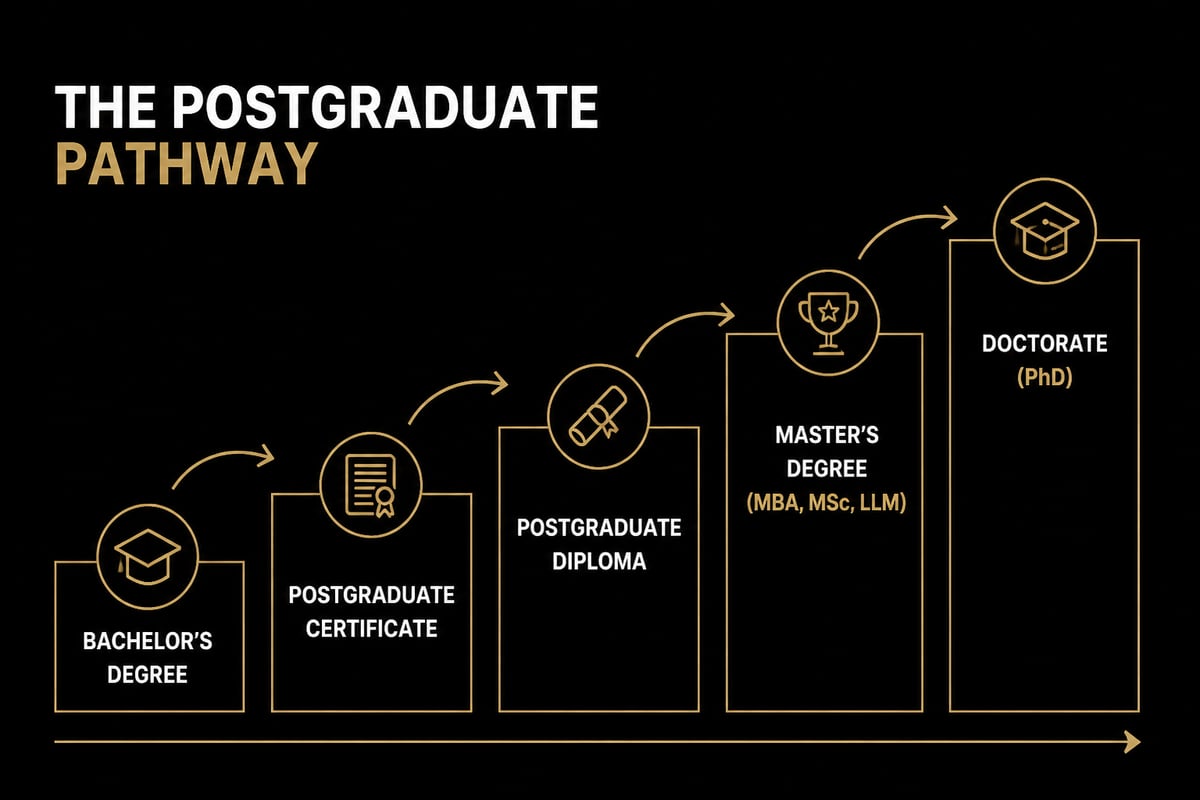
There are four main types of postgraduate qualification: postgraduate certificates, postgraduate diplomas, master's degrees and doctorates, as nidirect sets out. They differ in depth, length and purpose.
| Qualification | Typical purpose | Typical full-time length |
|---|---|---|
| Postgraduate certificate | Short, focused skills update | Under a year |
| Postgraduate diploma | Professional or specialist training | Around one year |
| Master's degree (MBA, MSc, LLM) | Advanced specialisation or career change | At least 12 months |
| Doctorate (PhD) | Original research contribution | At least three years |
The 12-month minimum for a master's degree and the three-year minimum for a doctorate both come from nidirect. Part-time and weekend formats stretch these timelines, which is how many employed students manage them.
Taught versus research study
Postgraduate study can be taught or research-based. Taught courses commonly rely on lectures, seminars and tutorials, while research degrees involve independent work under academic supervision, according to the UK National Careers Service. An MBA is typically taught. A PhD is research-led.
Who Is a Postgraduate Student?
A postgraduate student is anyone enrolled in a programme that requires a prior bachelor's degree. The category is wide, and it spans very different people.
- A manager in Accra completing an MBA while continuing to work.
- A legal professional studying for an LLM to specialise in international law.
- A graduate in theology or education pursuing a master's to move into leadership.
- A researcher working toward a doctorate.
Entry requirements vary by course. Normally, applicants need a bachelor's degree at 2:2 level or above, though nidirect notes that course requirements differ. Some programmes ask for more: the UK National Careers Service states that others may require a first-class honours degree.
Work experience often counts alongside grades, particularly for management programmes. For the exact admission criteria of a given programme, check the University Of Gold Coast's postgraduate brochure.
Postgraduate vs Graduate: Why the Terms Confuse People
Postgraduate and graduate overlap because they are used differently depending on where you are. In British and Ghanaian usage, a graduate is someone who has earned a bachelor's degree, and a postgraduate is someone studying beyond it. In the United States and Canada, "graduate student" usually means the same person a British speaker would call a postgraduate.
The Collins Dictionary notes this split, explaining that "graduate" is used in the US and Canada for a student pursuing advanced study. The practical consequence: when you read a programme description from a foreign institution, "graduate school" and "postgraduate programme" usually point to the same level of study.
Some quick definitions to keep straight:
- Undergraduate: studying for a first degree. See the undergraduate meaning explainer for detail.
- Graduate (British usage): someone who has completed a first degree.
- Graduate (North American usage): a student in advanced study after a bachelor's degree.
- Postgraduate: advanced study after a first degree, in British, Ghanaian and most Commonwealth usage.
For a closer look at the North American term, the graduate degree meaning article covers it in full, and the graduate and undergraduate difference page sets the levels side by side.
Is an Integrated Master's Degree Postgraduate?
An integrated master's degree is a single programme that combines undergraduate and postgraduate study, usually over four or five years, and awards a master's-level qualification at the end. Because the first years are undergraduate-level, it is not a postgraduate course you join after a bachelor's degree. It is a combined route in which you enter as an undergraduate.
Engineering and science subjects commonly use this format in the UK. A stand-alone master's, by contrast, expects you to arrive already holding a degree. If you already have a bachelor's degree, the stand-alone route is the one that applies to you, and it is the format used for professional master's programmes such as the MBA and LLM.

How Postgraduate Study Differs From Undergraduate Study
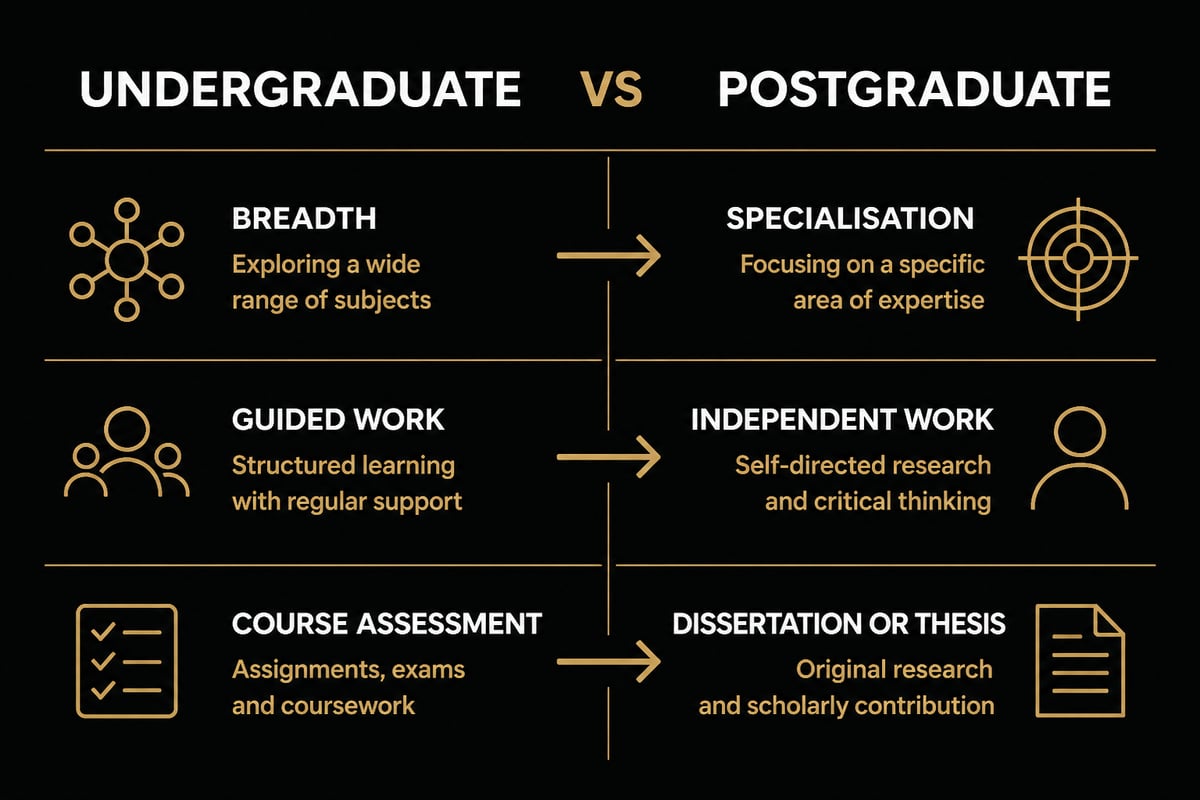
Postgraduate study differs from undergraduate study mainly in independence, depth and expectation. The Complete University Guide compares the two levels, outlines the UK qualification levels and describes taught and research degrees.
Where an undergraduate programme introduces a field and tests what you have absorbed, a postgraduate programme expects you to question that material, test it against evidence and apply it. A taught master's, for example, may set a reading list as a starting point and expect you to find further sources yourself. Research degrees go a step further: you work independently with academic supervision, and the length reflects it, with a master's taking at least 12 months of full-time study and a doctorate usually at least three years, according to nidirect.
Key differences you will notice:
- Narrower focus. You specialise in one field rather than surveying a broad curriculum.
- More independent work. Lecturers guide you, but you carry more of the reading, analysis and writing.
- Applied thinking. Assignments often draw on your workplace, which suits mid-career students. An MBA student might analyse a real budgeting or staffing problem from their own organisation.
- Smaller cohorts. Discussion and peer learning carry more weight.
- Higher stakes for a dissertation or thesis. Most master's programmes culminate in a substantial piece of original work.
Why the Postgraduate Meaning Matters for Working Professionals
Understanding the postgraduate meaning matters because it determines which qualification fits your goal, your timeline and your budget. Choosing the wrong level wastes time and money.
For a manager, the practical question is usually whether a short qualification or a full master's serves the next career step. A postgraduate certificate in management can sharpen specific skills quickly, while an MBA signals broader leadership readiness. Doctoral study suits those aiming at research, academia or high-level policy roles.
The four-level structure gives you a way to match the qualification to the need. If a promotion requires a specific skill set, a postgraduate certificate or diploma may be enough. If you want a career change or deeper specialisation, a master's degree, which takes at least 12 months of full-time study, is the more fitting level. If your goal is an original contribution to knowledge, the doctorate, usually at least three years full-time, is the path. Timelines matter for employed students too. Part-time and weekend formats stretch these durations, so ask how a programme is scheduled before you commit. Entry requirements also differ between courses, so confirm whether a 2:2 or a first-class honours degree is expected before you apply.
Regional comparisons also help. Countries structure postgraduate eligibility and duration differently, and Study in India summarises postgraduate and doctoral eligibility and typical study durations there, a useful contrast when you compare international options.
How the University Of Gold Coast Fits In
The University Of Gold Coast offers postgraduate programmes built for people who already have careers. Classes run one full weekend a month, so working professionals can study without leaving their jobs, and flexible payment plans let students pay as they go.
Further facts relevant to your decision:
- Degrees are awarded by the University of Gold Coast and accredited by the Ghana Tertiary Education Commission (GTEC).
- The university holds the Presidential Charter, granted by the Government of Ghana.
- Faculty bring real-world industry experience into the classroom.
- The learning environment is Christ-centred, combining academic excellence with ethical leadership.
Programmes span business, law and theology, with qualifications including the MBA, MSc, LLM, PhD and professional diplomas. Management-focused professionals can start with the postgraduate certificate in management, and the full list of postgraduate programmes shows every option. For fees, entry requirements and timetables, consult the university's programme pages or contact its admissions team directly.
This route is built for postgraduate and professional study. It is not designed for students seeking full-time, campus-based undergraduate education.
Related Terms Worth Knowing
These terms appear often in postgraduate admissions material:
- Postgrad / PG: informal and administrative shorthand for postgraduate.
- Master's degree: a postgraduate degree, such as an MBA, MSc or LLM, that deepens expertise.
- Doctorate: the highest academic degree, usually a PhD, based on original research.
- Dissertation: an extended written project, typically at master's level.
- Thesis: a longer research document, typically at doctoral level.
- Postgraduate certificate and diploma: shorter, lower-credit qualifications that sit below a master's.
- Taught degree: assessed through coursework and exams.
- Research degree: assessed mainly through a thesis.
FAQ
What is a postgraduate graduate?
The phrase usually describes someone who holds a bachelor's degree and has moved on to advanced study. In British and Ghanaian usage the person is simply called a postgraduate, while North American usage would call them a graduate student.
What is the difference between grad school and a master's degree?
Grad school is the institution or division where advanced study takes place, while a master's degree is one qualification you can earn there. Doctorates and graduate certificates are also awarded through grad school, so a master's is one option within it.
What does "graduate" mean in the context of education?
In British and Ghanaian usage, a graduate is a person who has completed a degree, most often a bachelor's. In the US and Canada, the word also describes a student in advanced study after that first degree.
Start by listing the qualification level you need, then compare it against the postgraduate brochure so you know which programme matches your goals. The University Of Gold Coast offers MBA, MSc, LLM, PhD and professional diploma options in business, law and theology, delivered one weekend a month for people who are working. When you are ready to move from research to enrolment, you can apply now and begin your postgraduate journey.