
The requirements for masters admission usually include a recognized bachelor's degree, academic transcripts, a minimum grade average, a current CV, a personal statement, and one or more references. Some programs add an entrance test or an interview, and many business programs expect a few years of work experience. The exact list varies by institution, so confirm each item with the program you plan to join before you start collecting documents.
For managers and professionals in Ghana who intend to keep their jobs while studying, the practical question is how to assemble a strong file in the time your schedule allows. This article sets out each requirement, explains what admissions committees look for, and shows how to prepare.
What Are the Standard Requirements for Masters Admission?
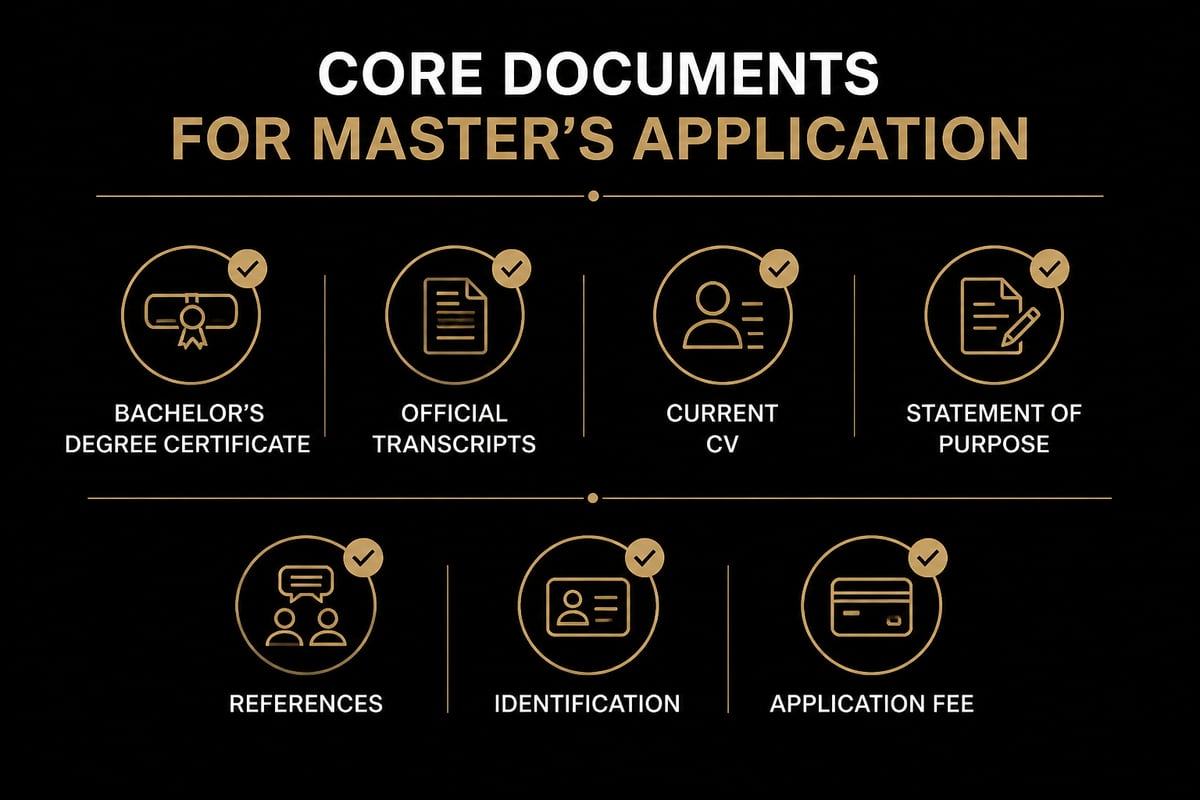
Most master's programs ask for the same core set of documents: a completed bachelor's degree, official transcripts, a CV, a statement of purpose, references, and proof of identity and English proficiency where relevant. These items let a committee judge your academic preparation, your motivation, and your fit with the program.
A typical application file contains:
- A completed application form with accurate personal and academic details
- A bachelor's degree from an accredited institution, or its recognized equivalent
- Official transcripts showing every course and grade
- A current CV that emphasizes career progression and responsibility
- A statement of purpose explaining why you want the degree and what you will do with it
- References, either academic or professional
- Application fee, where the institution charges one
For example, UNC-Chapel Hill’s Graduate School lists a completed four-year bachelor's degree or international equivalent and a cumulative B average (3.0 GPA) as minimum graduate-school requirements. Individual programs often set higher bars than the institutional floor, so treat published minimums as the starting point.
Which Degree and Academic Background Do You Need?
You need a bachelor's degree from a recognized institution, and for most business master's programs the degree does not have to be in business. Admissions teams care that your undergraduate study was credible and that you can handle postgraduate coursework.
Programs fall into two broad groups. Specialized programs, such as an MSc in a technical field, often ask for a related first degree or prerequisite courses. Management programs, including the MBA, commonly accept graduates from any discipline because they value professional experience alongside academic results.
If your bachelor's degree came from outside Ghana, expect a credential check. Institutions may ask for certified transcripts and confirmation that the awarding body is recognized. Ask the admissions office early, because verification can take longer than any other step.
Some professionals have substantial experience but a non-standard academic history. If that describes you, read the University of Gold Coast's guide on pursuing a master’s without a bachelor’s degree to understand what alternative pathways may look like.
What GPA or CGPA Can Apply for Masters Programs?
A cumulative grade average of roughly a B, or 3.0 on a 4.0 scale, is a common minimum for master's admission at many institutions, and some programs consider candidates slightly below it when other parts of the file are strong.
A GPA above the typical minimum is a solid starting point for a master's application. A strong statement, solid references, and relevant work history can offset a grade average that is merely adequate. Admissions committees read the whole file rather than a single number.
If your grades are below the stated minimum, take these steps:
- Ask the program whether it offers conditional or probationary admission.
- Highlight your best-performing years or final-year results in your statement.
- Show recent evidence of academic ability, such as a professional certification or a completed short course.
- Request references from supervisors who can speak to your analytical and written skills.
Many working professionals find that a decade of progressive responsibility carries more weight than an undergraduate transcript from years ago. Programs that serve mid-career applicants tend to reflect that.
Do Master's Programs Require Work Experience?
Business and management master's programs often expect professional experience, while research-oriented programs less commonly require it. Experience matters most where classroom discussion draws on real organizational problems.
If you are a manager or senior professional, this works in your favor. Be specific on your CV: name team sizes, budgets, projects, and measurable outcomes. A line such as "Led a team of 12 and reduced procurement cycle time by 20 percent" tells a committee more than a list of duties.
Programs designed for working adults also tend to value what you contribute to peers. Many such programs bring industry experience into the classroom and assume students are already employed. Your own career history becomes part of the learning environment.
Are Entrance Tests Like the GRE or GMAT Required?
Standardized tests are required by some programs and waived by others, so the answer depends on the specific program. The University of Illinois Graduate College states that it does not require GRE or GMAT scores at the college level, though an individual program may require them.
When a test is requested, ETS advises that scores should be weighed alongside the rest of an applicant's materials, as explained in its guidance on how graduate programs use GRE scores. Check the validity period of any earlier score with the program, since it may limit how long a past result can be used.
Before you book a test, check three things:
- Whether the program requires, recommends, or waives it
- Whether professional experience can substitute for a score
- The deadline for submitting results
Many programs aimed at working managers rely on the CV, statement, and interview instead of a test. Confirm this with the admissions office before you invest weeks in preparation.
How Do You Write a Strong Statement of Purpose?
A strong statement of purpose is specific, concise, and tied to a clear career goal. The University of Illinois notes that academic statements are required and that the program-set maximum length ranges from 500 to 1,000 words, so stay within whatever limit your program sets.
Structure it in four parts:
- Your starting point. Summarize your current role and the problem or gap you have encountered.
- Your reason for the degree. Explain what knowledge or credential would close that gap.
- Your fit with the program. Name the courses, format, or faculty strengths that match your needs.
- Your plan. State what you will do with the qualification in your organization or industry.
Avoid generic claims about being passionate or driven. A committee reads dozens of those. A concrete example, such as managing a restructuring or leading a first-time export project, does more than adjectives.
For professionals, address the practical question directly: how you will balance study with work. Mention your employer's support if you have it, and describe how you manage time.
Who Should Write Your References, and How Many Do You Need?
Most programs request two or three references, and you should choose people who have directly supervised or taught you. The University of Illinois notes that most graduate programs require three reference letters, but applicants should confirm the number with the proposed program.
For a working professional, the best referees are usually:
- A current or former line manager who can describe your results and leadership
- A senior colleague or client who has seen you handle responsibility
- A former lecturer, if you studied recently or stayed in contact
Give each referee as much notice as you can before the deadline. Send them your CV, your draft statement, and a short note on why you are applying, so their letters align with your file. A referee who knows your goals writes a more useful letter than one who is guessing.
What Do Admissions Teams Look for Beyond the Documents?
Admissions teams look for evidence that you will finish the program, contribute to it, and apply what you learn. Documents prove eligibility. Judgment about readiness comes from how the pieces fit together.
Three signals carry weight. The first is consistency: your CV, statement, and references should tell the same story. The second is motivation with a plan, meaning you can name what you want and how the degree gets you there. The third is capacity, which is whether your schedule, finances, and support at work allow you to complete the course.
Some institutions also bring a distinct character to the learning environment. Some institutions, the University of Gold Coast among them, describe an ethical or faith-based approach to leadership alongside academic work. If values and leadership matter to you, mention them in your statement, because they help a committee see why you chose that institution.
What Documents Should You Prepare Before You Apply?
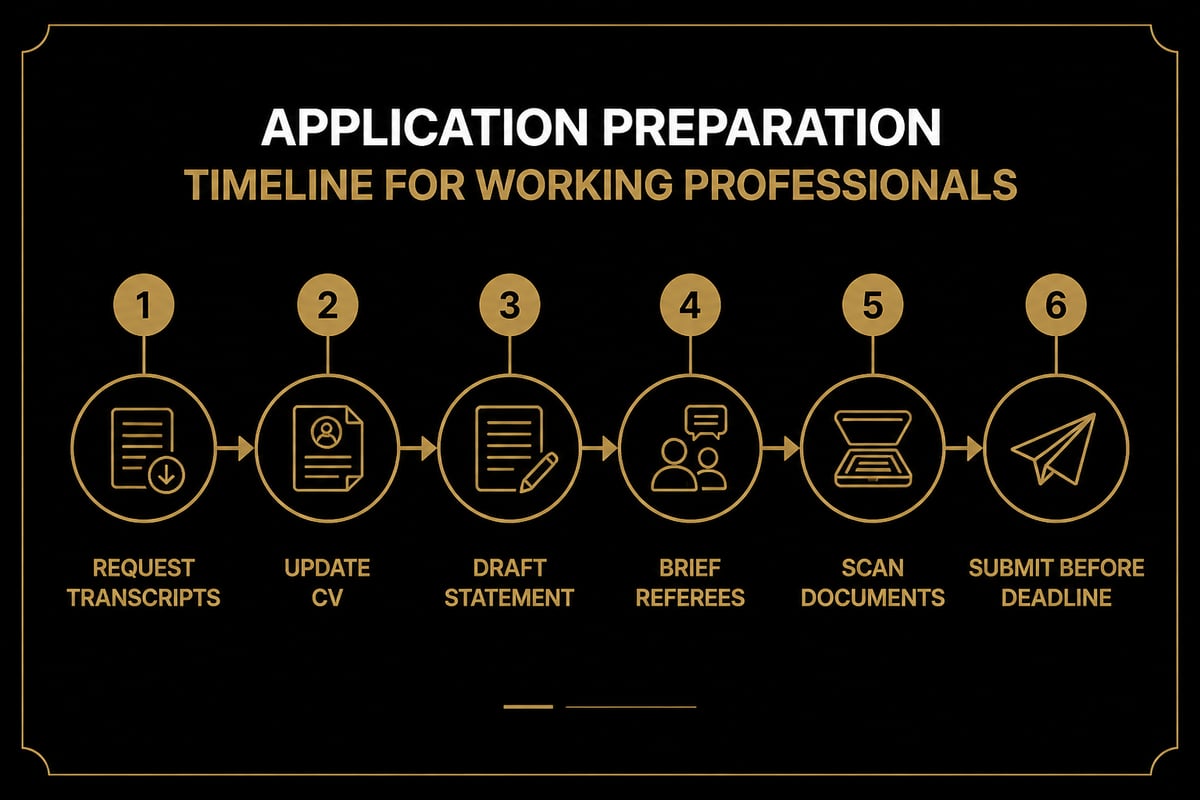
Prepare your documents several weeks before the deadline, because transcripts, certified copies, and references are the items most likely to cause delays. Gather everything into a single folder, digital and physical, so you can respond quickly when the admissions office asks for a missing item.
A practical preparation sequence:
- Request official transcripts and degree certificates from your previous institution.
- Update your CV with measurable achievements.
- Draft your statement of purpose and have a trusted colleague review it.
- Contact your referees and share your materials.
- Scan identification and certificates in clear, legible files.
- Check the application deadline, fee, and submission method.
Application steps at most universities follow a similar sequence, even if the portals differ, so check each institution's own guide for its exact process.
If you are organizing a personal portfolio or professional website to support your application, a tool such as Ai SiteForger can help you build a clean online profile by describing what you need. That is optional, and it is not an admissions requirement.
What Are the Requirements for a Dual MBA?
A dual MBA follows the same admissions logic as a standard MBA: a recognized bachelor's degree, a CV showing professional experience, a statement of purpose, and references. What changes is the structure of the degree, since you complete two specializations rather than one.
The University of Gold Coast's Dual MBA lets students complete two MBA specializations in 18 months, with core course exemptions for the second. For a manager who wants a broader skill set, such as combining finance with leadership or operations, this avoids repeating foundation courses. Application forms for this programme are available through the Dual MBA admissions request forms page.
For current entry criteria, document lists, and fees, contact the university directly rather than relying on general summaries, since requirements can change.
How Does Study Format Affect Your Application?
The format of a program affects who it suits, so check it against your work schedule before you apply. A full-time, daytime program can be impractical for a manager with fixed office hours, while a modular or weekend structure can fit a demanding job.
At the University of Gold Coast, classes run one full weekend a month, so working professionals can study without leaving their jobs. Cost is a legitimate factor in your decision, and the university's article on affordable master’s programs discusses what to weigh.
Accreditation deserves equal attention. All academic programmes at the University of Gold Coast are accredited by the Ghana Tertiary Education Commission, and the university holds the Presidential Charter granted by the Government of Ghana. Verifying accreditation protects the value of your qualification with employers and regulators.
For a wider view of admission criteria at the university, the page on master’s program requirements is a helpful companion to this overview.
If you want to supplement your career with an additional income stream while studying, resources such as Make Extra Money Academy offer practical guidance on side income. For professionals who may later advise or consult in their field, Exact Insight is an expert network that connects specialists with organizations seeking niche knowledge.

FAQ
Is 25 too old to start a master's?
No. No. Age is not a barrier to a master's degree, and many students begin in their late twenties, thirties, or later. Background and experience are treated as an asset.
Do people with a master's get called Dr.?
No. The title "Dr." is reserved for holders of a doctorate, such as a PhD, or for professionals like medical doctors. A master's graduate uses the degree letters after their name, such as MBA or MSc, instead of a title.
Can I apply if my final grade is below the minimum?
Sometimes. Some programs offer conditional admission or weigh professional experience, references, and your statement against a lower grade. Contact the admissions office, explain your circumstances, and ask what supporting evidence would strengthen your file.
Start by listing each document you need and requesting your transcripts this week, since they take the longest to arrive. If you want a program built around a working schedule, the Dual MBA offers two specializations in 18 months, and the University of Gold Coast's team can confirm current entry criteria for your situation. When you are ready to submit your file, Apply Now to begin your application and move toward a postgraduate qualification that fits around your career.