
Pursuing a master's degree represents a significant investment in your future, but the rising cost of graduate education has many prospective students searching for affordable options. The cheapest masters programs offer quality education without the overwhelming debt burden, making advanced credentials accessible to a broader range of professionals. Understanding the true cost of graduate school, including tuition, fees, living expenses, and potential financial aid, empowers you to make informed decisions about your academic and career trajectory.
Understanding the Real Cost of Master's Programs
When evaluating the cheapest masters degree options, looking beyond the sticker price is essential. According to the latest trends in college pricing, published tuition represents only part of the total cost equation. Graduate students must account for mandatory fees, technology charges, health insurance, textbooks, and living expenses that can add thousands of dollars to annual budgets.
Net price, the amount students actually pay after scholarships, grants, and assistantships, often differs substantially from published rates. Many institutions offer graduate assistantships that provide tuition remission plus a stipend in exchange for teaching or research duties. These opportunities can transform an expensive program into one of the cheapest masters options available when calculated on a net-cost basis.
Key cost components to evaluate:
- Base tuition per credit hour or annual rate
- Mandatory student fees and technology charges
- Health insurance requirements
- Course materials and textbooks
- Living expenses (housing, food, transportation)
- Opportunity cost of reduced work hours
The Consumer Financial Protection Bureau’s financial planning tool provides comprehensive guidance for calculating your true program cost, including loan projections and monthly payment estimates. This resource helps prospective students understand the long-term financial implications of different program choices.

Types of Affordable Master's Degree Programs
The landscape of the cheapest masters programs spans multiple delivery formats and institutional types, each offering distinct advantages for budget-conscious students.
Public In-State Programs
State universities traditionally offer the cheapest masters degrees for residents. In-state tuition rates at public institutions can be 50-70% lower than out-of-state or private alternatives. Many flagship state universities maintain strong academic reputations while keeping graduate tuition accessible for state residents.
Regional public universities often provide even lower tuition rates, particularly for professional master's programs in education, business, and health sciences. These institutions frequently serve working professionals with evening and weekend formats that allow students to maintain full-time employment.
Online Master's Programs
Online programs have revolutionized access to affordable graduate education. The cheapest masters degrees online eliminate commuting costs, relocation expenses, and sometimes offer lower per-credit tuition rates than on-campus equivalents. Accredited online programs from public universities often mirror the quality and curriculum of traditional formats while providing flexibility for working adults.
Advantages of online programs:
- No relocation or housing costs
- Continued full-time employment during studies
- Access to programs nationwide regardless of location
- Often lower overall cost structure
- Self-paced options in some cases
However, prospective students should verify accreditation and investigate program outcomes before enrolling. The Urban Institute’s research on master’s program accountability highlights significant variations in graduate outcomes even among similarly priced programs.
Competency-Based Programs
Competency-based education allows students to progress by demonstrating mastery rather than completing seat time. For experienced professionals, these programs can dramatically reduce time to degree and total cost, making them among the cheapest masters options when measured by total investment.
Fields Offering the Most Affordable Graduate Degrees
Certain disciplines consistently offer more affordable graduate options than others, often due to program structure, delivery format, or institutional priorities.
Education
Master's degrees in education, including curriculum and instruction, educational leadership, and special education, frequently rank among the cheapest masters programs. Many are designed for working teachers and offered through public universities at reduced rates. Some states provide additional tuition assistance or loan forgiveness for educators pursuing advanced credentials.
Business Administration
While elite MBA programs command premium prices, numerous accredited business schools offer affordable options. Regional universities provide quality MBA programs at a fraction of the cost of top-tier schools. The MBA in Entrepreneurship and Innovation represents one example of specialized business education designed to balance affordability with career-focused curriculum.
| Program Type | Average Annual Tuition | Typical Duration | Total Program Cost |
|---|---|---|---|
| Online MBA | $12,000 – $25,000 | 2 years | $24,000 – $50,000 |
| In-State Public MBA | $15,000 – $30,000 | 2 years | $30,000 – $60,000 |
| Education MA | $8,000 – $18,000 | 2 years | $16,000 – $36,000 |
| Public Affairs MPA | $10,000 – $22,000 | 2 years | $20,000 – $44,000 |
Public Administration and Policy
Master's programs in public administration (MPA) and public policy tend to be more affordable, particularly at state universities. These programs prepare graduates for government and nonprofit careers, and many institutions deliberately keep costs low to support public service career paths.

Strategies to Find the Cheapest Masters Programs
Identifying truly affordable graduate education requires strategic research and comparison across multiple dimensions.
Research In-State Options First
Begin your search with public universities in your state of residence. In-state tuition typically offers the lowest base cost, and familiarity with the institution's reputation within your regional job market provides additional value. Contact graduate admissions offices directly to inquire about assistantships, fellowships, and other funding opportunities not advertised publicly.
Compare Total Program Costs
Create a comprehensive cost comparison spreadsheet that includes all expenses for your entire degree. The cheapest masters program based on annual tuition may not remain the most affordable when calculated over the full program duration, especially if accelerated formats or transfer credits can reduce time to completion.
- Calculate total tuition and fees for complete program
- Add estimated living expenses (or foregone income)
- Subtract expected financial aid and assistantships
- Factor in program length (shorter programs reduce opportunity costs)
- Consider post-graduation earning potential
The National Center for Education Statistics data provides authoritative benchmarks for comparing institutional costs and understanding national trends in graduate education pricing.
Investigate Employer Tuition Assistance
Many employers offer tuition reimbursement or assistance for graduate education related to your current role. This benefit can transform an otherwise expensive program into one of the cheapest masters options available to you. Review your employee benefits package and discuss educational support with your human resources department before finalizing program selection.
Explore Accelerated and Combined Degree Programs
Accelerated master's programs compress coursework into shorter timeframes, reducing overall costs through decreased opportunity costs and fewer semesters of fees. Some universities offer combined bachelor's/master's programs allowing undergraduates to begin graduate coursework during their senior year, saving both time and money.
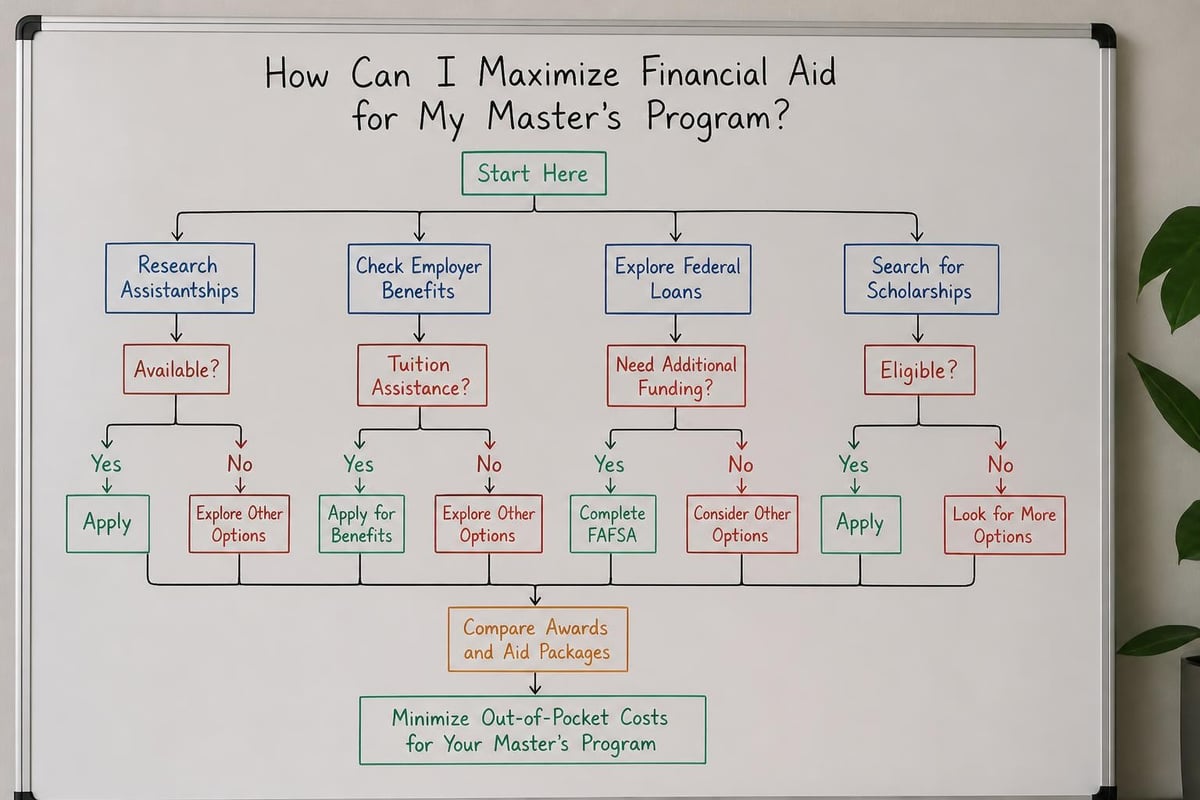
Financial Aid and Funding for Graduate Students
Understanding graduate financial aid differs significantly from undergraduate funding. Federal student aid for graduate programs operates under different rules, as outlined in the 2024-25 FAFSA specifications.
Graduate funding sources:
- Graduate assistantships (teaching, research, administrative)
- Fellowships and scholarships
- Federal Direct Unsubsidized Loans (up to $20,500 annually)
- Grad PLUS loans (up to cost of attendance)
- Employer tuition assistance
- Military benefits (GI Bill, Tuition Assistance)
- Professional association scholarships
Graduate assistantships represent the most valuable funding source for the cheapest masters education. These positions typically provide full or partial tuition remission plus a monthly stipend ranging from $1,000 to $3,000. Competition for assistantships varies by field, with STEM programs often offering more opportunities than humanities or social sciences.
Program-Specific Scholarships
Many departments maintain scholarship funds specifically for graduate students in particular fields. Contact department chairs and graduate program directors directly to inquire about available funding. These awards often go unadvertised and may be allocated based on faculty recommendations or departmental needs.
Evaluating Return on Investment Beyond Price
While identifying the cheapest masters programs is important, ensuring adequate return on investment requires examining post-graduation outcomes. As Brookings Institution research demonstrates, master's degree value varies tremendously across fields and specific programs.
Salary Premiums by Field
Certain master's degrees command substantial salary premiums that justify higher tuition investments. Engineering, computer science, business analytics, and healthcare administration typically offer strong financial returns. Conversely, some fields provide modest salary increases that make choosing the cheapest masters program essential for financial sustainability.
The College Scorecard’s program-level data now includes earnings information for specific degree programs, allowing prospective students to compare typical salaries by program and institution. This transparency helps evaluate whether premium-priced programs deliver commensurate salary outcomes.
Career Advancement Opportunities
Return on investment extends beyond immediate salary increases to include career advancement potential, job security, and professional network development. The cheapest masters degree may provide the credential necessary for promotion within your current organization, delivering returns through enhanced career stability rather than immediate pay raises.
| Career Goal | Recommended Approach | ROI Timeline |
|---|---|---|
| Promotion in current field | Employer-sponsored, affordable in-state program | 1-3 years |
| Career transition | Carefully research program-specific outcomes | 3-7 years |
| Professional credential requirement | Cheapest accredited option meeting licensing standards | Immediate |
| Academic preparation | Funded research assistantship at reputable institution | 5-10 years |
Regional and Specialized Affordable Options
Geographic flexibility can unlock additional affordable graduate education opportunities. Some states and regions maintain particularly cost-effective public university systems with strong graduate programs.
Southern and Midwest Universities
Public universities in southern and midwestern states often offer the cheapest masters programs nationally, combining low tuition with affordable living costs. Institutions in Texas, Florida, North Carolina, and Ohio provide quality graduate education at competitive rates, particularly for online students who can access in-state tuition through reciprocity agreements.
Specialized Professional Programs
Universities with mission-driven programs in ministry, theology, social work, and public health sometimes subsidize graduate education to support professional fields that serve communities. These specialized programs may offer the cheapest masters degrees in their respective fields while maintaining strong accreditation and placement outcomes. University Of Gold Coast exemplifies institutions offering diverse graduate programs across business, law, and theology with attention to accessibility and professional development.
International Options
For students with geographic flexibility, some international universities offer English-language master's programs at costs substantially below U.S. averages. European public universities, particularly in Germany, Norway, and Finland, charge minimal or no tuition for graduate students, though living expenses and visa requirements require careful evaluation.
Making Your Final Decision
Selecting the cheapest masters program that aligns with your career goals requires balancing affordability with quality, accreditation, and outcomes. Create a detailed comparison matrix that weights factors according to your priorities.
Decision factors to weight:
- Total program cost (tuition, fees, living expenses, opportunity cost)
- Accreditation and program reputation
- Format flexibility (online, evening, weekend options)
- Available financial aid and assistantships
- Post-graduation salary data and placement rates
- Alumni network strength in your target industry
- Program completion rates
- Time to degree completion
Request detailed cost breakdowns from finalists, including all mandatory fees and typical additional expenses. Speak with current students and recent graduates about hidden costs and financial aid reliability. Many of the cheapest masters programs provide excellent education and outcomes, but due diligence ensures your investment delivers expected returns.
The most affordable path to your graduate degree often combines strategic program selection with maximum utilization of available aid sources. By thoroughly researching options, comparing true costs, and aligning programs with career objectives, you can earn a valuable master's credential without overwhelming debt.
Finding affordable graduate education requires balancing cost, quality, and career alignment, but numerous institutions offer accessible pathways to advanced credentials without excessive debt. Whether you're seeking specialized business training, professional development in education or law, or academic preparation for doctoral study, strategic program selection ensures your investment delivers strong returns. The University Of Gold Coast provides diverse graduate programs designed to support academic and professional advancement across multiple disciplines, combining quality education with accessible pathways to your degree. Explore how University Of Gold Coast can help you achieve your graduate education goals while maintaining financial sustainability.