
Accelerated graduate education has transformed how professionals and recent graduates approach postgraduate study. One year masters programs represent a compelling alternative to traditional two-year degrees, offering intensive academic rigor compressed into a shorter timeframe. These programs appeal to students seeking to minimize opportunity costs, reduce tuition expenses, and enter the workforce faster with advanced credentials. Understanding the structure, benefits, challenges, and career outcomes of these accelerated pathways helps prospective students make informed decisions about their academic investment.
What Defines One Year Masters Programs
One year masters programs typically require 12 months of full-time study, condensed from the traditional 24-month format. The academic intensity remains comparable to longer programs, with students completing coursework, research projects, and dissertations in an accelerated timeframe.
These programs often follow the European Commission’s second-cycle framework, requiring 60 ECTS credits (European Credit Transfer System) compared to 90-120 credits for extended formats. The concentrated structure demands significant commitment, with students frequently attending classes year-round without traditional summer breaks.
Credit Requirements and Academic Load
The credit distribution in accelerated master's degrees requires careful planning:
- 60 ECTS credits delivered across three academic terms
- 15-20 credits per term with intensive module delivery
- Dissertation component worth 15-30 credits completed in final months
- No extended breaks between terms to maintain momentum
Understanding how credits translate across systems matters for international students. The University of Bologna’s ECTS guidance provides standardized conversion tables that help students evaluate workload expectations and grade comparisons across European institutions.

Popular Fields Offering Accelerated Programs
Certain disciplines lend themselves particularly well to one year masters programs based on curriculum structure and professional demand.
Business and Management
MBA programs represent the most common accelerated format, with institutions worldwide offering intensive business education. Students complete core modules in finance, marketing, strategy, and operations before specializing in areas like entrepreneurship or international business.
Law and Legal Studies
LLM (Master of Laws) programs frequently adopt the one-year structure, allowing legal professionals to gain specialized expertise in corporate law, international law, or human rights without prolonged career interruption.
| Program Type | Typical Duration | Credit Hours | Dissertation Required |
|---|---|---|---|
| MBA | 12 months | 60 ECTS | Optional/Project |
| MSc Business | 12 months | 60 ECTS | Yes |
| LLM | 12 months | 60 ECTS | Yes |
| Professional Diplomas | 9-12 months | 30-60 ECTS | Varies |
STEM and Social Sciences
Master of Science programs in data analytics, computer science, public health, and international relations increasingly offer one-year options. These programs balance theoretical foundations with practical applications through intensive lab work, case studies, and capstone projects.
The University Of Gold Coast structures its MSc offerings to deliver comprehensive content within accelerated timeframes, integrating online resources and flexible learning modules.
Financial Advantages of Compressed Timelines
The economic benefits of one year masters programs extend beyond reduced tuition to encompass opportunity costs and faster return on investment.
Direct Cost Savings
Tuition represents the most obvious saving. Students pay for one year of fees rather than two, immediately cutting education costs by approximately 40-50% compared to extended programs. This reduction proves especially significant for international students facing higher fee structures.
Additional financial benefits include:
- Reduced living expenses (rent, food, transportation) for 12 fewer months
- Lower visa and health insurance costs for international students
- Diminished loan interest accumulation due to shorter borrowing periods
- Earlier access to post-graduation salary increases
Opportunity Cost Reduction
Beyond direct expenses, accelerated programs minimize income foregone while studying. Professionals returning to work one year earlier gain:
- Twelve additional months of salary at post-master's compensation levels
- Earlier career progression and promotion opportunities
- Faster recovery of educational investment through enhanced earnings
- Reduced career gap on professional résumés
Research comparing international study formats and their impact on employability outcomes suggests that intensive programs delivering integrated work placements can achieve comparable career readiness despite compressed delivery.

Immigration and Post-Study Work Considerations
For international students, one year masters programs intersect significantly with immigration policy, particularly regarding post-study work rights.
United Kingdom Graduate Route
The UK government's Graduate Route allows international students to remain for two years after completing qualifying degrees. Recent evaluation of the graduate route examined how this policy affects student recruitment and retention, with one-year master's graduates representing a significant proportion of beneficiaries.
Policy reviews, including the Graduate Route rapid review, have assessed whether compressed programs should receive different treatment. Current regulations treat one-year and two-year master's degrees equally for post-study work eligibility, maintaining the two-year graduate visa regardless of program length.
Global Visa Implications
Different countries approach post-study work authorization variably:
- Australia: Temporary Graduate visa (subclass 485) grants two years regardless of master's duration
- Canada: Post-Graduation Work Permit length varies by program duration (one-year programs receive one-year permits)
- United States: Optional Practical Training (OPT) provides 12-24 months based on field of study, not program length
Understanding these distinctions helps international students evaluate how one year masters programs align with their immigration and career objectives.
Admission Requirements and Prerequisites
One year masters programs typically maintain rigorous admission standards equivalent to longer formats.
Academic Qualifications
Applicants generally need:
- Undergraduate degree with minimum classification (typically 2:1 or equivalent)
- Relevant academic background in related disciplines
- Strong academic transcripts demonstrating consistent performance
- Research proposal for dissertation-based programs
Professional Experience
Many accelerated programs, particularly MBAs and professional master's degrees, require demonstrated work experience:
| Program Type | Work Experience | Preferred Years | Alternatives Accepted |
|---|---|---|---|
| MBA | Required | 3-5 years | Exceptional academic records |
| Executive MSc | Required | 5-10 years | Senior leadership roles |
| Standard MSc | Preferred | 1-2 years | Internships/placements |
| LLM | Optional | 0-3 years | Legal practice certification |
Language Proficiency
International students must demonstrate English language competency through standardized tests (IELTS, TOEFL, PTE) with scores typically ranging from IELTS 6.5-7.0 or equivalent.
Curriculum Structure and Learning Intensity
The pedagogical design of one year masters programs maximizes learning efficiency through intensive delivery methods.
Term Organization
Most programs divide the year into three distinct phases:
- Foundation term (September-December): Core modules establishing theoretical frameworks
- Specialization term (January-April): Elective courses and advanced topics in chosen concentration
- Dissertation term (May-August): Independent research and thesis completion
This structure maintains continuous engagement, eliminating traditional summer breaks and requiring sustained academic focus throughout the calendar year.
Teaching Methods
Accelerated programs employ diverse pedagogical approaches to deliver comprehensive content efficiently:
- Intensive block teaching with modules delivered over 1-2 weeks
- Blended learning combining face-to-face seminars with online resources
- Flipped classroom models requiring pre-class preparation
- Group projects emphasizing collaborative problem-solving
- Industry guest lectures and practical case studies
Career Outcomes and Employability
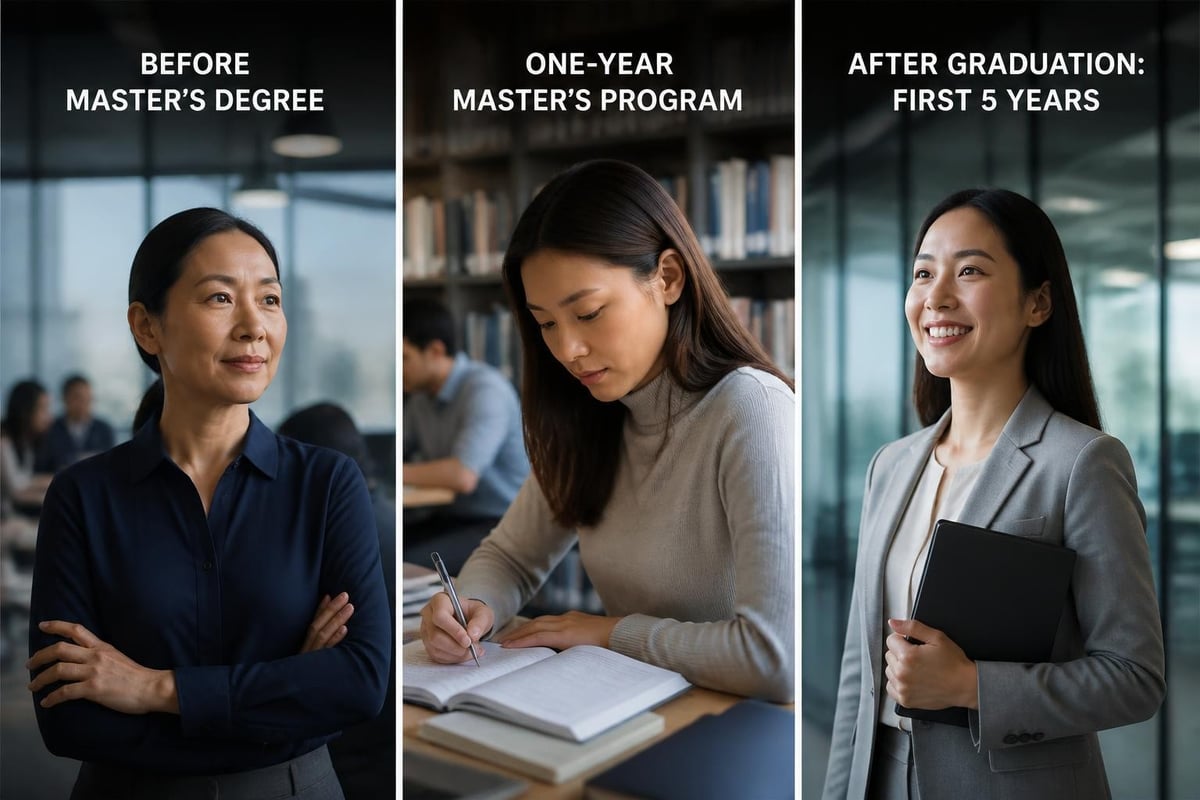
Graduate employment statistics demonstrate that one year masters programs deliver strong career outcomes comparable to traditional formats.
First-Destination Data
According to the NACE First Destinations report, master's graduates achieve higher employment rates and starting salaries than bachelor's degree holders, with program duration showing minimal impact on initial job placement success.
Key employment metrics include:
- 85-90% employment or further study within six months
- 15-25% average salary increase compared to pre-master's earnings
- Higher placement rates in graduate-level positions versus undergraduate-only peers
- Strong representation in consulting, finance, technology, and professional services sectors
Employer Perception
Employers increasingly recognize one year masters programs as rigorous credentials, particularly when delivered by established institutions. The intensive nature often signals strong time management, resilience, and focused career objectives.
Balancing Intensity with Well-Being
The compressed timeline of one year masters programs demands careful attention to student wellness and sustainable study practices.
Time Management Strategies
Successful students employ structured approaches to managing academic demands:
- Weekly planning allocating specific hours to each module and assignment
- Prioritization frameworks distinguishing urgent versus important tasks
- Digital tools for deadline tracking and project management
- Study groups providing peer support and collaborative learning
- Regular breaks maintaining productivity and preventing burnout
Support Services
Institutions offering accelerated programs typically provide enhanced student support recognizing the demanding nature of compressed delivery. Resources include academic advisors, writing centers, mental health counseling, and career services specifically calibrated for intensive program participants.
Comparing Regional Variations in Program Design
One year masters programs vary significantly across geographic regions based on educational traditions and regulatory frameworks.
United Kingdom Model
UK universities pioneered the one-year master's format, now standard across taught postgraduate education. Programs run September through August with three academic terms and no summer vacation. This model emphasizes independent research culminating in substantial dissertations worth significant credit portions.
European Approach
Continental European institutions increasingly offer one-year options alongside traditional two-year programs, particularly for international student recruitment. The Bologna Process standardization enables 60-ECTS programs meeting qualification framework requirements while maintaining academic rigor.
North American Context
United States and Canadian universities predominantly offer two-year master's degrees, though accelerated one-year options exist in business, education, and professional fields. These programs often cater to working professionals through evening, weekend, or hybrid formats.
Specialized Program Formats
Beyond traditional full-time residential models, one year masters programs now encompass diverse delivery methods.
Executive Programs
Designed for senior professionals, executive master's programs compress coursework into weekend modules or intensive blocks, allowing students to maintain employment while studying. These programs typically require 7-10 years of professional experience and command premium tuition reflecting specialized content and networking opportunities.
Blended and Online Options
Technological advances enable hybrid formats combining online coursework with periodic campus residencies. These structures extend access to students unable to relocate while maintaining academic standards through proctored assessments and intensive in-person components.
Professional Diplomas
Some institutions offer professional diplomas as intermediate credentials, requiring fewer credits than full master's degrees but providing specialized expertise. These programs particularly suit professionals seeking focused skills development without comprehensive academic research components.
Making the Decision: Is a One-Year Program Right for You?
Prospective students should evaluate multiple factors when considering one year masters programs versus traditional alternatives.
Ideal Candidate Profiles
Accelerated programs particularly suit individuals who:
- Possess clear career objectives requiring specific advanced credentials
- Want to minimize time away from professional roles
- Seek cost-effective routes to postgraduate qualifications
- Thrive in intensive, fast-paced learning environments
- Have strong self-discipline and time management capabilities
Situations Favoring Longer Programs
Traditional two-year formats may better serve students who:
- Desire extensive research experience and publication opportunities
- Plan academic careers requiring comprehensive methodology training
- Need time for career exploration and internship opportunities
- Prefer measured pacing with traditional academic calendars
- Seek teaching assistantship funding requiring multi-year commitment
Application Strategies for Competitive Programs
Gaining admission to prestigious one year masters programs requires strategic preparation and compelling application materials.
Building Strong Applications
Successful applicants typically demonstrate:
- Clear narrative connecting previous education, work experience, and program choice
- Specific career goals articulated with realistic understanding of industry requirements
- Academic readiness evidenced through transcripts, test scores, and writing samples
- Distinctive achievements differentiating application from competitive peer pool
- Strong references from academic or professional supervisors attesting to capabilities
Timeline Considerations
Application processes for accelerated programs often follow standard academic cycles:
| Application Round | Deadline Period | Decision Timeline | Enrollment Date |
|---|---|---|---|
| Early/Priority | September-November | December-January | Following September |
| Main Round | December-February | March-April | Following September |
| Late/Rolling | March-May | May-June | Following September |
Earlier applications often receive priority consideration and higher scholarship allocation, making advance planning advantageous.
Future Trends in Accelerated Graduate Education
The landscape of one year masters programs continues evolving in response to labor market demands, technological capabilities, and student preferences.
Micro-Credentials and Stackable Degrees
Institutions increasingly offer modular programs allowing students to complete individual certificates that accumulate toward full master's degrees. This flexibility enables professionals to pace learning around career commitments while building toward comprehensive credentials.
Industry Partnerships
Collaborative program design with employers ensures curriculum relevance and may include guaranteed internships, mentorship programs, or sponsored student cohorts. These partnerships enhance employability outcomes and strengthen program value propositions.
Technological Integration
Artificial intelligence, virtual reality, and adaptive learning platforms enable more personalized and efficient content delivery, potentially allowing further compression without sacrificing educational quality.
One year masters programs offer an efficient pathway to advanced credentials, combining academic rigor with reduced time and financial investment. Whether pursuing an MBA, MSc, LLM, or professional diploma, accelerated formats deliver comprehensive education preparing graduates for career advancement and specialized expertise. If you're ready to fast-track your academic journey with flexible, intensive postgraduate study, University Of Gold Coast provides diverse master's programs across business, law, theology, and professional fields, supported by extensive online resources and dedicated student services designed to help you succeed in your accelerated academic goals.