
A doctorate degree represents the pinnacle of academic achievement, marking the transition from knowledge consumer to knowledge creator. This terminal degree demonstrates expertise in a specialized field, equipping graduates with advanced research capabilities and opening doors to academic, research, and executive leadership positions. Whether you're considering a PhD program in business administration, theology, law, or another discipline, understanding the commitment, process, and outcomes of doctoral study is essential for making an informed decision about your academic future.
Understanding the Doctorate Degree Landscape
The doctorate degree ecosystem extends far beyond the traditional Doctor of Philosophy (PhD). Professional doctorates like the Doctor of Business Administration (DBA), Doctor of Education (EdD), and Juris Doctor (JD) offer specialized training for practitioners seeking the highest credentials in their fields.
Research vs. Professional Doctorates
Research doctorates emphasize original scholarship and theoretical contributions to a discipline. Students pursuing these degrees spend years developing novel research questions, designing methodologies, and generating new knowledge. The dissertation-a substantial original work-becomes the centerpiece of the degree.
Professional doctorates focus on applying research to solve real-world problems within specific industries or professions. These programs typically feature shorter completion times and dissertations that emphasize practical application rather than pure theoretical advancement.
Key distinctions include:
- Research doctorates prepare scholars for academic careers and research positions
- Professional doctorates target advanced practitioners and industry leaders
- Dissertation requirements vary in scope, methodology, and application focus
- Time-to-degree averages 5-7 years for research PhDs versus 3-5 years for professional doctorates
- Funding structures differ significantly between the two pathways

The Doctorate Degree Application Process
Securing admission to a competitive doctoral program requires meticulous preparation and strategic planning. Programs evaluate candidates holistically, examining academic credentials, research potential, professional experience, and alignment with faculty expertise.
Essential Application Components
Your application package serves as evidence of your readiness for doctoral-level work. Admissions committees scrutinize every element to assess whether you possess the intellectual capacity, motivation, and preparation needed to complete rigorous doctoral training.
- Academic transcripts demonstrating strong performance in previous graduate coursework
- Letters of recommendation from faculty or professionals who can speak to your research potential
- Statement of purpose articulating your research interests and career objectives
- Writing sample showcasing analytical and communication skills
- Standardized test scores (GRE, GMAT) where required, though many programs have eliminated this requirement
- Research proposal outlining preliminary ideas for dissertation research
- Curriculum vitae documenting academic achievements, publications, and relevant experience
The University Of Gold Coast offers comprehensive guidance throughout the application process, helping prospective doctoral students identify programs aligned with their research interests and career goals.
Selecting the Right Program
Program selection significantly impacts your doctoral experience and career trajectory. Consider factors beyond reputation and rankings when evaluating options.
| Selection Criteria | Why It Matters | Questions to Ask |
|---|---|---|
| Faculty expertise | Determines research supervision quality | Do faculty members publish in my areas of interest? |
| Funding packages | Affects financial stress and time-to-degree | What percentage of students receive full funding? |
| Placement outcomes | Signals career preparation effectiveness | Where do graduates work five years post-completion? |
| Program structure | Influences flexibility and support | How are coursework, exams, and dissertation balanced? |
| Research resources | Enables high-quality scholarship | What libraries, labs, and databases are available? |
Financing Your Doctorate Degree Journey
Financial considerations often determine whether candidates can pursue doctoral education. Understanding funding mechanisms helps you make sustainable decisions about enrollment and program selection.
Funding Sources and Strategies
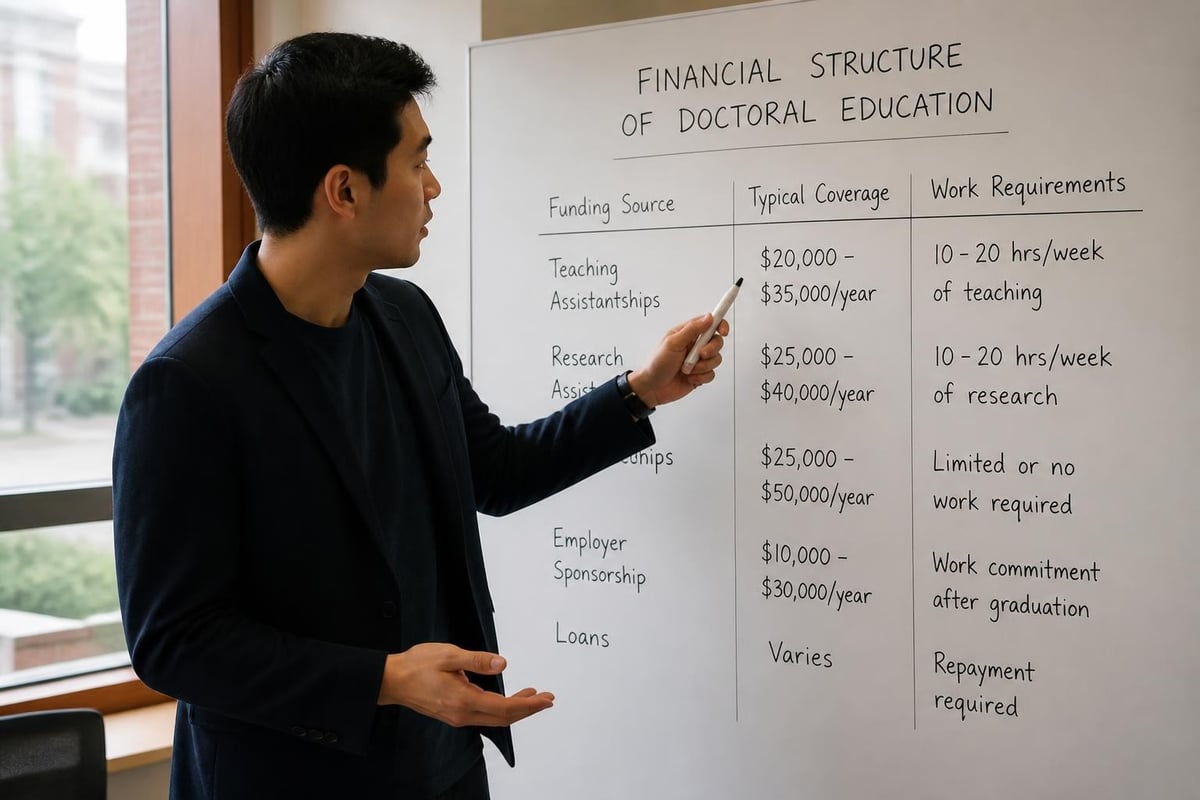
Most research doctorate students receive funding packages that cover tuition and provide stipends for living expenses. These packages typically combine teaching assistantships, research assistantships, and fellowships. The NSF Graduate Research Fellowship Program represents one of the most prestigious funding opportunities available to STEM doctoral students.
Professional doctorate students more commonly self-fund their education or receive employer sponsorship. These programs rarely offer the same comprehensive funding packages available to research PhD candidates.
Common funding mechanisms:
- Teaching assistantships provide stipends in exchange for instructional support (10-20 hours weekly)
- Research assistantships fund students to work on faculty research projects
- Fellowships offer financial support without work requirements
- Employer sponsorship covers tuition for working professionals
- Student loans supplement other funding sources, though research shows that doctoral debt levels vary significantly by field
Managing finances during doctoral study requires careful planning. Create realistic budgets that account for stipend limitations, plan for summers without guaranteed funding, and explore supplemental income opportunities like consulting or freelance work within your field.
Navigating the Doctoral Student Experience
The doctorate degree journey encompasses distinct phases, each presenting unique challenges and opportunities for growth. Success requires resilience, time management, and strategic relationship-building.
Coursework and Comprehensive Examinations
Most doctoral programs begin with 1-3 years of intensive coursework designed to build foundational knowledge and research skills. Students master theoretical frameworks, methodologies, and literatures that inform their subsequent dissertation research.
Comprehensive examinations-variously called qualifying exams, prelims, or candidacy exams-mark the transition from coursework to independent research. These high-stakes assessments evaluate whether students have developed sufficient expertise to conduct original scholarship.
Preparation strategies include:
- Form study groups with peers to discuss key concepts and texts
- Create comprehensive reading lists organized by topic and theme
- Practice writing timed essays under exam-like conditions
- Meet regularly with advisors to clarify expectations and receive feedback
- Develop frameworks for synthesizing large bodies of literature efficiently
The Dissertation Process
The dissertation represents your unique contribution to scholarly knowledge. This substantial document-typically 200-400 pages for research doctorates-demonstrates your ability to identify research gaps, design appropriate methodologies, analyze data rigorously, and communicate findings effectively.
Purdue OWL’s comprehensive dissertation guidance provides practical frameworks for planning, writing, and formatting your dissertation according to academic standards.
Dissertation phases typically include:
| Phase | Duration | Key Activities | Milestones |
|---|---|---|---|
| Proposal Development | 3-6 months | Literature review, methodology design | Proposal defense |
| Data Collection | 6-18 months | Fieldwork, experiments, archival research | IRB approval, data gathering |
| Analysis | 6-12 months | Statistical analysis, qualitative coding | Draft chapters |
| Writing | 6-12 months | Drafting, revising, formatting | Committee review |
| Defense | 1-2 months | Final revisions, presentation prep | Successful defense |
The University Of Gold Coast provides extensive dissertation support through online library resources, writing centers, and methodological consultations.
The Advisor-Student Relationship
Your dissertation advisor shapes your doctoral experience more than any other factor. This relationship functions as an apprenticeship where you learn to think, write, and conduct research like a scholar in your discipline.
Selecting and Working with Advisors
Choose advisors based on expertise alignment, advising style, availability, and track record of student success. Recent research on graduate advising emphasizes the importance of clear expectations, regular communication, and mentorship that extends beyond purely technical supervision.
Successful doctoral students actively manage the advisor relationship through:
- Regular meetings with prepared agendas and specific questions
- Clear communication about progress, challenges, and timeline expectations
- Receptivity to feedback even when criticism feels difficult
- Professional boundaries that maintain appropriate advisor-student dynamics
- Building a dissertation committee that provides diverse perspectives and expertise
When advisor relationships become dysfunctional, don't hesitate to seek mediation through program directors or consider switching advisors. Your doctorate degree completion depends on productive mentorship.

Career Preparation and Post-Doctoral Outcomes
Earning a doctorate degree opens diverse career pathways, though many students receive limited preparation for non-academic careers. Approximately 60% of doctorate recipients pursue careers outside traditional tenure-track academic positions, making intentional career development essential throughout your program.
Academic and Alternative Career Paths
Traditional academic careers follow a relatively standardized trajectory: postdoctoral fellowships, assistant professorships, tenure review, and advancement to senior faculty positions. However, industry postdocs and alternative research careers offer compelling alternatives with different timelines, compensation structures, and work-life balance considerations.
Career sectors for doctorate holders:
- University faculty positions (teaching-focused and research-focused)
- Government research laboratories and policy institutes
- Corporate research and development divisions
- Consulting firms seeking specialized expertise
- Non-profit organizations and think tanks
- University administration and student affairs
- Publishing, science communication, and knowledge translation roles
Developing Transferable Skills
The Council of Graduate Schools research on PhD career skills emphasizes that doctoral training develops competencies valued across sectors: project management, data analysis, written communication, presentation skills, and complex problem-solving.
Intentionally cultivate transferable skills through:
- Seeking teaching opportunities that develop communication and leadership abilities
- Participating in interdisciplinary collaborations that broaden perspectives
- Attending professional development workshops on grant writing, data visualization, and project management
- Building professional networks beyond your immediate research community
- Pursuing internships or consulting projects that apply research skills to practical problems
The faculty and staff at University Of Gold Coast bring diverse professional backgrounds, providing students with mentorship that bridges academic and applied contexts.
Time Management and Work-Life Integration
Completing a doctorate degree while maintaining physical health, mental wellness, and personal relationships requires deliberate boundary-setting and sustainable work practices. The extended timeline-averaging 5.7 years according to the latest earned doctorates survey-means that marathon pacing matters more than sprinting.
Strategies for Sustainable Progress
Doctoral work expands to fill available time unless you establish clear boundaries and productivity systems. Develop routines that protect writing time, prevent burnout, and maintain progress even when motivation wanes.
Effective time management approaches:
- Time blocking dedicates specific hours to writing, reading, teaching, and personal activities
- Daily writing habits build momentum through consistent practice rather than sporadic marathons
- Project management tools track dissertation milestones and break overwhelming tasks into manageable steps
- Accountability partners provide motivation and honest feedback on progress
- Regular exercise and sleep protect cognitive function and emotional resilience
- Mental health support addresses anxiety, imposter syndrome, and isolation common in doctoral training
Recognize that progress isn't always linear. Setbacks, failed experiments, and rejected manuscripts are normal parts of the doctoral journey. Building resilience and maintaining perspective helps you navigate inevitable challenges without abandoning your doctorate degree goals.
Institutional Resources and Support Systems
High-quality doctoral programs provide comprehensive support infrastructures that facilitate student success. These resources-from writing centers to statistical consulting services-represent significant institutional investments in your development.
Leveraging Available Resources
Research universities maintain extensive support systems specifically designed for doctoral students. Familiarize yourself with available resources early and use them proactively rather than waiting until crises emerge.
| Resource Type | Support Provided | When to Access |
|---|---|---|
| Writing centers | Feedback on drafts, writing strategies | Throughout dissertation writing |
| Statistical consulting | Methodology design, data analysis assistance | Before and during data collection |
| Library services | Literature searches, citation management | Comprehensive exams, proposal development |
| Career services | Resume review, job search strategies | Beginning in year three |
| Counseling centers | Mental health support, stress management | Preventively and during difficult periods |
| Graduate student organizations | Peer community, professional development | Throughout program enrollment |
Many institutions now offer online resources accessible beyond traditional campus boundaries. The University Of Gold Coast’s online programs demonstrate how digital platforms can deliver robust support for doctoral students regardless of geographic location.
Emerging Trends in Doctoral Education
The doctorate degree landscape continues evolving in response to workforce demands, technological capabilities, and equity considerations. Understanding current trends helps you anticipate how doctoral training might shift during your enrollment.
Innovations Reshaping Doctoral Programs
Interdisciplinary programs address complex problems requiring expertise across traditional disciplinary boundaries. These programs prepare graduates to collaborate across specializations and translate knowledge for diverse audiences.
Online and hybrid formats expand access to doctoral education while maintaining academic rigor. Technology enables synchronous global seminars, asynchronous course modules, and virtual dissertation defenses.
Competency-based progression shifts focus from credit hours to demonstrated mastery of specific skills and knowledge domains. This approach can reduce time-to-degree while ensuring comprehensive preparation.
Enhanced career preparation integrates professional development throughout doctoral training rather than treating it as an afterthought. Programs increasingly offer internships, industry partnerships, and explicit transferable skills training.
Diversity and inclusion initiatives work to broaden participation in doctoral education, recognizing that diverse perspectives strengthen scholarship and innovation.
These trends reflect growing recognition that doctorate degree programs must prepare graduates for evolving career landscapes while maintaining the rigorous scholarship that defines doctoral education.
Earning a doctorate degree represents a transformative intellectual journey that develops research expertise, critical thinking, and specialized knowledge at the highest academic level. Success requires strategic program selection, effective advisor relationships, sustainable work practices, and intentional career preparation that extends beyond traditional academic pathways. University Of Gold Coast supports doctoral students through comprehensive academic programs, extensive online resources, and experienced faculty mentorship across business, law, theology, and additional fields, providing the guidance and infrastructure needed to complete your doctorate degree and launch your next professional chapter.