
Finding the least expensive masters degree online requires more than simply comparing advertised tuition rates. Graduate education represents a significant investment in your professional future, and understanding the true cost of online programs-including hidden fees, technology charges, and opportunity costs-helps you make informed decisions that balance affordability with academic quality. The landscape of online graduate education has expanded dramatically, with institutions competing to offer flexible, cost-effective pathways to advanced credentials.
Understanding True Program Costs Beyond Sticker Price
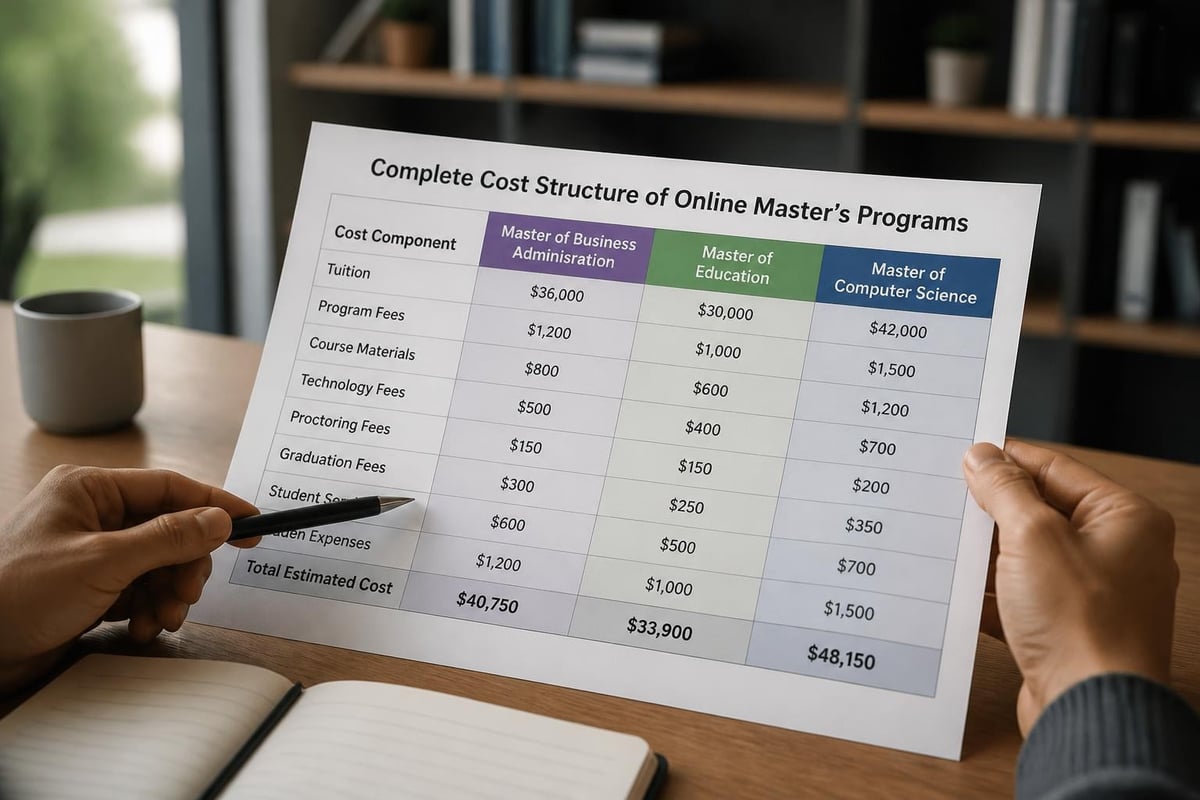
When evaluating the least expensive masters degree online options, prospective students often focus solely on per-credit tuition rates advertised on university websites. This approach misses critical cost components that substantially affect total program investment.
Comprehensive cost analysis should include:
- Per-credit or per-semester tuition rates
- Technology and platform fees for online learning systems
- Course materials, digital textbooks, and software licenses
- Graduation, application, and enrollment fees
- Proctoring charges for exams and assessments
The methodology for calculating true program cost reveals that advertised tuition may represent only 60-70% of actual out-of-pocket expenses. Some programs bundle technology access and materials into a flat rate, while others charge separately for each component, making direct comparisons challenging without detailed analysis.
Hidden Fees That Impact Affordability
Technology fees for online platforms can range from $50 to $500 per semester, depending on the institution's digital infrastructure. Learning management systems, virtual library access, and cloud-based collaboration tools all contribute to these charges. Programs offering lower base tuition sometimes offset the difference through higher ancillary fees.
Application fees typically range from $0 to $100, though many institutions waive these charges during promotional periods. Graduation fees for processing diplomas and transcripts add another $100-300 to final program costs, regardless of total tuition paid.
Accreditation and Quality Standards for Low-Cost Programs
The least expensive masters degree online programs maintain credibility through recognized accreditation that validates academic rigor and employer acceptance. Regional accreditation from bodies recognized by the Council for Higher Education Accreditation (CHEA) provides the gold standard for institutional quality.
Understanding distance education accreditation standards helps distinguish legitimate low-cost programs from diploma mills that offer credentials with little market value. The Distance Education Accrediting Commission (DEAC) specifically evaluates online and distance learning programs, ensuring they meet rigorous educational outcomes and student support benchmarks.
| Accreditation Type | Recognition Level | Typical Oversight |
|---|---|---|
| Regional | Highest (transferable credits) | Institutional and program-level review |
| National | Mid-tier (field-specific) | Specialized professional standards |
| Programmatic | Discipline-focused | Business (AACSB), Engineering (ABET), etc. |
Balancing Cost and Academic Reputation
Lower tuition doesn't necessarily indicate inferior quality. Many state universities extend in-state tuition rates to all online students, creating genuinely affordable options with strong academic standing. Public institutions often subsidize online programs through legislative appropriations, enabling them to offer the least expensive masters degree online while maintaining research faculty and comprehensive student services.
Private nonprofit universities sometimes discount online tuition to increase enrollment diversity or expand market reach. These strategic pricing decisions reflect institutional priorities rather than quality compromises, though prospective students should verify faculty credentials and learning outcomes data.
Fields Offering the Most Affordable Online Master's Programs
Certain disciplines consistently offer lower-cost online master's degrees due to reduced laboratory requirements, standardized curricula, and high enrollment numbers that allow economies of scale.
Affordability leaders by field:
- Business Administration (MBA) – $8,000-$15,000 total program cost
- Education and Teaching – $9,000-$18,000 for MEd programs
- Human Resources Management – $10,000-$16,000 complete
- Public Administration (MPA) – $12,000-$20,000 total
- Information Technology – $11,000-$22,000 depending on specialization
Business programs dominate the least expensive masters degree online category because curriculum standardization enables efficient delivery at scale. The University Of Gold Coast offers MBA programs alongside specialized master's degrees that leverage digital delivery to control costs while maintaining academic standards.
Technology and STEM Program Pricing
Computer science and data analytics master's programs typically cost more due to specialized software licenses and virtual lab environments. However, certain schools price these programs competitively at $15,000-25,000 total cost, recognizing strong demand and the potential to enroll large cohorts that reduce per-student delivery expenses.
Engineering programs requiring simulation software, specialized equipment access, or residency components generally exceed low-cost thresholds, though some institutions offer hybrid models where core coursework remains online and affordable while brief intensive sessions address hands-on requirements.

State Schools and Regional Advantage Strategies
Public universities in certain states maintain legislative mandates to offer affordable graduate education to working professionals. These institutions frequently provide the least expensive masters degree online options by extending resident tuition rates regardless of geographic location.
According to national education statistics, average graduate tuition at public institutions remained substantially below private university rates in 2026, with online programs often priced even lower than on-campus equivalents. This pricing reflects state funding models and institutional commitments to access.
Regional Tuition Compacts and Reciprocity
Several regional higher education compacts allow students to access reduced tuition at out-of-state public universities. The Western Interstate Commission for Higher Education (WICHE), Southern Regional Education Board (SREB), and Midwest Student Exchange Program create pathways to affordable online graduate education beyond home-state options.
These compacts typically reduce out-of-state charges to 150% of resident rates-still significantly below full non-resident pricing-making programs at flagship state universities accessible to students seeking the least expensive masters degree online within particular academic disciplines.
Employer Tuition Assistance and Return on Investment
The affordability equation extends beyond absolute program cost to include employer reimbursement opportunities and long-term salary benefits. Many organizations provide tuition assistance ranging from $2,500 to $10,000 annually for job-related graduate education.
Research indicates that graduate degrees generate financial returns, though outcomes vary significantly by field and program quality. Low-cost programs that lead to professional advancement or salary increases of $10,000-20,000 annually represent superior investments compared to moderately priced programs with limited career impact.
ROI optimization strategies:
- Select programs aligned with employer-identified skill gaps
- Verify whether curriculum meets industry certification requirements
- Research alumni career outcomes and placement rates
- Calculate break-even timeframes based on expected salary growth
The financial returns of online graduate programs demonstrate substantial variation even among similarly priced options. Programs with strong industry partnerships, practical capstone projects, and career services support typically generate higher returns despite potentially moderate cost differences.
Corporate Partnership Programs
Some universities partner with major employers to offer discounted tuition exclusively to company employees. These arrangements can reduce the least expensive masters degree online costs by an additional 10-25% through volume agreements or shared educational objectives. Technology companies, healthcare systems, and government agencies frequently negotiate such partnerships.
Comparing Per-Credit Versus Flat-Rate Pricing Models
Pricing structure significantly impacts total program cost, especially for students who may need reduced course loads or extended completion timelines. Understanding these models helps identify truly affordable options.
| Pricing Model | Best For | Typical Range | Total Cost Example (36 credits) |
|---|---|---|---|
| Per-credit | Part-time students, flexible schedules | $250-$600/credit | $9,000-$21,600 |
| Flat-rate semester | Full-time students, faster completion | $3,000-$6,000/semester | $12,000-$24,000 (4 semesters) |
| Subscription | Competency-based, self-paced | $3,500-$7,000/6-month term | $7,000-$21,000 (varies widely) |
Per-credit models offer the least expensive masters degree online options for students taking one or two courses per term while working full-time. Costs remain predictable and scale linearly with enrollment intensity, though extended completion timelines may increase total expenses through inflation and opportunity costs.

Flat-rate semester pricing benefits students who can maintain full-time status (typically 9+ credits per term), effectively reducing per-credit costs as enrollment increases. This model rewards aggressive completion strategies and may offer the lowest total investment for students able to dedicate substantial time to coursework.
Competency-Based Education Pricing
Subscription-based competency programs allow students to complete as many courses as possible during fixed enrollment periods, typically six months. Highly motivated learners with relevant professional experience can potentially finish entire master's degrees in 12-18 months, making these among the least expensive masters degree online options available.
However, competency-based programs require exceptional self-discipline and often suit students with significant prior knowledge who can accelerate through familiar content. Those needing more structured pacing may find traditional per-credit models more cost-effective despite higher nominal prices.
Financial Aid and Scholarship Opportunities
Federal financial aid eligibility for graduate programs differs substantially from undergraduate assistance. Graduate students can access unsubsidized Direct Loans up to $20,500 annually, though these accrue interest immediately and contribute to long-term debt burden.
According to research on graduate school costs, scholarships and grants for master's students remain less abundant than undergraduate options, making low-tuition programs particularly valuable. Institutional aid, employer reimbursement, and professional association scholarships offer the most promising funding sources.
Scholarship search strategies:
- Professional associations in your field (often $1,000-5,000 awards)
- University-specific graduate scholarships and assistantships
- Diversity and inclusion programs targeting underrepresented populations
- Veterans benefits through the GI Bill
- State-sponsored workforce development grants
Graduate assistantships traditionally reduce costs through tuition waivers in exchange for teaching or research support, though online programs offer fewer such positions. Some innovative institutions create virtual assistantships where students support online course facilitation, library services, or enrollment operations remotely.
Strategic Enrollment and Cost-Saving Tactics
Beyond selecting inherently low-cost programs, students can reduce expenses through strategic enrollment decisions and institution-specific policies that reward particular behaviors.
Transfer credit acceptance policies allow students to complete foundation courses at community colleges or less expensive institutions before enrolling in their primary program. Many schools accept 6-12 transfer credits toward master's degrees, potentially reducing costs by $1,500-7,200 depending on per-credit rates.
Military-affiliated students should verify whether institutions participate in the Yellow Ribbon Program, which can reduce or eliminate out-of-pocket costs for veterans using GI Bill benefits. Some schools limit Yellow Ribbon slots, making early application critical for accessing this funding.
Timing and Promotional Pricing
Application fee waivers during recruitment campaigns save $50-100 per program application, allowing broader searching without escalating costs. Many institutions waive fees for alumni, military members, or during open house events, effectively reducing barriers to exploring the least expensive masters degree online options.
Some schools offer tuition discounts for enrolling in consecutive terms without breaks, paying semester costs in full rather than installment plans, or referring other students to the program. While individually modest, these discounts compound across a 24-30 month program to generate meaningful savings.
Quality Indicators Beyond Cost Alone
Low tuition must align with demonstrable educational value to represent genuine affordability rather than false economy. Several quality indicators help distinguish solid programs from those cutting essential services to achieve low prices.
Faculty credentials matter significantly-programs staffed primarily by adjunct instructors without terminal degrees or current professional practice may lack the expertise to deliver career-relevant education. The least expensive masters degree online programs from reputable institutions maintain faculty standards comparable to on-campus offerings.
Student support services including technical assistance, academic advising, and career counseling contribute substantially to completion rates and post-graduation outcomes. Programs that reduce costs by eliminating student support often see higher attrition, ultimately increasing per-degree costs for those who must retake courses or extend enrollment.
Learning Outcome Transparency
Institutions committed to controlling costs while optimizing graduate degree value publish learning outcomes data, alumni career placement statistics, and employer satisfaction metrics that allow prospective students to evaluate program effectiveness objectively.
Completion rates offer another quality proxy-programs graduating fewer than 50% of enrollees within expected timeframes may indicate inadequate support, unclear expectations, or misaligned student preparation that increases effective costs through delayed completion or non-completion.
Making Your Final Program Selection
Choosing the least expensive masters degree online that aligns with your career objectives requires systematic comparison across multiple dimensions: total cost, time to completion, accreditation status, faculty qualifications, career services, and alumni outcomes.
Create a comparison spreadsheet tracking total program cost (including all fees), expected completion timeline, required credit hours, and available start dates for your top five programs. Calculate the effective monthly cost by dividing total program expense by months to completion, providing a clearer affordability picture than sticker price alone.
Decision criteria checklist:
- Regionally accredited or DEAC-accredited institution
- Total program cost under $20,000 or within available funding
- Faculty holding terminal degrees in the field
- Published completion rates above 60%
- Career services or alumni networking support
- Curriculum aligned with professional goals
- Flexible scheduling compatible with work obligations
Request detailed cost breakdowns from admissions offices rather than relying on website estimates. Ask specifically about technology fees, graduation costs, required textbooks, and any course-specific charges that might not appear in base tuition figures.
Visit program-specific student portals when possible to evaluate learning platform usability and resource accessibility. The University Of Gold Coast provides prospective students with demonstrations of online learning environments and student support systems that illustrate the complete educational experience beyond coursework alone.
Program Format and Delivery Considerations
Synchronous programs requiring real-time attendance at scheduled sessions may create challenges for working professionals despite low tuition. Asynchronous formats offering complete scheduling flexibility often provide better value by enabling students to maintain full-time employment without reduced hours or income loss.
Cohort-based models where student groups progress through curriculum together create networking opportunities and peer support that enhance educational value. These programs typically maintain fixed start dates (often quarterly or semester-based) compared to open-enrollment models with monthly starts.
Accelerated formats compressing traditional two-year programs into 12-16 months reduce opportunity costs substantially, though intensive pacing demands significant weekly time commitments. Calculate whether salary foregone or hours lost from primary employment during accelerated completion exceed savings from faster degree attainment.
Technology Requirements and Hidden Costs
Verify minimum technology specifications for program platforms. Some least expensive masters degree online options require students to purchase specific software, high-speed internet above basic consumer levels, or proctoring equipment that adds unexpected costs. Programs providing cloud-based software access or bundling technology fees into tuition offer better value transparency.
Residency requirements for orientation, capstone defenses, or intensive workshops create travel and lodging expenses that substantially impact total program costs. While brief residencies can enhance educational quality through networking and hands-on experiences, budget-conscious students should account for these expenses when comparing programs advertising low tuition.
Identifying the least expensive masters degree online that delivers genuine career value requires careful analysis of total costs, quality indicators, and alignment with professional objectives. The most affordable program means little if it fails to advance your career or lacks employer recognition in your field. By systematically comparing tuition structures, verifying accreditation, evaluating faculty credentials, and calculating true all-in costs including fees and materials, you position yourself to make investment decisions that balance immediate affordability with long-term professional returns. University Of Gold Coast combines accessible pricing with comprehensive academic programs across business, law, theology, and professional disciplines, supported by robust online libraries and student portals designed to facilitate your success from enrollment through graduation and beyond. Explore how our MBA, MSc, LLM, and professional diploma programs can advance your career while respecting your budget constraints.